
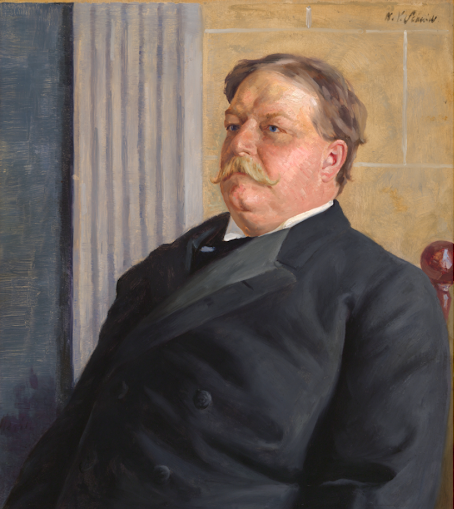
Time in office
March 4, 1909–March 4, 1913
Vital Statistics
Born: September 15, 1857, in Cincinnati, Ohio
Died: March 8, 1930, in Washington, D.C.
Political Affiliation
Republican Party
First Bite
William Taft’s doctor once told him to cut his breakfast steak down from twelve ounces to eight—a compromise Taft treated less like doctor’s orders and more like a gentle suggestion, though with his wife keeping a watchful eye on his plate, he didn’t always have much choice in the matter.
THE MAIN COURSE
William Howard Taft may HAVE beEN the most enthusiastic eater ever to occupy the White House.
He may have been the most famously enthusiastic presidential eater in American history.
Taft’s breakfast routine at the White House tells the story: every morning, two oranges, a twelve-ounce steak, and several pieces of toast slathered in butter, all washed down with cup after cup of well-sugared, cream-heavy coffee. Eggs were the one item strictly banned from the table—he couldn’t stomach them—though potatoes, especially hashed browns, were always welcome when his diet permitted.
That home routine was almost modest compared to what Taft treated himself to when he left Washington. At a single stop in Savannah, he reportedly consumed a breakfast of grapefruit, potted partridge, broiled venison, grilled partridge, maple-soaked waffles, hominy, hot rolls, and bacon. Lunch was bouillon, smelts in tartar sauce, lamb chops, and a dessert course of raspberry jelly with whipped cream, salted almonds, and bonbons. When dinner rolled around, the table held lobster stew, salmon cutlets, roast tenderloin, and frozen pudding. On trains, Taft’s chef, African American John Smeades, baked what were reputably the best apple pies. Turtle soup—traditionally made from diamondback terrapin—was a particular favorite Taft requested both at home and at formal functions. Salted almonds functioned less like an occasional treat and more like a constant snacking companion, while vegetables, notably, did not.
Taft’s love of eating extended to some unusual delicacies. He was famously fond of roast possum and was happy to substitute it for beef whenever the mood struck. According to cookbook author Poppy Cannon, Taft once received a twenty-six-pound possum as a Thanksgiving centerpiece and another shipped live to the White House by Texas hunters as a gift. The association ran so deep that marketers tried to brand a “Billy Possum” stuffed toy to rival Teddy Roosevelt’s wildly successful teddy bear, but the effort never caught on.
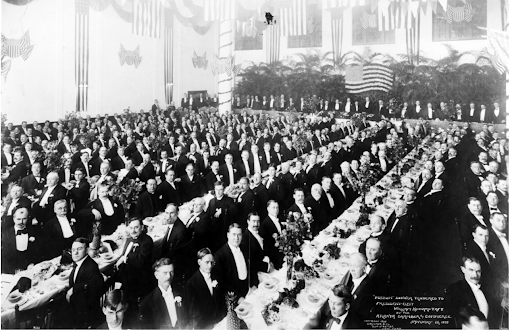
Taft’s weight was more than a matter of appetite: It was a genuine, documented medical struggle that trailed him for most of his adult life. He weighed 243 pounds at college graduation, ballooned to 320 by his late forties as Secretary of War, and lost 70 pounds under the guidance of English physician Nathaniel Yorke-Davies, only to gain it all back within a couple of years. By the time he left the White House, he weighed around 335 pounds. His correspondence with Yorke-Davies survives in the Library of Congress and has since been studied as one of the earliest documented cases of medical weight management in American history.
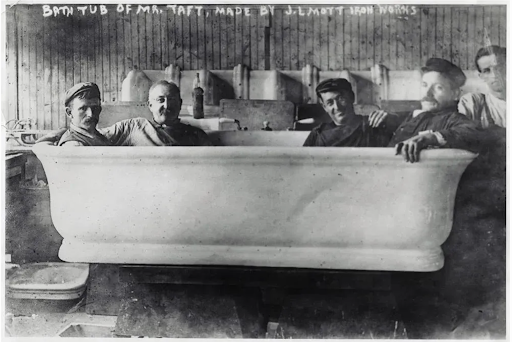
More strikingly, a 2003 study published in the journal Chest argued that Taft likely suffered from severe obstructive sleep apnea, based on his documented tendency to fall asleep during the day, chronic snoring, and high blood pressure. The famous story that Taft became stuck in the White House bathtub is almost certainly false. He did, however, have an unusually large custom tub installed. A contemporary photograph shows four men sitting inside it. What is true, and rather remarkable, is what happened after he left office. Within about a year, Taft dropped more than 60 pounds and kept it off for the rest of his life, and by most accounts, his daytime drowsiness disappeared right along with the weight.
As for beverages, Taft was a lifelong teetotaler according to contemporary accounts, though he happily kept a well-stocked European wine cellar for guests and served champagne freely at dinner. He did, however, have a serious coffee habit.
Entertaining at the Taft White House ran on a kind of joyful chaos. Plans changed constantly, guest counts shifted by the hour, and the kitchen staff reportedly did not start cooking lunch until thirty minutes before it was meant to be served, simply because nobody could predict how many people would show up. His wife, Helen Herron (“Nellie”) Taft, meanwhile, ran the household budget with real discipline. She employed three cooks and reportedly kept the monthly food bill below $1,000 through careful wholesale purchasing.
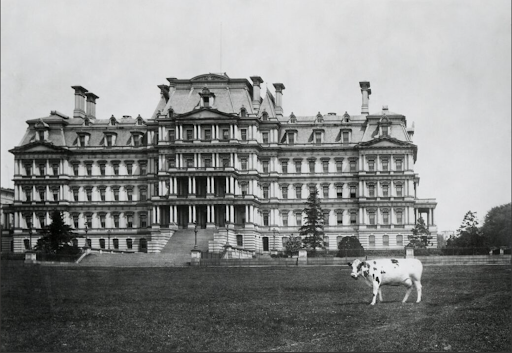
Though he was always a city man, Taft kept two cows on the White House grounds to supply the family with fresh milk and butter: First, Wooly Mooly, who died in 1910 after apparently overindulging in oats, and then her replacement, Pauline Wayne, who became the last cow ever to graze on the White House lawn. After Taft left office, Pauline lived out her days on a farm in Wisconsin.
Taft’s one genuine attempt at food policy did not go so well. In 1911, Taft pushed through a reciprocity agreement with Canada meant to lower food and raw material costs for American consumers. It was good news for grocery bills, but a blow for American farmers then faced with cheaper Canadian imports. The deal passed on the American side, only to collapse when the backlash helped topple the sitting Canadian government, leaving Taft with nothing to show for the fight. Where predecessor Teddy Roosevelt had been vocal and hands-on about rural life and food policy, Taft mostly let those things run on their own momentum.
Taft’s own retirement wasn’t nearly as quiet as Pauline’s. After losing his 1912 reelection bid to Woodrow Wilson, he taught law at Yale for nearly a decade before President Harding in 1921 finally handed him the job he had wanted all along: Chief Justice of the United States Supreme Court, a post he held until shortly before his death in 1930. It made him the only person in American history who led both the executive and judicial branches—and he did it considerably lighter than the man who had left the White House a decade earlier.
Try it at home
Turtle Soup
A Taft luncheon staple—rich, old-fashioned, and about as far from a diet dish as a soup can get. Unlike the veal-only “mock turtle” soup popular at the time, this version uses real turtle meat, simmered alongside a veal-based broth for depth. When served at state dinners, Mrs. Taft hired a special chef to prepare it, and President Taft insisted it be served with champagne.