

Time in office
September 14, 1901–March 4, 1909 (ascended after President William McKinley’s assassination; then elected in his own right in 1904)
Vital Statistics
Born: October 27, 1858, in New York City
Died: January 6, 1919, in Oyster Bay, New York
Political Affiliation
Republican Party
First Bite
Theodore Roosevelt was a heavy coffee drinker. His son recalled that his father’s cup was “more in the nature of a bathtub” than a mug, and Roosevelt reportedly sweetened it with as many as seven sugar cubes.
THE MAIN COURSE
Theodore Roosevelt approached food the same way he approached everything else: With enormous appetite, total conviction, and very little patience for fussiness.
He famously insisted his eggs be hard-boiled and nothing else, demanded homemade rolls served in real quantity. In one often-repeated account, he once startled an observer by polishing off an entire chicken and four large glasses of milk in a single sitting. When Roosevelt lunched alone, dinner-party sophistication went out the window: He’d happily settle for a big bowl of milk, sometimes with crackers crumbled in, treating it as a perfectly respectable meal for the nation’s leader.
That lusty appetite ran in the family. Roosevelt’s taste for hominy, served buttered and salted at breakfast or as a starch alongside lunch and dinner, may have its roots in his mother’s Georgia upbringing. And he had a genuine soft spot for sweets, particularly the Sagamore Hill Sand Tarts named for his Oyster Bay, New York, estate. Peaches were his favorite fruit, and his idea of a perfect meal was refreshingly simple: a medium sirloin steak with blood-red gravy and a large, mealy potato. He drew the line at bananas and avocados, which he avoided entirely, and he wasn’t much of a drinker; On the rare occasion he indulged, it was an oddly sugary version of a mint julep. His feelings on fried chicken, meanwhile, were practically doctrine: “The only way to serve fried chicken is with white gravy soaked into the meat.”
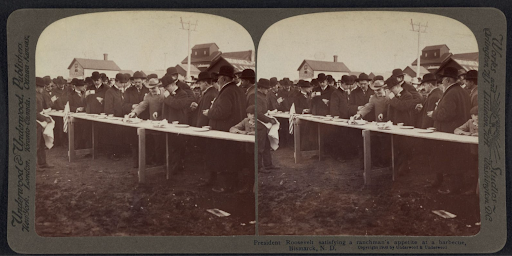
Roosevelt treated the dinner table less as a place for fine dining and more as a stage for conversation. Yet, despite his famously plain daily tastes, Roosevelt could still turn it on when the occasion called for it. His 42nd birthday dinner in 1900 (when he was still William McKinley’s vice-president) was a lavish multi-course affair running from Bluepoint oysters and green turtle soup through a fillet of beef and quail with bread sauce, paired with wines at every course—a striking contrast to his usual bowl of milk and crackers. His daughter Alice’s wedding pushed that contrast even further, drawing the biggest White House crowd since Nellie Grant’s wedding decades earlier. It featured a 130-pound cake so large that an impatient Alice ditched the ceremonial knife and cut into it with a military sword instead.
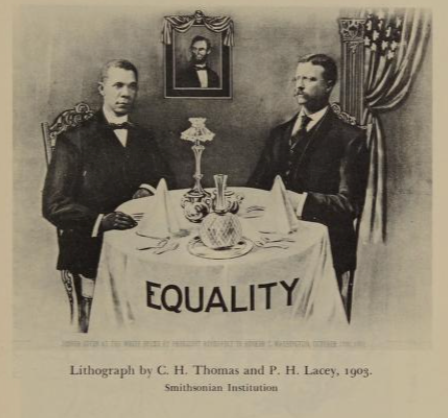
Roosevelt’s dinner invitations weren’t always so casual in their consequences. In the fall of 1901, just weeks into an administration still finding its footing after McKinley’s assassination, Roosevelt was hosting dinners at the White House almost nightly, using the guest list itself as a political tool (today that’s called culinary diplomacy). On October 16, he invited educator Booker T. Washington to join him at the table alongside a fellow guest. By all accounts, it was an unremarkable, cordial evening. The reaction the next morning was anything but. Once newspapers published the White House’s routine guest list, the story exploded into the biggest news since McKinley’s death, with editorials across the South and beyond harshly condemning Roosevelt for the event. It was the first time an African American had ever been formally entertained at the White House table. The dinner was a striking challenge to the racial conventions of the era, even though Roosevelt’s record on race was complicated and fell well short of modern standards of racial equality.
When a 1906 newspaper story accused his White House of extravagant, multi-course dining, Roosevelt fired back personally in the same paper, insisting his real routine was hard-boiled eggs and coffee for breakfast, bread and milk for lunch, and a dinner that rarely ran past three courses. It’s a claim that holds up reasonably well against everything else known about his habits; Roosevelt liked what he called “coarse food and plenty of it,” not fancy dining for its own sake.
That appetite for plain living extended outdoors, where Roosevelt was happiest of all. He was an avid forager, happily gathering fiddlehead ferns, dandelion greens, and wild asparagus on his own land, and he devoted roughly forty-seven acres of his Sagamore Hill estate to a working farm. It was entirely fitting, then, that Roosevelt learned he was about to become president while deep in the wilderness himself. He was climbing Mount Marcy in the Adirondacks when word reached him that McKinley, shot by an assassin days earlier, had died. He rushed down the mountain by wagon in the middle of the night to be sworn in.
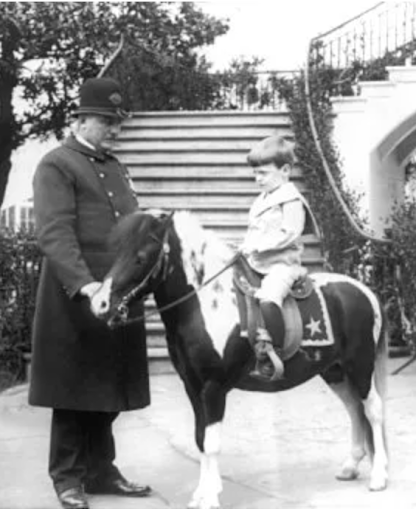
Family life, too, at the White House was nature-oriented. Roosevelt and his wife Edith raised six children there, and the household came with something closer to a private menagerie than a collection of pets—a bear, badger, hyena, one-legged rooster, pony, snakes, guinea pigs, and more, all cycling in and out of the White House.
That hands-on relationship with food and land helps explain why, of everything Roosevelt accomplished in office, his food-safety legacy remains among the most consequential. In 1906, Upton Sinclair’s novel The Jungle exposed horrifying conditions in Chicago’s meatpacking plants. Roosevelt initially dismissed Sinclair as a socialist “crackpot,” but he took the underlying claims seriously enough to send two independent investigators to see the plants for themselves, distrusting the U.S. Department of Agriculture’s own cozy relationship with the industry. Their findings confirmed Sinclair’s account almost entirely, and Roosevelt, calling the conditions “revolting,” used the threat of releasing the full report publicly to prod a reluctant Congress to act.
On June 30, 1906, Roosevelt signed both the Meat Inspection Act, authorizing federal inspection of meat “from the hoof to the can,” and the Pure Food and Drug Act, banning the interstate sale of mislabeled or adulterated food and drugs and laying the foundation for what would eventually become the U.S. Food and Drug Administration. Roosevelt considered it one of the signature achievements of his presidency, and contemporaries agreed it marked one of the first times ordinary Americans felt the direct reach of federal regulation in their daily lives.
His conservation instincts ran in the same vein. He created the U.S. Forest Service in 1905 and, during his presidency, helped protect an estimated 230 million acres of land as national forests, eighteen national monuments, and five national parks. He also created the first federal bird and game reserves, laying the foundation for today’s web of national wildlife refuges. He treated the nation’s land and food supply as something worth actively protecting rather than leaving to commercial interests.
Roosevelt had remarkably little patience for anyone who tried to cut corners with everyone else’s dinner, either. In just under eight years, he had brought the federal government into the business of inspecting what Americans ate and protecting the land it came from––two responsibilities the country has not relinquished since.
Try it at home
Fat Rascals
Hot, buttery biscuits straight from Edith Roosevelt’s own cookbook. These were a family staple kept on hand for holidays and drop-in guests alike, and a regular fixture at breakfast alongside Roosevelt’s hard-boiled eggs.