
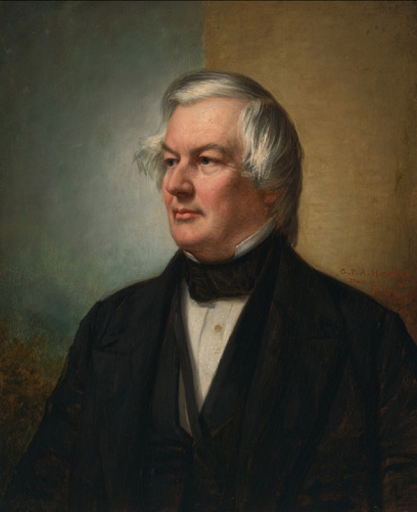
Time in office
July 10, 1850–March 4, 1853
Vital Statistics
Born: January 7, 1800, in Locke Township, NY
Died: March 8, 1874, in Buffalo, NY
Political Affiliation
Whig Party
First Bite
According to his New York Times obituary, Millard Fillmore’s last words, commenting on the soup he had just eaten, were, “The nourishment is palatable.”
THE MAIN COURSE
Millard Fillmore did not win his way into the White House. He inherited it, mid-tragedy, with zero warning.
On the morning of July 9, 1850, the vice president was going about his business in Washington when word came that Zachary Taylor—likely felled by a foodborne illness, of all things—hadn’t made it through the night. By that afternoon, Fillmore had taken the oath of office. He’d go on to serve just two years and eight months before the Whig Party’s civil war over slavery and the Compromise of 1850 (which barred slavery in the new state of California but tolerated or even strengthened its grip elsewhere) closed the door on a second term.
Fillmore had grown up dirt poor on the New York frontier, the second of eight kids. He worked on his father’s farm and apprenticed with a cloth maker before basically teaching himself law. That no-frills upbringing followed him straight to the dinner table. Fillmore’s food was hearty frontier fare: thick soups built from meat, potatoes, and vegetables, more stew than broth, the kind of meal that left nothing behind to waste. Corn pudding and resurrection pies (a frugal little dish made from layered meat and potatoes meant to use up scraps) were regulars too. He was a man of strict temperance with zero patience for frivolity, at the table or anywhere else. Under his watch, the White House traded dancing and gala parties for formal dinners and official functions.
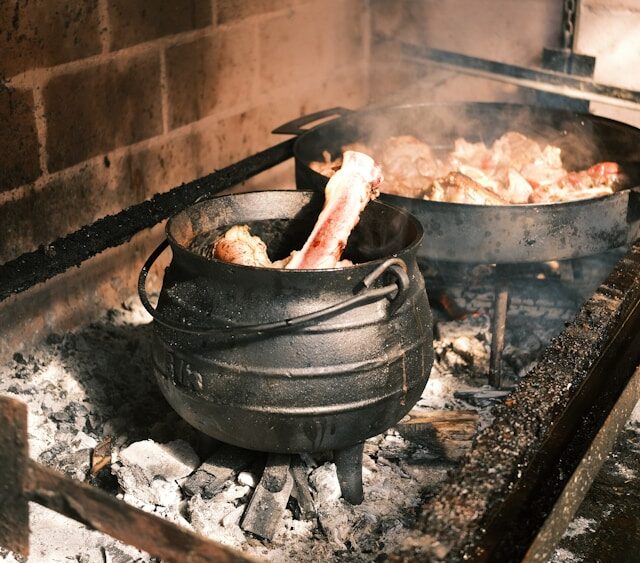
When Fillmore moved in, the White House kitchen was still cooking much as it had in 1800. Thomas Jefferson had equipped the White House kitchen with an iron range and a stew stove, but when Fillmore moved in some four decades later, the cook still preferred a huge open fireplace with cranes and hooks. At some point during Fillmore’s term, his wife, Abigail, a former schoolteacher with a reputation for practicality, arranged for a shiny new iron cookstove to be brought in, but the cook wanted nothing to do with it, and it sat in the basement like an unused treadmill.
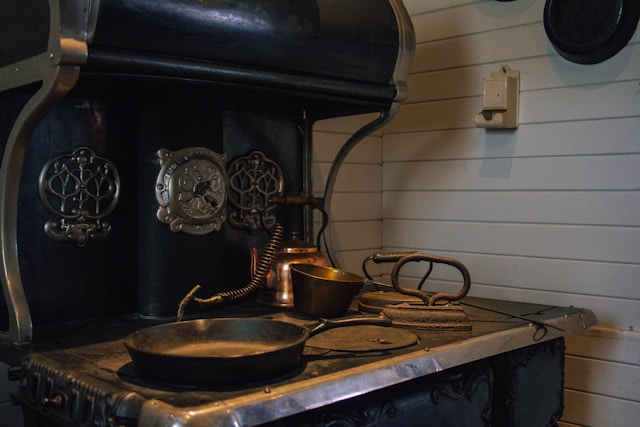
The kitchen staff wanted nothing to do with the newfangled oven. As the story goes, Fillmore’s chef called it a “contraption” and openly doubted anyone could cook on the thing. So Fillmore, never one to let a problem just sit there, is said to have marched down to the U.S. Patent Office himself, studied the stove until he understood exactly how it worked, then came home and taught his staff how to use it. It’s a charming story, and one that’s been repeated in presidential food histories for decades—though, worth noting, the trail traces back mainly to Poppy Cannon’s 1968 The Presidents’ Cookbook, and no contemporary firsthand account has surfaced to confirm that the Patent Office field trip actually happened. It circulates alongside another Fillmore legend—that he installed the first White House bathtub—which turned out to be an outright, pre-internet hoax invented by journalist H.L. Mencken in 1917, then absorbed uncritically into reference books for generations after. Whether or not Fillmore was personally involved in installing it, the underlying fact holds up: Abigail Fillmore is the one often credited with getting a modern stove into the White House kitchen.
By the time it reached the White House, the iron cookstove had already been quietly revolutionizing American kitchens for decades. It burned more efficiently, gave cooks real control over heat, and was already standard in ordinary households across the country. That it still took this long to get one into the executive mansion says something about all too many institutions: They’ll happily keep doing things the old way long after a better way exists.
Fillmore’s actual food policy, it turns out, was just as practical as his soup. As chairman of the House Ways and Means Committee, he had already helped push through protective tariff legislation back in 1842, a cause he stuck with for decades. As the frontier farm kid that he was, he genuinely believed tariffs on foreign imports were good policy and helped farmers. He brought that belief to the White House, using his first annual message to Congress, in December 1850, to call for tariffs that would encourage home production without shutting out foreign competition. The same message turned to Peruvian guano, which had become so desirable to American farmers, he declared, that it was the government’s duty to get it imported at a reasonable price. He promised that nothing would be omitted toward that end and suggested that Peru, by lifting its restraints on the trade, would be doing itself a favor.
The guano trade was serious business: Nitrogen-rich bird droppings mined from islands off Peru had become the era’s most valuable fertilizer, so central to American farming that Congress passed the Guano Islands Act in 1856, allowing U.S. citizens to claim any unoccupied island containing guano deposits as American territory. The boom, though, was sometimes built on brutality, including indentured Chinese workers subjected to horrific conditions on the mining islands—a dark moral undercurrent beneath an important agricultural policy.
Fillmore never got the grand legacy he might have hoped for. History mostly remembers him as an accidental president who inherited the job when President Taylor suddenly died and that his Whig Party collapsed not long after he left office. Those factors helped ensure that his time in the White House felt more like a footnote than an era. But in his own quiet way, the same qualities that got him there—stubbornness, self-reliance, and a frontier kid’s refusal to accept that something couldn’t be figured out—showed up again and again, whether it was a stove sitting unused in the basement or an important tariff bill. Fillmore never dazzled anyone at the dinner table, and he never dazzled anyone in office either. He just quietly got on with the business of fixing what needed fixing, one problem at a time.
He ate the way he ran meetings—quickly, deliberately, and with no patience for lingering. Pastry chef Bill Yosses recalled that Bush approached dinner with the same sense of purpose he brought to everything else. State dinners reinforced that pace: By longstanding tradition, the meal ends when the head of state’s fork goes down, regardless of how much the guests have managed to eat. Get seated next to a talker and you went home hungry. Bush wasn’t drinking through it either—he’d quit at 40, cold, and kept no bar he indulged personally.
What he did keep was a sweet tooth operating well above the national average. White House chef Matthew Wendel joked that Bush would ask what was for dessert before he’d even touched dinner. Chocolate chip cookies were a staple at the ranch and Camp David. A seven-layer, chocolate-covered chocolate cake, according to Yosses, was Bush’s favorite cake. Sticky toffee pudding became a holiday fixture for the whole family. Bush ate dessert most nights of his presidency and stayed visibly fit the entire time, which reflects either excellent genes or “proof” that a steady workout regimen can outrun almost any scrumptious cake.
Try it at home
Millard Fillmore’s Beef Stew
This one-pot stew embodies Millard Fillmore’s tastes exactly: hearty, simple, and a meal in and of itself.