
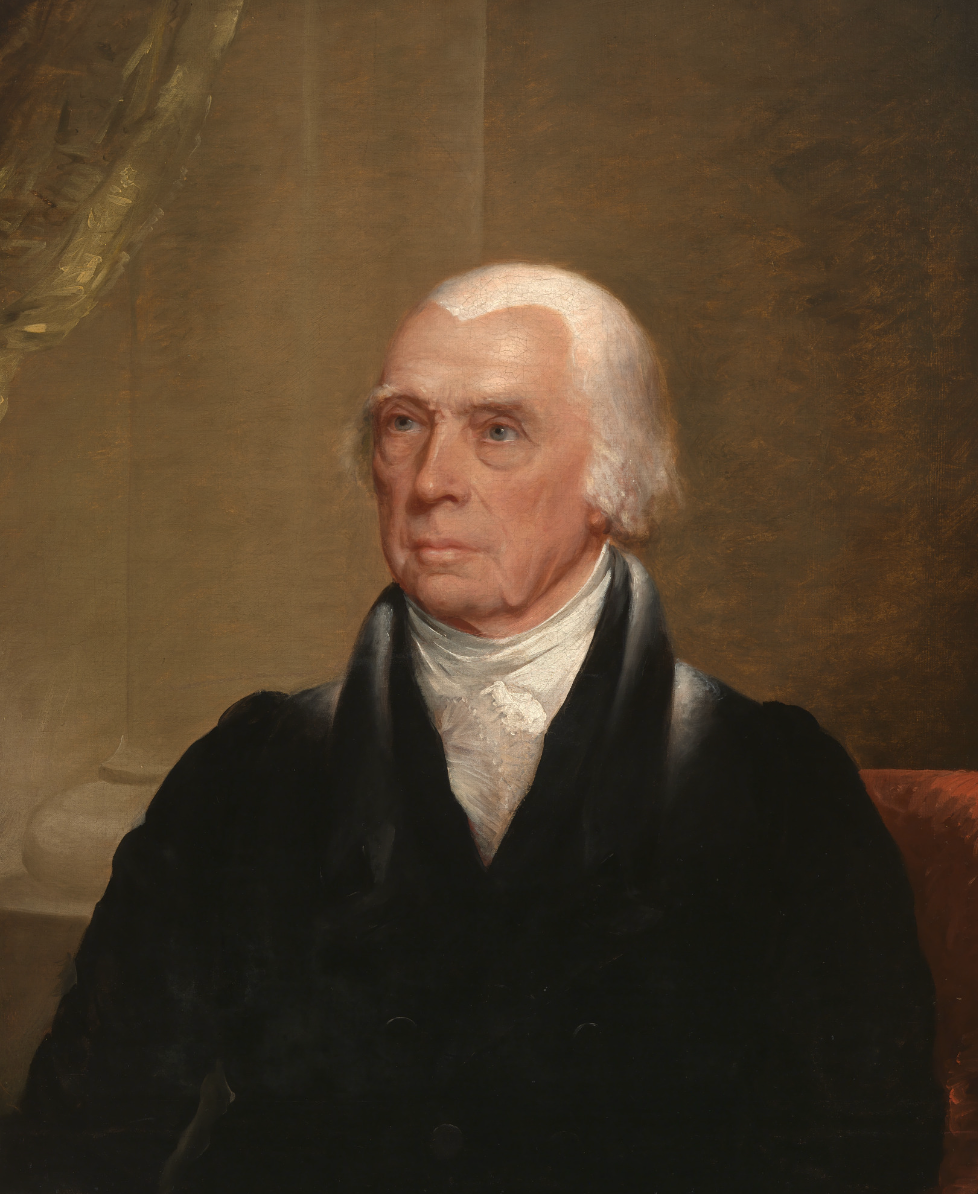
Time in office
March 4, 1809 – March 4, 1817
Vital Statistics
Born: March 16, 1751, Port Conway, Virginia
Died: June 28, 1836, Orange County, Virginia
Political Affiliation
TBC
First Bite
At 5’4” and around 100 pounds, Madison was by far the smallest American president—a man with a presumably small appetite presided over some of the most lavish and hospitable tables the White House has ever seen.
THE MAIN COURSE
Here is what we know about what James Madison ate: not much.
The man who drafted the Constitution, authored the Federalist Papers, and served as Secretary of State before becoming the fourth president of the United States left almost no record of what ended up on his own fork. A portrait of his early married table survives from Philadelphia—ham or salt fish at breakfast, a roast at two, boiled peas, fried eggs, salad, pastries, and wine through dessert—but whether any of that reflected his own tastes, or simply whatever the household put in front of him, is impossible to say. For someone who spent his post-presidential years delivering formal speeches about how farming was humanity’s highest calling and the engine of all civilization, the omission is remarkable. Biographers have looked. They keep coming back empty-handed.
What the record does preserve, in vivid and almost theatrical detail, is Madison’s wife, Dolley. Dolley Madison set the precedent for the role of the first lady in White House entertaining so thoroughly that the standard she established outlasted her husband’s presidency by generations. She supervised her own kitchen, presided at the head of the table while Madison sat to the side, planned the menus, managed the staff, and held weekly Wednesday evening drawing room receptions that became a fixture of Washington social life—politicians conducted informal business, singers or musicians came to showcase their talents, and virtually everyone in the capital found a reason to attend. Her philosophy was simple and consistently executed: “The profusion of my table,” she once wrote, “arises from the happy circumstance of abundance and prosperity in our country.” The more the merrier.


The dinners were festive and elaborate—French cuisine, the finest wines, and dessert spreads that ran to ice cream, a treat Dolley is credited with helping popularize. Food bills during the Madison presidency could reach $50 a day, a remarkable figure at a time when a whole turkey cost around seventy-five cents. Many of the surviving recipes from the era are hers: soft gingerbread, layer cake with caramel frosting, bouillon, cranberry chutney, apricot ice cream. Even the Easter Egg Roll on the White House lawn is attributed to Dolley, though historians have spent considerable energy failing to confirm she actually started it.
The most famous meal of his presidency was one he never ate. On the night of August 24, 1814, with British troops advancing on Washington, Dolley had dinner prepared as usual—set for forty guests, including cabinet members and officers expected home from the field. Paul Jennings, who was an enslaved worker in the Madison household, reported setting the table himself and placing the ale, cider, and wine in the coolers. By the time the British arrived, the Madisons were long gone. Accounts differ on exactly what the soldiers found, but the most satisfying version—and the one most often repeated—is that they sat down to the meal before setting the place on fire. Madison, the man who had argued that cultivating the earth and feeding people was humanity’s highest calling, had his dinner eaten by the enemy and his house burned to the ground. As for Madison himself: he was across the Potomac River, and history does not record what he had for dinner.
Try it at home
Dolley Madison’s Soft Gingerbread
Though James Madison left no recipes, Dolley left plenty. This soft gingerbread, preserved in White House files and beloved enough that subsequent First Ladies kept making it, is about as close as you’ll get to eating at the Madison table. Warmly spiced, poured rather than scooped, and best served fresh from the oven with a dusting of powdered sugar.