
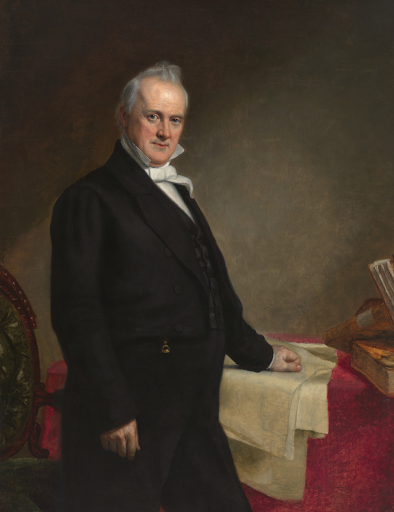
Time in office
March 4, 1857–March 4, 1861
Vital Statistics
Born: April 23, 1791, in Cove Gap, PA
Died: June 1, 1868, in Wheatland, PA
Political Affiliation
Democratic Party
First Bite
James Buchanan was the only president to remain a lifelong bachelor, which meant official hostess duties fell to his niece—a more successful arrangement, historically speaking, than most of his actual decisions.
THE MAIN COURSE
James Buchanan arrived at the White House in March of 1857 with a personal fortune amassed from his years as a successful lawyer.
His entourage included a French chef and a niece who knew how to throw a party—which, after four consecutive presidents who’d banned dancing, restricted drinking, and reduced White House entertaining to something resembling a church supper, landed like a starting gun.
The inaugural feast set the tone for everything that followed. Six thousand guests attended—one of the biggest such Inauguration celebrations in the nineteenth century. The menu ran to four hundred gallons of oysters, five hundred quarts of chicken salad, seventy-five hams, sixty saddles of mutton, four saddles of venison, eight rounds of beef, one hundred twenty-five beef tongues, twelve hundred gallons of ice cream, five hundred quarts of jellies, and a cake four feet tall, with three thousand dollars (equivalent to over one hundred thousand dollars today) spent on wine alone. Despite all that preparation, the food ran out before everyone even got a plate—a logistical failure that might even have portended how Buchanan would mismanage the politics leading to the possible secession of southern states from the Union.
With no first lady to fill the role, hostess duties fell to his niece, Harriet Lane—socially gifted and entirely at ease with the job a confirmed bachelor uncle couldn’t do himself. Washington adored her instantly. She set the social register for the Buchanan White House: formal, elegant, and genuinely fun in a way the capital hadn’t experienced in years. Whatever an occasion called for, Buchanan provided, frequently subsidizing events out of his own pocket when the official allowance came up short. Apparently the one thing money couldn’t buy him was a wife, but it could buy quite a lot of oysters.
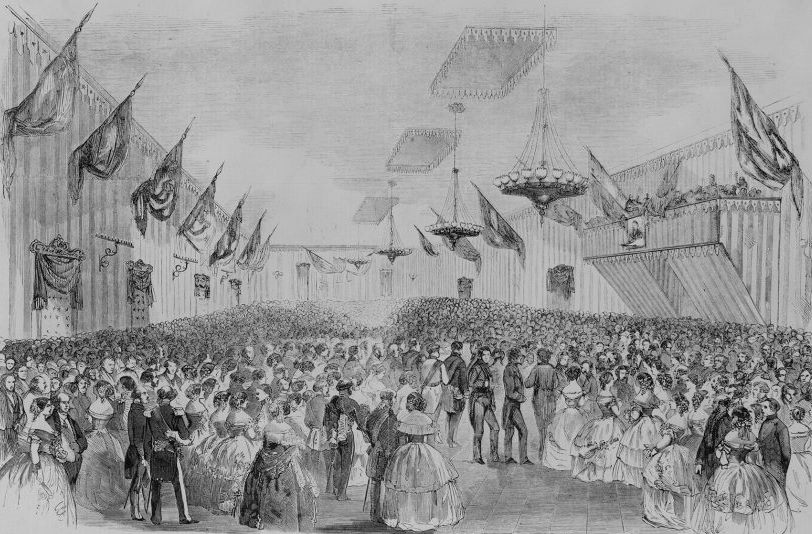
The man actually running the kitchen was Charles Gautier, Buchanan’s French chef, brought in to handle the logistics of entertaining on this scale. Buchanan’s years abroad as Pierce’s Minister to Great Britain gave him a genuine appreciation for French cuisine––a taste Gautier was well-equipped to deliver. Terrapin—turtle simmered in butter, cream, and sherry—became something of a house specialty, served at every dinner that mattered.
But left to his own devices, Buchanan’s tastes stayed resolutely unglamorous. Raised Pennsylvania Dutch, he never lost his fondness for sauerkraut and cabbage, writing about both often enough that the version made by his housekeeper, Miss Hetty, earned its own mentions in his letters. Succotash and Delaware shad rounded out the homier end of his diet. The French banquets and the fermented cabbage coexisted without apparent friction, the same way Buchanan himself drifted easily between London drawing rooms and Lancaster County farmland—a man fluent in two entirely different vocabularies of comfort.
He drank to match the scale of everything else: a noted fondness for Madeira and whiskey, with the White House reportedly going through ten gallons of whiskey a week on his watch. Between the rich food and the steady drinking, he developed gout, the occupational hazard of well-fed, well-lubricated men of his era.
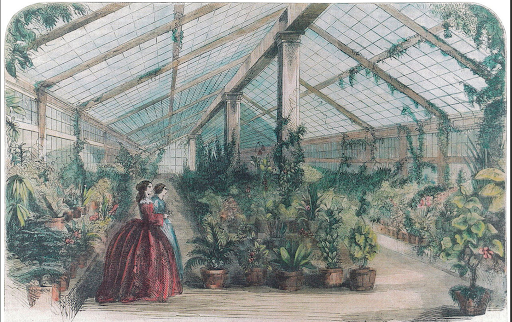
At his Wheatland, Pennsylvania, estate, Buchanan kept a proper gentleman’s farm—kitchen garden, strawberry patch, fruit orchard, and a grapery producing clusters of Malaga grapes that reportedly weighed up to six pounds apiece. He imported that enthusiasm to the White House, completing a glass conservatory on the West Terrace in 1857 that housed the grapery alongside a fern room, an orchid room, a geranium house, and a rose house. Harriet had pushed for it, and for a bachelor with expensive taste and no one to come home to, it certainly enriched his domestic life.
In terms of farm policy, Buchanan remained a staunch supporter of protective tariffs, and he presided over America’s booming importation of guano. America’s thriving fertilizer industry was built entirely on imported seabird droppings, commerce that his predecessors Millard Fillmore had championed and Franklin Pierce had helped institutionalize. If Buchanan’s greatest contribution to American food production was helping farmers buy more bird poop, history has, on balance, recorded worse legacies.
But in 1859 Buchanan vetoed the Land‑Grant College Act. That Act would have created agricultural and mechanical (A&M) colleges nationwide. He believed that the measure was unconstitutional and harmful to federal–state relations. His veto delayed the creation of America’s extraordinarily productive agricultural college system. Fortunately, Lincoln signed the revised Morrill Act in 1862, launching land‑grant universities and modern agricultural science.
Buchanan took office having promised to serve only one term. He kept that promise, though by 1861 it’s unclear whether he had much say in the matter. His actions and inactions tracked the country’s final descent into civil war step for step. He cited constitutional limits as he deferred to the states and largely declined to act as seven states seceded shortly after he lost the 1860 election to Abraham Lincoln. He earned a reputation as the man who watched the house catch fire and called it a states’ rights issue. Public contempt, at least in the North, ran deep enough in the years afterward that his portrait was pulled from the Capitol over fears it would be vandalized.
Buchanan retired to Wheatland, tended his garden, and spent his remaining years quietly absorbing the verdict of history, which was not kind and not wrong. Historians have generally blasted Buchanan’s presidency for paving the way to the Great Rebellion because of his response to secession and the escalating sectional crisis. (Not a surprise that in 2016, Robert Strauss published The Worst President––The Story of James Buchanan.)
Try it at home
Sauerkraut
This Pennsylvania Dutch staple transforms humble cabbage and salt through the slow magic of fermentation into tangy, flavorful sauerkraut. Simple but enduring, this recipe closely resembles the sauerkraut that was on James Buchanan’s table.