
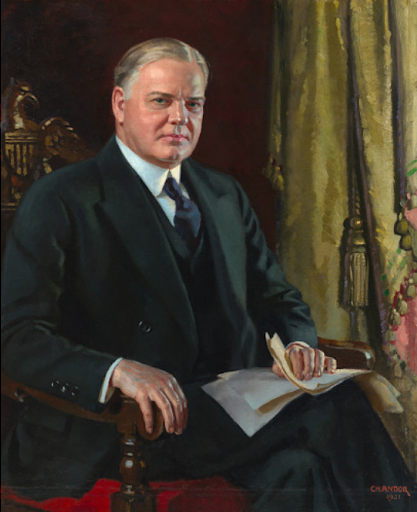
Time in office
March 4, 1929–March 4, 1933
Vital Statistics
Born: August 10, 1874, in West Branch, Iowa
Died: October 20, 1964, in New York, New York
Political Affiliation
Republican Party
First Bite
A Depression-era soup kitchen dish of macaroni, sliced hot dogs, and canned tomatoes and corn was nicknamed “Hoover Stew”—not because Herbert Hoover ate it, but because his name had become shorthand for the hardship that people were experiencing.
THE MAIN COURSE
Herbert Hoover arrived at the White House with a reputation as one of the great humanitarian administrators of his era.
After the Great War (World War I) Hoover organized a massive food relief effort that shipped American grain and supplies to feed war-ravaged Belgium, then led the U.S. Food Administration, which conserved food at home to support the troops and Allies overseas during World War I.
Given Hoover’s earlier career in food relief, there is a striking irony in the fact that his presidency became associated with breadlines, unemployment, and hunger during the Great Depression. Before the economic crash in 1929, though, the Hoover White House featured genuine elegance. The Hoovers entertained relentlessly—breakfasts, luncheons, dinners, and afternoon teas, sometimes two at once in separate rooms—but they dined together, just the two of them, only three times in four years, each on their wedding anniversary. Only the finest ingredients made it to the table, often imported and out of season, with first lady Lou Hoover caring less about cost than about quality. She simply insisted that everything be the best available, well-cooked and well-served. Dinners, even informal ones, often ran a full seven courses. Hoover himself was famously efficient about eating them: He ate quickly, grew visibly impatient if a dinner dragged on, and was said to have gobbled down a complete multi-course meal in as quick as eight minutes.
Breadline at McCauley Water Street Mission under the Brooklyn Bridge, New York (Library of Congress)
Hoover’s personal tastes stayed surprisingly down-to-earth. Hoover adored lobster prepared with mushrooms, peppers, and sherry cream, and had a soft spot for egg timbales, a paprika-flecked custard dish he’d often request a second helping of at luncheons. His longtime cook, Mary Rattley, called him “the easiest man in the world to please,” citing his love of corn soup, cream potato soup, and above all Virginia ham, made from her own closely guarded recipe of brown sugar, vinegar, and currant jelly. But no dish ever quite matched what Hoover remembered from his Iowa childhood. Despite a lifetime spent dining at some of the finest tables across the globe, he insisted the finest food he’d ever eaten came from his Aunt Millie’s kitchen—a sentiment that showed up on his own table too, in his favorite dish of all: mashed sweet potatoes with butter, nutmeg, and walnuts, topped with browned marshmallows.
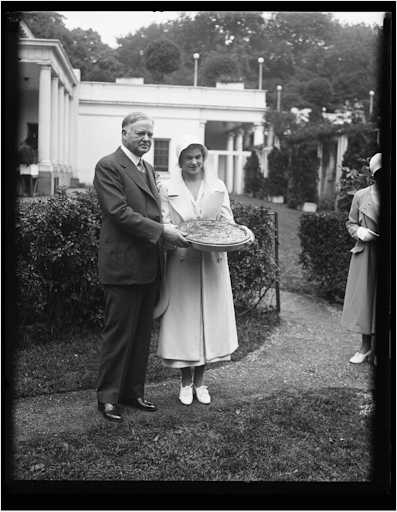
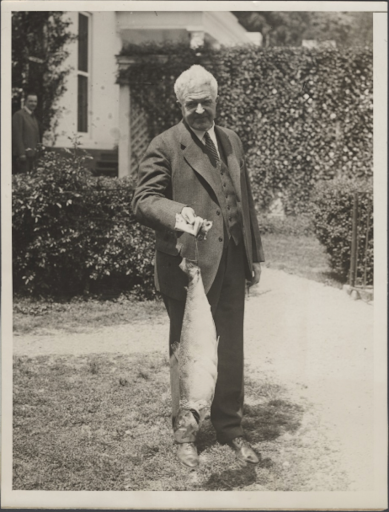
Amid all that abundance, small missteps still occurred. Guest lists sometimes swelled into the thousands, occasionally straining the kitchen past its capacity. At one particularly crowded event, staff had to raid picnic hampers packed for an upcoming weekend trip just to keep the food coming. And ceremony didn’t always survive contact with an overeager kitchen. When Maine’s traditional first-salmon-of-the-season gift arrived at the White House in 1930, the “White House chef, evidently thinking that the place for so fine a fish was in the oven, immediately decapitated it and prepared it for its journey which would end on the presidential table,” detailed the Washington Post. A frantic congressman and the head of the Secret Service raced to sew the head back on in time, leaving the fish’s tail as the only visible casualty—and, as far as anyone recorded, Hoover never noticed the difference.
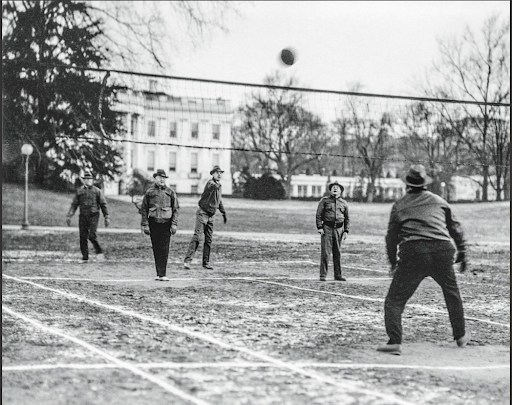
Hoover balanced all that rich living with an equally serious commitment to exercise, most famously through “Hoover-ball.” That game was similar to volley ball, but played with an eight-pound medicine ball. Invented by his White House physician, the game became a morning tradition that Hoover often played with his so-called “Medicine Ball Cabinet” before a breakfast of fruit, toast, and coffee under a White House magnolia tree.
Hoover organized a massive food relief effort that shipped American grain and supplies to feed war-ravaged Belgium, then led the U.S. Food Administration, which conserved food at home to support the troops and Allies overseas during World War I. Given that legacy, it’s more than a little ironic that his own presidency would end up defined by the one crisis he couldn’t feed his way out of.
Before the economic crash in 1929, though, the Hoover White House ran on genuine elegance. The Hoovers entertained relentlessly—breakfasts, luncheons, dinners, and afternoon teas, sometimes two at once in separate rooms—but they dined together, just the two of them, only three times in four years, each on their wedding anniversary. Only the finest ingredients made it to the table, often imported and out of season, with first lady Lou Hoover caring less about cost than about quality. She simply insisted that everything be the best available, well-cooked and well-served. Dinners, even informal ones, often ran a full seven courses. Hoover himself was famously efficient about eating them: He ate quickly, grew visibly impatient if a dinner dragged on, and was known to finish a complete multi-course meal in as little as eight minutes flat.
Remarkably, the fancy entertaining barely slowed down once the Depression hit. Just seven months into Hoover’s term, breadlines spread across the country—yet the White House kept its revolving door of wealthy, famous, and well-connected guests spinning. The Hoovers simply began paying for unofficial entertaining out of their own pocket rather than cut back. By Hoover’s own later estimate, he covered roughly 140,000 meals a year at a personal cost of about $125,000, worth several million dollars today. Their guest lists read like a who’s-who of the era regardless of the economic gloom outside—aviators Amelia Earhart and Charles Lindbergh, physicist Marie Curie, film mogul Louis B. Mayer, and businessman Henry Ford all passed through as guests, some staying overnight. Not every gathering went smoothly: when Mrs. Hoover, to her credit, invited Jessie De Priest, wife of the first Black congressman elected since 1901, to one of her teas, the resulting controversy made front-page news across the country for weeks.
Hoover’s agricultural policy, unfortunately, couldn’t rescue him and the country the way it once had for others. He inherited a farm sector already reeling from wartime overproduction and years of falling prices. His signature response, the Agricultural Marketing Act of 1929, created a Federal Farm Board meant to stabilize farm prices through cooperative marketing rather than direct government loans—a plan that mostly stalled because too few farmers were willing to cut production voluntarily.
Things got worse from there: the Smoot-Hawley Tariff Act of 1930, originally framed as farm relief, ballooned into a sweeping tariff hike after heavy lobbying from other industries. More than a thousand economists begged Hoover to veto it. But he signed it anyway, and the results were exactly as bad as predicted—other nations retaliated with tariffs of their own, American exports collapsed, and farm exports alone fell by a third within just a few years. The man who had once fed a starving Europe left office watching Americans line up at soup kitchens for a “Hoover Stew”—not as tribute, but as accusation. Fairly or not, Hoover became the face of the Depression itself, and voters made their verdict clear in 1932, turning him out of office in a landslide win for Franklin Delano Roosevelt.
Try it at home
Marshmallow-Topped Sweet Potatoes
Hoover’s favorite dish from home—mashed sweet potatoes with butter, nutmeg, cream, and walnuts, finished under a browned layer of marshmallows. Sweet, simple, and a rare taste of comfort from a presidency that ultimately provided very little.