
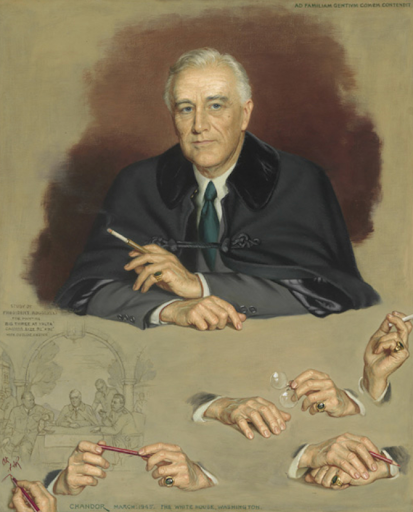
Time in office
March 4, 1933–April 12, 1945
Vital Statistics
Born: January 30, 1882, in Hyde Park, New York
Died: April 12, 1945, in Warm Springs, Georgia
Political Affiliation
Democratic Party
First Bite
Poor Franklin Roosevelt. He was born into more money than most of his constituents could even imagine—plus he lived on an estate in Hyde Park, New York, held a Harvard degree, and had a mother who never let him forget either. But when he was in the White House he sought to eat like ordinary, struggling Americans. He spent twelve years dining all too often on organ meats, prune pudding, and other foods he really didn’t like.
THE MAIN COURSE
Franklin D. Roosevelt grew up on old New York money, and was tutored at home on a sprawling estate with farm. tHE STAFF NUMBERED IN THE HUNDREDS. just the kind of upbringing that tends to produce a fairly refined palate.
And it did: FDR loved Lake Superior whitefish planked and boned just so, indulged happily in caviar and pâté de foie gras when the Russians sent it, kept a rotating cheese course of Camembert and Roquefort for dessert, and brewed his own dark French-roast coffee to precise specifications every morning. Left to his own devices, Roosevelt may have run one of the more sophisticated tables in White House history.
He was not, however, left to his own devices. His wife, Eleanor Roosevelt, had other priorities entirely.
When Eleanor and her newly hired housekeeper, Victoria “Henrietta” Nesbitt, took over the White House kitchen in 1933, the country was in the depths of the Great Depression. Eleanor decided that the White House table ought to reflect the grim era. Nesbitt herself, hired after Eleanor tasted her homemade whole wheat bread at a church function in Hyde Park, was never just kitchen help. She had remarkable authority over the White House kitchen and often had the final say over what appeared on the table, even when FDR complained.
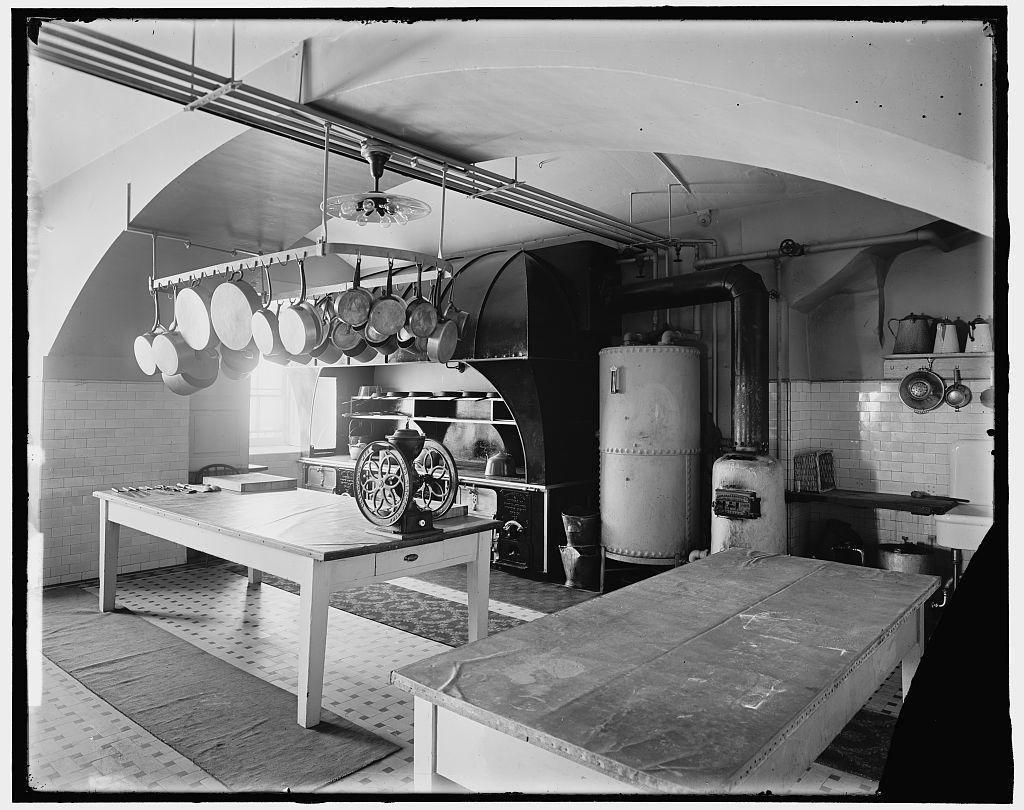
The kitchen Nesbitt inherited was a horror show. On her first inspection, Nesbitt found cockroaches, a wood-lined refrigerator she described as “bad-smelling,” worn wooden drainboards, and a rusted-out dumbwaiter. “I can’t work up any charm for cockroaches,” she wrote later. “No matter how you scrub it, old wood isn’t clean.” Nesbitt didn’t hesitate. Her verdict to Eleanor was blunt: tear it out and start over. The result, formally dubbed Public Works Project No. 634, was a full renovation in 1935. The dangerous old wiring was replaced, along with swapping the ancient gas range for electric ranges and ovens, and rethinking the layout so staff could move conveniently through prep, cooking, and plating. The cockroach-ridden rathskeller Nesbitt had inherited became one of the more modern and efficient kitchens in the country—but the food served under Nesbitt acquired a reputation for being unusually dull and drab.
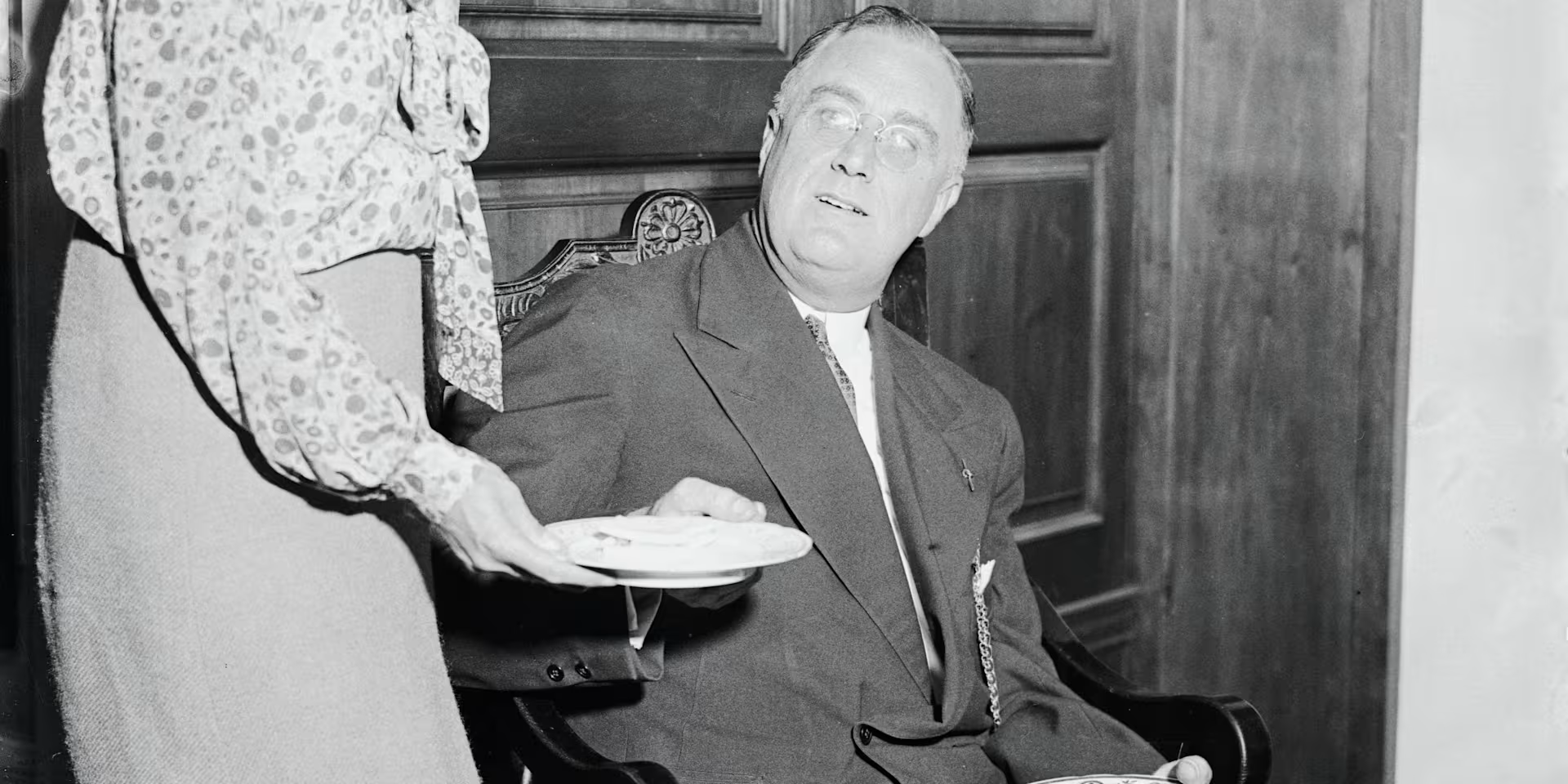
Eleanor and Nesbitt began serving meals that were nutritious, economical, and almost defiantly bland: cold jellied bouillon, prunes, mutton, gelatin salads, cheap cuts of meat like offal and sweetbreads––deliberately modeling the kind of thrifty home economics she hoped struggling American families might adopt themselves. As messaging, it worked. As actual food, it was rough enough that dinner guests reportedly started eating beforehand just to be safe, and the White House press corps couldn’t resist gossiping about the president’s public grumbling over yet another plate of broiled kidneys on toast. Even so, Nesbitt remained, by most accounts, a well-meaning overseer of the kitchen but an untrained cook herself. She once botched a batch of terrapin soup so badly that FDR banned her from ever attempting it again.
FDR was not above eating the simple meals that marked the era, enduring them with a mix of good humor and quiet rebellion. Just weeks into his presidency, he was served at his desk such a lunch, costing just seven and a half cents to produce ($2.00 in 2026 dollars): deviled eggs in tomato sauce, mashed potatoes, and prune pudding. That sort of meal was designed to publicly signal solidarity with a struggling country. Roosevelt reportedly cleaned his plate and called it “good,” and newspapers ran the recipes soon after.
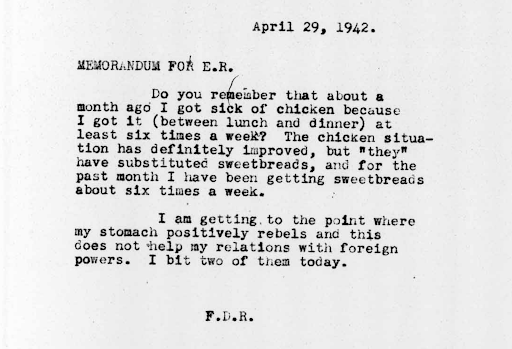
But that stoicism had its limits. Fed up with endless bowls of oatmeal, FDR apparently tried another tactic: He clipped cereal advertisements and left them where Nesbitt would see them. The menu did not change.
Nesbitt maintained, against what appears to be a fair amount of evidence, that the president was perfectly content with her cooking: “Yes, the commander in chief ate leftovers,” she insisted. “Relished them too.” And when World War II brought rationing, the family ate the same meat-scrap-stuffed eggs as everyone else.
Rather than face the fare in the dining room each morning, FDR often took breakfast alone on a tray in his own room, complete with his own coffee maker so he could brew his coffee exactly to his liking, free from whatever the kitchen had planned. He turned the broader standoff into political theater when it suited him. In a 1938 speech, he joked that critics claimed he “breakfasted every morning on a dish of ‘grilled millionaire,’” sarcastic hyperbole aimed at conservative opponents who painted him as a radical bent on destroying the wealthy. He preferred to counter that image with a homelier one of his own, insisting he’d rather have Eleanor’s scrambled eggs for breakfast than anything fancier––a line that landed as pure Depression-era populism.
The one meal everyone in the family could agree on was Sunday supper, a beloved weekly ritual that briefly closed the gap between Eleanor’s frugality and Franklin’s finer instincts. Unlike Nesbitt’s dreary official menus—Ernest Hemingway once described the meal he was served as “rainwater soup followed by rubber squab”—Sunday nights leaned into genuine comfort. Eleanor would scramble eggs tableside in a silver chafing dish while FDR played bartender, mixing martinis for guests himself, a tradition that stretched back to the earliest years of their marriage. The rest of the family’s private, everyday favorites followed that same warmer spirit: Welsh rarebit, creamed chipped beef, fried cornmeal mush drizzled with maple syrup, doughnuts, and FDR’s favorite, apple pie. It was, in its own small way, the closest thing the Roosevelt White House had to a truce—food that the family actually wanted to eat, rather than drab food serving a political poin
Entertaining, meanwhile, operated on a scale that made the kitchen’s frugality almost comic by comparison. Dinners for thirty routinely swelled to forty-five without warning, a tea planned for 3,000 guests once drew an extra 1,200, and FDR’s 1945 inaugural luncheon for 2,000 people required 200 chickens’ worth of chicken salad, 170 dozen rolls, and nearly 100 gallons of coffee—all under wartime rationing, no less.
Eleanor used food as a genuine political tool (now termed gastrodiplomacy) as often as a household budget line: her most famous meal, a 1939 porch picnic at Hyde Park for King George VI and Queen Elizabeth (the Queen Consort), served the King his first-ever hot dog alongside cold ham and turkey. He reportedly went back for seconds, and Queen Elizabeth II returned the gesture nearly two decades later by serving hot dogs to Americans during a 1956 visit to Buckingham Palace. It followed an earlier tradition of practicality dressed up as hospitality. Because getting a decent meal on a train during the Depression and the war years was no easy thing, departing White House guests were often sent off with a packed picnic lunch: sandwiches, fried chicken, stuffed eggs, fruit, and cake, with coffee, milk, or lemonade to wash it down.
Beyond his dinner table, food shaped Roosevelt’s presidency in far more consequential ways. He took office in March 1933 with the country in the grip of its worst economic collapse in history. Unemployment was nearing twenty-five percent, with breadlines snaking around city blocks and soup kitchens serving as a lifeline for millions of Americans who had lost everything. The cruelest irony of the era was that scarcity at the dinner table existed alongside genuine agricultural surpluses: Farmers were producing more foodstuffs than the market could absorb, crop prices had collapsed, and struggling families still went hungry because they couldn’t afford to buy what farmers couldn’t afford to sell. And it is important to remember that in 1933 around twenty-five percent of Americans lived on farms compared to one percent today.

Roosevelt’s Agricultural Adjustment Act (AAA) of 1933 was his answer to that paradox. It tackled the era’s crushing agricultural oversupply by paying farmers to take land out of production and having the federal government buy up surplus crops, stabilizing the collapsing prices for millions of struggling farm families. Grain collected as loan collateral was funneled into a federal reserve, which the government could draw on during droughts or other disruptions—a system built around a central goal known as “parity,” a price that covered a farmer’s production costs while providing a living wage comparable to non-farm families. The AAA was declared unconstitutional in 1936 but replaced in a revised form that passed constitutional muster two years later.
Asking a hungry country to accept that paying farmers to grow less food was the path to feeding more people was a tough sell. Roosevelt leaned on his fireside chats to make the case directly to the public, sitting by his radio microphone and talking Americans through policies that asked them to trust a government most of them had every reason to distrust. It wasn’t without real costs, though. The benefits skewed heavily toward large landowners, and because the subsidies went to landowners rather than the tenants and sharecroppers who worked their land, Black tenant farmers and sharecroppers were pushed off that land at devastating rates.
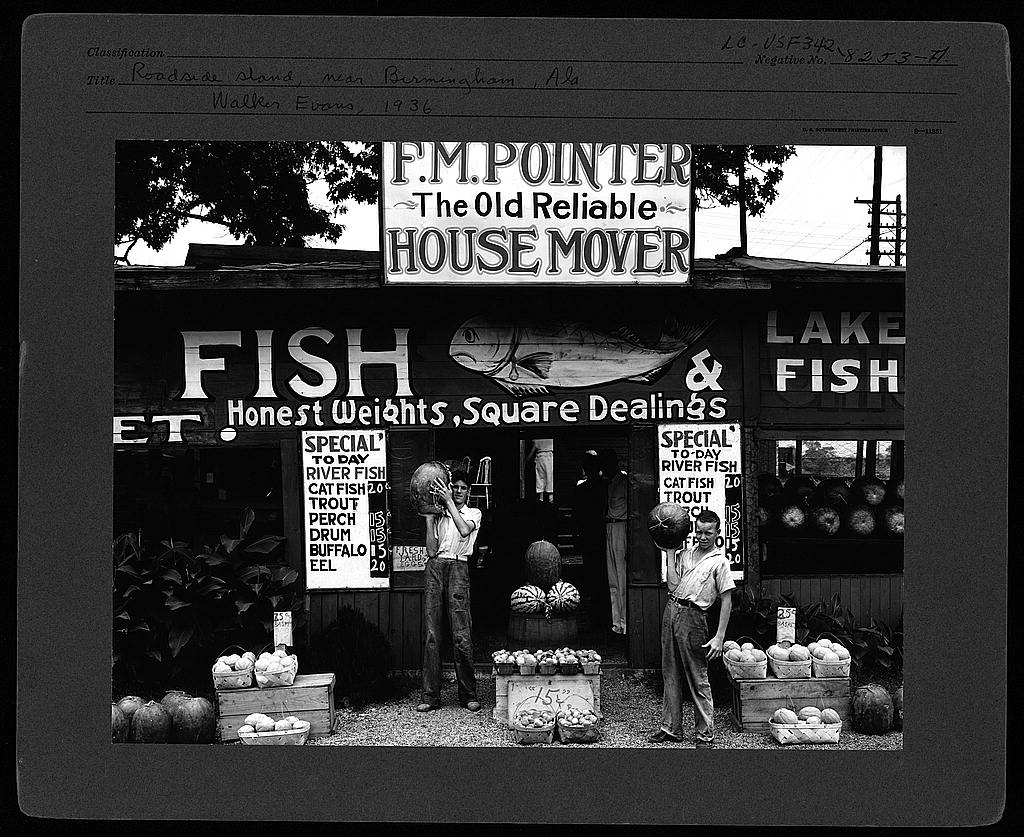
The broader New Deal farm apparatus left lasting institutions behind. For instance,
- The Rural Electrification Administration brought power to isolated farms across the country, quadrupling the share of American farms with electricity within a decade, from about eleven percent in 1934 to nearly half by 1945, and transforming daily life for millions of families.
- The Farm Security Administration offered direct support to small farmers whom the AAA overlooked, including low-interest loans, healthcare, and farming instruction for tenant families trying to hold onto their land.
- Conservation was folded into the same push––farmers were paid to plant soil-building crops like legumes and to set aside vulnerable acreage, a direct response to the Dust Bowl’s devastation of the nation’s topsoil in the 1930s.
Prohibition also came to an end on Roosevelt’s watch, and food supplied part of the argument for ending it. While Prohibition reduced alcohol problems, it increased economic problems and triggered social mayhem. By 1933, the country was deep in the Depression, and breweries had shut down along with thousands of jobs and the tax revenue that came with them. Roosevelt moved fast. Just weeks into his term, he asked Congress to legalize beer as a step toward economic recovery, and Congress responded with the Cullen-Harrison Act, which he signed on March 22, 1933. The law amended the Volstead Act to allow beer and wine up to 3.2 percent alcohol by volume, taking effect on April 7th. Roosevelt remarked upon signing it, “I think this would be a good time for a beer.” (Actually, martinis were FDR’s drink of choice.) Full repeal followed eight months later: on December 5, 1933, the Twenty-First Amendment was ratified, ending Prohibition after nearly fourteen years.
Franklin Delano Roosevelt’s September 1940 campaign speech on farm problems and policies (A/V Geeks 16mm Films)
Roosevelt also moved to close the gap between surplus and hunger more directly. The first Food Stamp Plan pilot, launched in Rochester, New York, in May 1939, helped low-income consumers purchase food while drawing down surplus commodities. It was a modest program born of Depression-era desperation that nonetheless planted the seed for what would eventually become SNAP, the federal government’s largest food assistance initiative today. The SNAP budget is now about $100 billion annually.
Roosevelt led the country through two momentous, world-shaking periods––the Depression and World War II––from a wheelchair the public was rarely allowed to see. His disability resulted from contracting polio in 1921, a problem that he managed with the same quiet control he brought to his morning coffee tray. Sadly, he never got to see the war’s end. Roosevelt died suddenly of a cerebral hemorrhage on April 12, 1945, in Warm Springs, Georgia. That was just weeks before Germany’s surrender and months before Japan’s surrender. FDR’s long-time cook at Warm Springs, Daisy Bonner (“The Queen of the Larder.” as he called her), famously wrote on the kitchen wall, “Daisy Bonner cook the first meal and the last one in this cottage for President Roosevelt.”
FDR had spent twelve remarkable years (the longest presidency in history) reshaping how the country farmed, ate, and thought about food security—even if he himself was still hoping for a little more than what Henrietta Nesbitt’s kitchen was willing to give him.
Try it at home
Eleanor’s Scrambled Eggs
This is the Sunday night staple Eleanor made tableside in a chafing dish for family and guests alike—just butter, eggs, cream, and salt, cooked low and slow until softly set. Simple enough for a first lady with no interest in cooking to master, it was good enough to bring even FDR to the table without complaint.