
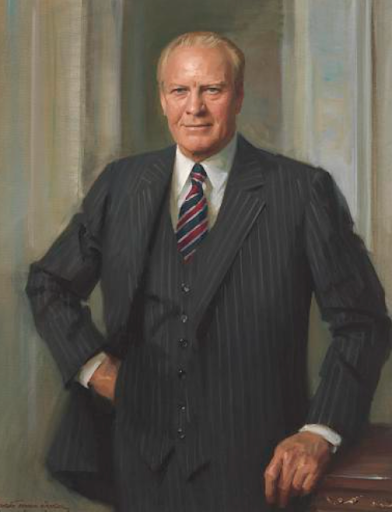
Time in office
August 9, 1974–January 20, 1977
Vital Statistics
Born: July 14, 1913, in Omaha, Nebraska
Died: December 26, 2006, in Rancho Mirage, California
Political Affiliation
Republican Party
First Bite
Ford’s go-to lunch was cottage cheese topped with raw onions and A1 steak sauce, a combination he affectionately called “Michigan gourmet food”—a nickname that says a lot about his sense of humor, if not his culinary ambition.
THE MAIN COURSE
Gerald Ford ate the way you might expect a Midwestern football star turned congressman to eat: plain, hearty, and entirely unpretentious.
Breakfast was orange juice, melon, an English muffin, and tea with lemon, with Ford himself toasting and buttering the English muffins (what a chef!) in the family kitchen on the second floor of the White House. Sundays got a small upgrade, courtesy of White House staff, with golden brown waffles topped “with the works,” including fresh strawberries (one of his favorites) and sour cream. Dessert, more often than not, meant a scoop of butter pecan ice cream, sometimes at both lunch and dinner.
Family dinners leaned into plain, classic American cuisine: pot roast and red cabbage, spare ribs with sauerkraut, spaghetti and meatballs, liver and onions, tuna casserole, and lean pork chops simmered in red wine with braised cabbage and apples. Cabbage, in one form or another, was one of his favorite vegetables. Betty Ford insisted on fresh-baked bread daily, made from her own recipe. Their very first family dinner in the White House—prime rib, parsleyed new potatoes, green beans, salad, and ice cream—set the tone for the plain, generous meals that followed. At family dinners, appetizer courses were usually skipped, and dessert was served only by request—for Ford, that request was almost always butter pecan ice cream.
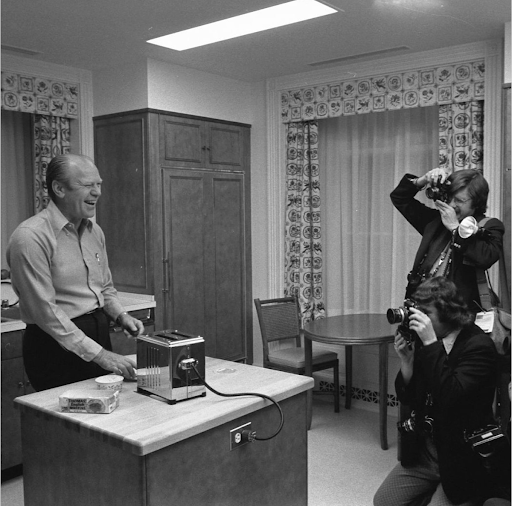

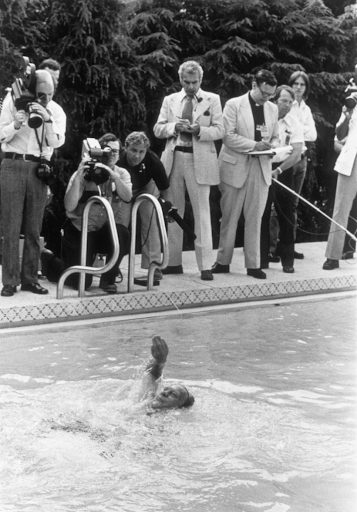
Ford genuinely viewed both eating and sleeping as something close to a waste of time which tracked with a man who filled his days with work, travel, swimming, golf, skiing, and tennis well into his seventies. White House chef Henry Haller recalled that Ford was incredibly active, and often had a big appetite to fuel it. He was serious enough about staying active that he had an outdoor pool installed at the White House specifically so he could swim laps daily.
Ford became president through an unusual succession. He was the only president who had never been elected either president or vice president. He was first appointed VP after Spiro Agnew resigned in 1973, then he became the thirty-eighth president less than a year later when President Richard Nixon was forced to resign. The transition happened so abruptly that the Fords had no time to prepare anything special. Ford simply went home to Alexandria that first night and, according to Alex Prud’homme’s Dinner With the President, celebrated becoming president over a plate of lasagna. Just a month into his term, he issued a full pardon to Nixon, a decision he framed as necessary to help the country move past Watergate, but one that badly damaged his own political standing.
Food occasionally got the better of Ford in more public ways, too. During his 1976 election campaign against Jimmy Carter, he stopped by the Alamo in San Antonio and was handed a tamale. He promptly bit into it—including the corn husk wrapping— apparently unaware it needed to be unwrapped first. Local news ran the footage all weekend, with a CBS correspondent recalling that Ford “nearly choked.” Mike Huckabee, a future governor of Arkansas who was living in Texas at the time, later recalled that the incident received extensive local attention. Whether it affected the election is impossible to determine. Carter went on to win both Texas and the presidency, making the Great Tamale Incident a small, almost absurd, foible with possible real electoral consequences––proof that a single awkward bite on the campaign trail can sometimes outweigh years of difficult policy work.
Ford’s farm policy picked up right where Nixon’s had left off. Agriculture Secretary Earl Butz stayed on from the Nixon administration, and with him came the same “full production” philosophy: subsidies tied to actual output rather than the old acreage limits, expanded exports, and government staying out of the way––a stance Ford framed at the Iowa State Fair as fair prices and open markets rather than handouts. That philosophy was put to the test in September 1975, when Ford temporarily suspended grain sales to the Soviet Union, worried that surging Soviet demand would leave too little supply for American consumers and traditional trading partners. The embargo angered Midwest farmers and fellow Republicans who felt he had abandoned his own free-market principles. Within weeks Ford negotiated a long-term grain agreement with the USSR that lifted the suspension.
Ford signed the International Development and Food Assistance Act of 1975, reorganizing America’s food-aid program to prioritize the countries hit hardest by shortages and expanding agricultural research in support of small and mid-size family farms. And he implemented measures at home to raise the estate-tax exemption and spread estate-tax payments over 25 years so family farms wouldn’t have to be sold off just to cover the bill. But the political damage from the grain embargo lingered long after it was resolved, and Ford’s choice of farm-state Senator Bob Dole as his 1976 running mate was widely seen as a direct attempt to win back the Midwest farmers he had alienated.
Ford’s pardon of Nixon might have doomed his 1976 election campaign because it fed a narrative that he was too closely tied to the very administration voters were eager to move past. That, combined with a struggling economy and the lingering resentment of Midwest farmers over the Soviet grain embargo, was enough to hand Jimmy Carter a narrow win. Ford left office having never actually won a national election in his own right.
Try it at home
Henry Haller’s Braised Red Cabbage
A hearty, homestyle staple of the Ford family table, straight from chef Henry Haller’s own White House recipe collection. Haller served this tangy braised cabbage alongside a slow-cooked pot roast. Plain and satisfying, it’s exactly the kind of meal Ford preferred over anything fancier.