
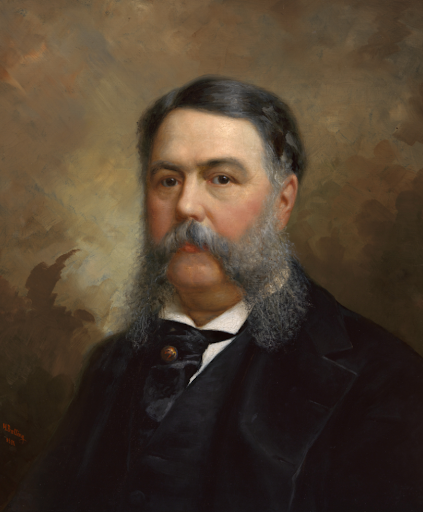
Time in office
September 20, 1881–March 4, 1885
Vital Statistics
Born: October 5, 1829, in Fairfield, Vermont
Died: November 18, 1886, in New York City
Political Affiliation
Republican Party
First Bite
Chester “Chet” Arthur once spent $1,500 on flowers for a single state dinner—roughly $48,000 today — which, given the man, tracks perfectly with his extravagant tastes.
THE MAIN COURSE
Chester A. Arthur became president after an assassin’s bullet took down James Garfield.
Nobody expected much from him. He’d spent most of his professional life as a Republican-machine man in New York, more comfortable handing out patronage jobs than making policy, and reformers assumed the presidency would go about as smoothly as his critics predicted. Instead, Arthur surprised everyone by governing with real independence—and by throwing some of the finest dinner parties Washington had ever seen.
In a biography of Arthur, Scott Greenberger says that in New York he was “a corrupt, greedy machine politician.” But then Arthur received several letters from a stranger, a young woman, that Greenberger speculates greatly influenced him. As his predecessor President Garfield, lay dying in New Jersey, she wrote in one letter, “The people are bowed in grief; but—do you realize it?—not so much because he is dying, as because you are his successor.” The normally cynical Mark Twain observed, “it would be hard indeed to better President Arthur’s administration.”
Arthur brought a French chef to the White House, one seasoned in the elaborate dinners of New York’s gourmet set, and he used him well. Official dinners were tastefully over-the-top: six wines of real quality, guest lists that swelled past fifty, and menus built around rich, fashionable dishes like turtle steak simmered in mushrooms and red wine. One of his close friends once said Arthur “loved the pleasures of the table” and could hold his liquor well enough that it only made his conversation more colorful. Guests agreed—one called him “an expert in significant detail,” a compliment that applied equally to his cuisine and his wardrobe. Arthur owned more than eighty pairs of pants and earned the nickname “Elegant Arthur,” which tells you something about his passions.
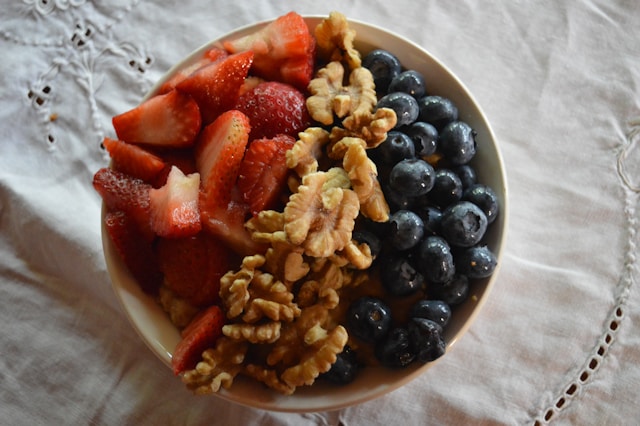
Despite the spectacle, Arthur ate with more restraint than his dinner parties suggested. Mornings brought only coffee and a roll. Lunch was oatmeal, fish, and fruit—nothing heavy. It was dinner where he let loose, favoring a mutton chop with ale or rare roast beef with roasted potatoes—a fitting choice for a man who was already wearing a pair of mutton chops on his face and clearly saw no reason to ration either the ones on his plate or on his face. He’d stretch those dinners into long evenings with friends, hating to end a night early. As a self-declared “night bird,” he kept guests bound by etiquette to stay until he called it quits, which one exhausted attendee described as “an interesting problem” to solve before midnight.
No appetite ran deeper than his love of seafood. Arthur was a devoted salmon fisherman, spending long stretches at the Thousand Islands (in the Saint Lawrence River) catching his own dinner. Eel was a particular favorite. Macaroni pie with oysters made frequent appearances at his table, and turtle steak, though technically not seafood, kept company with his aquatic obsessions as a signature indulgence. For a man who indulged in elegance, there was something refreshingly unpretentious about his enthusiasm for a fish he’d caught himself.
The president’s extravagance came with a cost. Critics whispered that his French cuisine and towering floral arrangements—sometimes shipped in from New York—were being funded by taxpayers, and the murmurs never fully died down. It didn’t help his political future. Like President Van Buren before him, tales of Arthur’s luxury eroded his public support. And insiders were aware that he suffered from Bright’s disease, a debilitating kidney ailment that might have reduced his effectiveness. In any case, he failed to secure his party’s nomination for a second term. He died two years after the 1884 election.
Still, Arthur’s legacy on food policy outlasted the dinner parties. In 1884, he signed the act creating the U.S. Department of Agriculture’s Bureau of Animal Industry, giving the federal government its first real authority to investigate animal disease and quarantine infected meat—a direct ancestor of modern food inspection laws. A year earlier, he had appointed Harvey W. Wiley to be the chief of the Department of Agriculture’s Chemical Division, setting in motion investigations into food adulteration that would culminate in the Pure Food and Drugs Act of 1906.
Try it at home
Mutton Chops
This dish was a real favorite of President Arthur.