
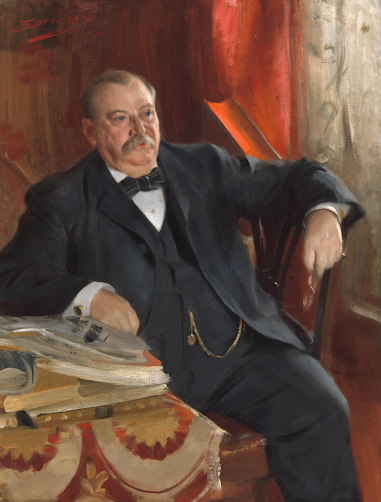
Time in office
March 4, 1885–March 4, 1889; March 4, 1893–March 4, 1897
Vital Statistics
Born: March 18, 1837, in Caldwell, New Jersey
Died: June 24, 1908, in Princeton, New Jersey
Political Affiliation
Democratic Party
First Bite
At a formal French-style White House dinner, Cleveland caught a whiff of what the kitchen staff was eating—corned beef and cabbage—and asked if he could trade meals with them instead.
THE MAIN COURSE
Grover Cleveland holds a distinction no other president managed until Donald Trump matched it more than a century later: he WAS ELECTED TO two non-consecutive terms.
Voted out in 1888 despite winning the popular vote, Cleveland simply came back in 1892 and picked up where he’d left off, becoming both the 22nd and 24th president in the process.
That persistence extended straight to his dinner table, where Cleveland made his preferences known early and often. Despite being cast during the 1884 campaign as boorish and uncouth, the reality was simpler: Cleveland genuinely preferred plain food to elaborate French cuisine, and he wasn’t shy about saying so. “I wish it was to eat a pickled herring, Swiss cheese, and a chop at Louis’,” he once wrote a friend, dreading yet another formal dinner of “the French stuff.” His cook Eliza, brought down from Albany specifically because she knew his tastes, kept things simple: oatmeal, beefsteak, eggs, or a chop for breakfast, with coffee to wash it down, and lunches that rarely stretched past fifteen minutes. That same preference for simplicity showed up again and again at his own table. On one occasion, after eating nothing more than ordinary corned beef and cabbage, he declared it “the best dinner I had had for months”—high praise from a man who’d sat through his fair share of elaborate state dinners.
None of that plain eating meant Cleveland skimped on official entertaining, though. He understood that the presidency came with an obligation to host well, regardless of his own personal taste for quiet evenings, and he delivered when it mattered. His first official White House dinner went over the top—swan and eagle centerpieces, potted plants, and enough flowers that departing female guests received souvenir bouquets wrapped in ribbon printed with an image of the White House itself. Wine flowed freely, too, with formal place settings often including six to eight separate wine glasses plus one for champagne, even though neither his sister Rose (who initially served as the hostess) nor, later, his young wife Frances actually drank.

Cleveland married while in office, tying the knot with his former law partner’s 22-year-old daughter, Frances Folsom, in a White House wedding that transformed the Blue Room into a flowering indoor garden. The intimate ceremony drew only forty guests, but crowds of onlookers still flocked to catch a glimpse of the new first lady, who was treated afterward to a wedding supper of terrapin, spring chicken, and an elaborate four-tier cake shipped in from New York. Frances proved to be a natural hostess in her own right, even introducing a second weekly reception specifically timed so working women could attend, and once serving a thirteen-course luncheon in honor of George Washington’s birthday.
Cleveland’s second term also briefly reunited him with a familiar face in the kitchen: Dolly Johnson, the celebrated Kentucky cook who’d previously served in Benjamin Harrison’s White House. Cleveland’s staff sought her out directly, and she returned at double her old salary—$150 a month, matching what the White House paid its male clerks and doorkeepers—though her second stint proved just as brief as her first, ending after only a few months for reasons that were never entirely clear.
Acting as the chief executive and not just a diner, Cleveland wielded his veto pen with some frequency, and food and farm measures were no exception to his willingness to say no. When Congress tried to send $10,000 in relief seed grain to drought-stricken Texas farmers, Cleveland vetoed it outright, warning that federal handouts “weakens the sturdiness of our national character”—a philosophy he applied just as firmly to his Department of Agriculture’s free seed-distribution program, which he scaled back after discovering it had handed out over nine million seed packets with almost no oversight.
Not everything got the veto treatment, though: he signed the Hatch Act of 1887, funding agricultural research stations at land-grant colleges nationwide, and in the closing weeks of his first term, elevated the Department of Agriculture to full Cabinet status—largely, true to form, just signing what Congress had already decided to send him rather than shaping it himself.
Try it at home
Corned Beef and Cabbage
Boiled low and slow until it falls apart, this humble, unfussy dish was Cleveland’s idea of a truly good meal—no French sauces required.