
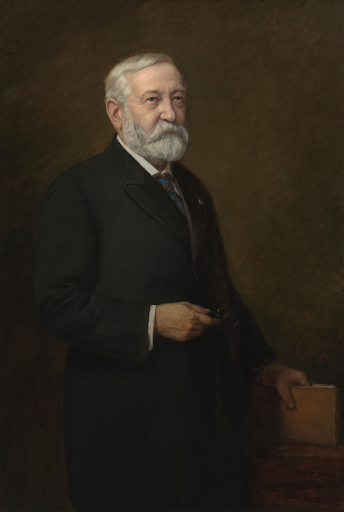
Time in office
March 4, 1889–March 4, 1893
Vital Statistics
Born: August 20, 1833, in North Bend, Ohio
Died: March 13, 1901, in Indianapolis, Indiana
Political Affiliation
Republican Party
First Bite
Benjamin Harrison’s staff called married men lucky at Christmas––they got a whole turkey as a gift, since they’d presumably be eating at home, while single staffers received fine gloves instead, on the assumption they’d be dining out.
THE MAIN COURSE
Benjamin Harrison’s presidency has a reputation, even among historians, for being a bit dull.
The food was good, the flowers were plentiful, and the entertaining hit all the right Gilded Age notes—but by most accounts, something was simply missing. Much of that came down to Harrison himself: he struck most people as cold and formal, a man more comfortable with distance than warmth. Only close friends ever glimpsed a jollier side underneath, and that side rarely made it past his own front door.
Politics and being the president ran in the family, much as it did with the Adamses, Roosevelts, and Bushes. Harrison was the grandson of William Henry Harrison, the country’s ninth president, who was elected in 1841 and died just 31 days later (from pneumonia). Whatever else you could say about Benjamin’s personality, at least he made it to the finish line.
What the Harrison White House lacked in spark, it made up for in genuine domestic contentment. The family was famously fond of soup—corn soup especially, a fitting favorite for a household of Ohio-Indiana natives who never met a corn recipe they didn’t like—along with oysters in every form Washington could offer. Harrison had a particular soft spot for figs, turning up again and again in pies and puddings. One dish, “Presidential Fig Pudding,” was said to sum up his palate perfectly: humble ingredients, elevated by real care in the kitchen. That care wasn’t accidental. First lady Caroline Harrison took the household’s cooking seriously enough to compile her own cookbook, Statesmen’s Dishes and How to Cook Them, and she personally reviewed the White House menus every single day, a level of daily involvement that earned her the genuine affection of her staff.
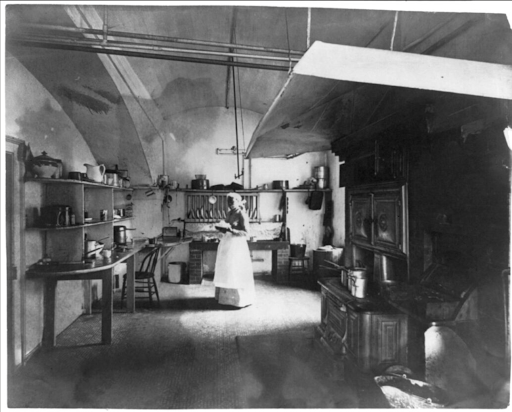
Much of that plain, home-style cooking came from Dolly Johnson, the family’s Kentucky cook—hired either through a friend of Caroline Harrison’s or, in the flashier version of the story, on Theodore Roosevelt’s personal recommendation after he tasted her cooking on a trip through Kentucky. Johnson, born enslaved in Georgetown, Kentucky, and biracial, brought her Bluegrass cooking style to the White House, replacing a French chef whose elaborate menus never quite suited the Harrisons’ plainer tastes. She made the family’s first White House Christmas dinner just weeks after arriving, cooking in kitchens so run-down that the first lady once complained in her diary that rats had nearly taken over the building—a problem serious enough to prompt a full renovation. Johnson’s stay was cut short when she returned home to care for a sick daughter, but she left enough of an impression that Grover Cleveland’s staff later brought her back for a second stint, this time at double her original pay.
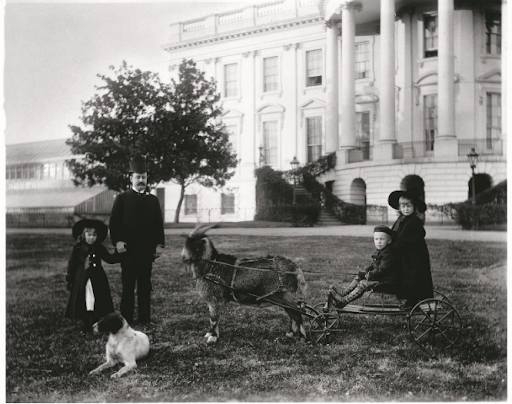
Family, more than politics, seemed to be where the Harrisons truly came alive. Christmas dinners were elaborate but distinctly unpretentious—oysters on the half shell, roast turkey with cranberry jelly, terrapin a la Maryland, and a parade of desserts including plum pudding and tutti frutti ice cream, capped off with macaroons for anyone still hungry. Grandchildren’s birthdays got the same enthusiastic treatment, complete with bonbon baskets at every place setting and biscuits piled high enough to feed an army. The family even kept a pet goat on the White House lawn named “His Whiskers,” who spent his days pulling Harrison’s grandchildren around the grounds in a small cart—arguably the liveliest personality in the entire administration. The Harrisons kept their family gatherings almost entirely private, letting their formal, buttoned-up reputation stand in for a domestic life that was actually pretty warm.
That domestic happiness didn’t last, unfortunately. Caroline, the same first lady who’d fussed over menus and painted china by hand, died of cancer in the White House in October 1892, just weeks before her husband’s reelection bid. The loss cast a long shadow over the end of his term, compounding an already difficult political moment; Harrison’s support for high tariffs and silver purchases had helped strain the economy toward what would soon become the Panic of 1893. Grief mixed with politics to end his hopes for a second term at the hands of Grover Cleveland.
Whatever else can be said about Harrison’s presidency, his food policy left a genuinely important legacy. In 1890 and 1891, he signed two Meat Inspection Acts, the country’s first federal law requiring the inspection of meat products for export. (In 1906 a more comprehensive meat-inspection law was adopted, along with the Pure Food and Drug Act, the true antecedent of today’s food-safety laws.) That same year, his administration replaced tariffs on imported raw sugar with a direct subsidy paid to American sugar growers, and added reciprocity provisions to trade policy, using access to American markets as leverage to open up new markets abroad for U.S. agricultural goods. He also signed the Forest Reserve Act of 1891, preserving some 22 million acres of public timberland—including the land that would become Yellowstone’s forest reserve—and effectively founding what grew into the National Forest System. For a president remembered as forgettable, it was a surprisingly consequential record.
Try it at home
Presidential Fig Pudding
A simple, old-fashioned dessert featuring Harrison's favorite fruit—plain in the pan, but rich with flavor once you dig in.
This recipe is adapted from Poppy Cannon’s The Presidents’ Cookbook.