
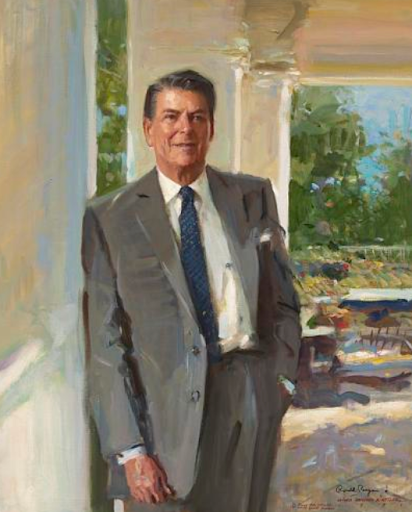
Time in office
January 20, 1981–January 20, 1989
Vital Statistics
Born: February 6, 1911, in Tampico, Illinois
Died: June 5, 2004, in Los Angeles, California
Political Affiliation
Republican Party
First Bite
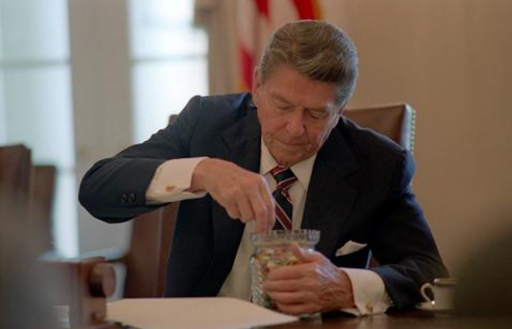
Ronald Reagan believed you could learn a lot about people from how they ate jelly beans, once explaining: “You can tell a lot about a fella’s character by whether he picks all one color or just grabs a handful.” He kept a glass jar of them on his desk at all times and offered them to virtually every visitor who sat down with him.
THE MAIN COURSE
For a man who spent eight years hosting world leaders at lavish dinners in the White House, Reagan preferred surprisingly simple everyday meals.
Reagan was said to prefer something plain and unfussy on his own plate such as hash, meatloaf, and macaroni and cheese. Even his most famous food habit fit that pattern: According to the Ronald Reagan Presidential Library and Museum, Reagan started eating jelly beans in 1966, using the candy to help himself quit pipe smoking during his first run for California governor. The habit followed him for the next two decades straight through the presidency. His favorite flavor was licorice. The Jelly Belly brand became something of a national phenomenon on his watch. The manufacturer, Herman Goelitz Candy Company, actually developed its blueberry flavor in 1980 specifically to round out a red, white, and blue set, shipping three and a half tons of beans to Washington just for his 1981 inauguration. After that, the White House kept a standing order of 720 bags a month, every single meeting came with a crystal jar of the candies on the table, and Reagan handed out custom Jelly Belly jars stamped with the Presidential Seal as gifts to visiting heads of state.
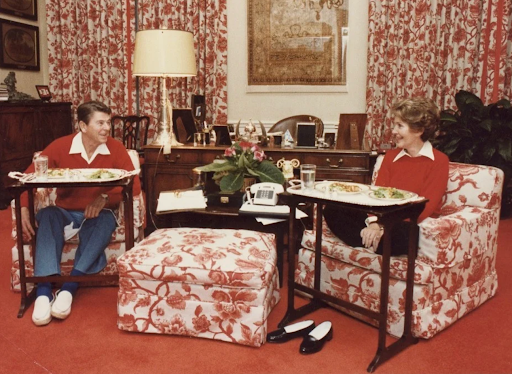
Beyond the jelly beans, Reagan’s actual diet was considerably more disciplined than his sweet tooth might suggest, at least when Nancy was around to enforce it. On a normal day, breakfast was bran cereal with skim milk, melon or grapefruit, and decaf coffee, with eggs permitted only once a week alongside whole wheat toast or an English muffin. Lunch was almost always soup: navy bean, black bean, scotch broth with barley, or lentil with diced hot dogs. When Nancy was away, Reagan sometimes ate richer foods such as steak and macaroni and cheese. Dinners turned into thick, well-done steaks, gooey macaroni and cheese, and chocolate mousse for dessert. Reagan had a real sweet tooth regardless of who was watching, with honey-baked apples as his nightly go-to (Nancy preferred old-fashioned apple Brown Betty.) Monkey bread, a heavy, sweet holiday loaf, became a family tradition reserved for special occasions. He also had a lasting soft spot for old-fashioned roast beef hash, and the couple famously ate frozen dinners together on trays in front of the television. In fact, in 1984 Reagan issued a proclamation recognizing March 6 as Frozen Food Day, following a congressional resolution, effectively memorializing his own dinner routine as a matter of federal record.
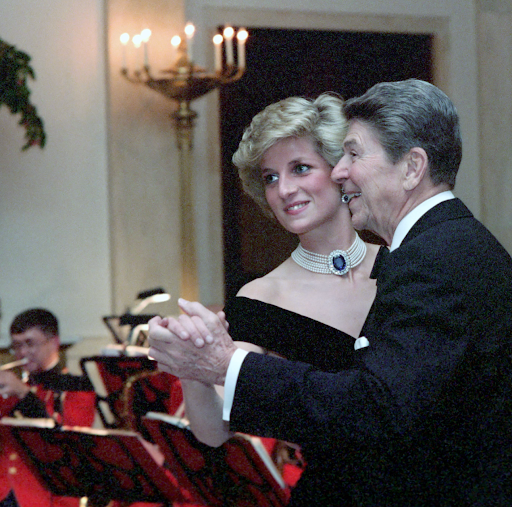
Entertaining under the Reagans, unlike Ronald’s own everyday tastes, ran on elegance and glamour, and Nancy in particular treated it as a matter of political importance, determined to prove Hollywood polish could hold its own in Washington. The Reagans hosted fifty-nine state dinners over their eight years in the White House, more than any other first couple in history. Their guests included seven kings, three queens, seventy-seven prime ministers, forty-five foreign ministers, and thirteen princes.
A surprise seventieth birthday party Nancy threw just weeks into the administration set the tone early, drawing Hollywood royalty like Frank Sinatra, Cary Grant, and Elizabeth Taylor for a black-tie dinner of stuffed veal and lobster en Bellevue. The most famous night of the administration, though, was a 1985 dinner for Prince Charles and Princess Diana, which Nancy insisted be “the finest dinner anyone has ever seen.” The evening ended with dancing in the Entrance Hall, where actor John Travolta, still riding the high of Saturday Night Fever, swept in and danced with the princess herself—one of the most photographed moments of Reagan’s entire presidency.
Reagan’s food policy carried a genuine contradiction running through both terms: he preached small government and free markets, yet his administration spent huge sume on farm programs. His first term, in particular, produced a string of self-inflicted problems:
- He signed the 1981 farm bill with dairy price supports set so high that the government was legally obligated to buy up any milk farmers couldn’t sell at that guaranteed price. Farmers, naturally, kept producing, resulting in a massive government cheese surplus.
- He lifted Carter’s Soviet grain embargo that same year, restoring a major export market and signaling that trade, not subsidies, was his preferred tool for supporting farm income.
- His administration initially met the worst farm crisis since the Great Depression with a hands-off stance, publicly insisting there was no “blank check” available to bail out struggling farmers as high interest rates and a strong dollar crushed exports and buried families in debt.
- He tightened participation rules for the Food Stamp program, reducing enrollment by several million people. He froze spending on the WIC program (for pregnant and lactating women) at a time of rising costs. And his administration reduced federal support for the National School Lunch Program and other nutrition programs. His administration’s proposal for school meals would have allowed condiments, such as ketchup and relish, to be counted as vegetables was so widely mocked that it was rescinded within a month.
- To manage the surplus his own price supports had created, his administration began giving away government-held cheese by the truckload, releasing thirty million pounds in December 1981 alone.
Listen as Reagan shares his hostility toward the Food Stamp Program on possibly his first three-minute radio show. His show, broadcast before he was elected president, reached thirty million listeners.
His second term told a considerably different story, correcting course on several fronts:
- He signed the Food Security Act of 1985, finally lowering price supports toward market rates and creating the Conservation Reserve Program, along with the sodbuster and swampbuster provisions that protected fragile farmland.
- He formalized the earlier cheese giveaways into the Emergency Food Assistance Program, which went on to distribute more than five hundred and sixty million pounds of surplus dairy to food banks and welfare recipients throughout the decade.
- Congress stepped in where Reagan’s own instincts hadn’t, passing Chapter 12 bankruptcy protections for family farmers in 1986 and a $4 billion debt-restructuring package the following year.
- He kept up the personal goodwill campaign throughout, with National Agriculture Day proclamations and regular appearances before groups like the Future Farmers of America, even as the underlying economic numbers stayed bleak for much of the decade.
Several pieces of that legacy outlasted him by decades. The Conservation Reserve Program remains one of the largest private-land conservation programs in the country (notwithstanding Trump-era cuts), and Chapter 12 bankruptcy protection became a permanent fixture of federal law that didn’t exist before the 1980s. The Emergency Food Assistance Program, born out of Reagan’s dairy giveaways, still operates as a standing mechanism for distributing surplus food to those in need. But the era’s darker legacy lingered too—the farm consolidation pressure that intensified under Reagan-era financial strain never fully reversed, and rural America remains smaller and more corporate-dominated today than it was in 1980. Even the infamous ketchup episode has outlived its original controversy, becoming a lasting cultural shorthand for Republicans efforts to shrink nutrition programs. The fight resurfaced almost word for word in 2011, that time over pizza sauce.

Reagan left office in 1989 having survived an assassination attempt, negotiated the first real nuclear arms reductions of the Cold War, and reshaped American politics for a generation. But the same instinct that made him so effective at charming a room—the jelly beans, the folksy warmth, the easy Hollywood affability—also let him coast through some genuinely damaging policy failures without much political cost. Farmers spent much of his presidency drowning in debt while his administration insisted there was no “blank check” to help them, hungry families lost school lunch and food stamp funding even as surplus cheese piled up in government warehouses, and rural America never fully recovered from the consolidation his policies accelerated. History remembers the charm, but it’s worth remembering the bill that came with it.
Try it at home
President Reagan’s Favorite Macaroni and Cheese
The dish that showed up the second Nancy left town and the diet rules quietly took the night off—gooey, unapologetic, and proof that even a First Lady famous for discipline had her own recipe for letting loose.