
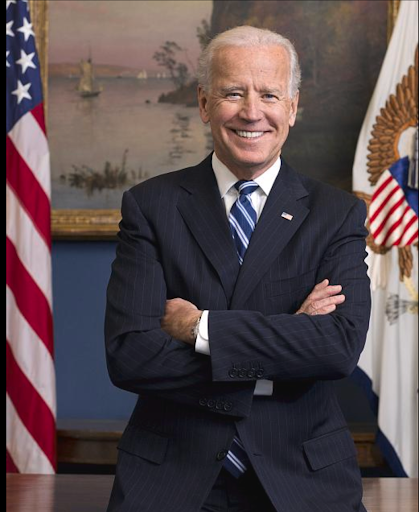
Time in office
January 20, 2021–January 20, 2025
Vital Statistics
Born: November 20, 1942, in Scranton, PA
Currently: Living in Wilmington, DE
Political Affiliation
Democratic Party
First Bite
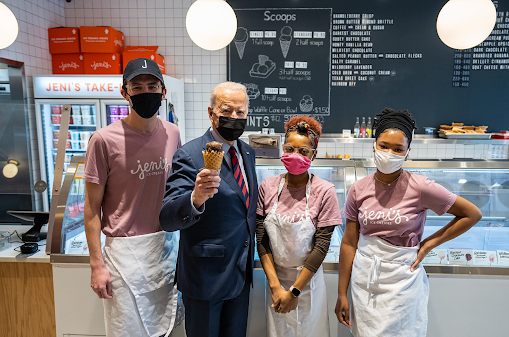
Joe Biden once fielded reporters’ questions about a possible Gaza ceasefire while holding an ice cream cone in a New York shop. Though it reflected his love of ice cream, the moment was widely mocked online and by late-night hosts, who noted the odd contrast between the casual setting and the seriousness of the news.
THE MAIN COURSE
Joe Biden’s tastes have been described, not unkindly, as childlike. He has had a lifelong preference for nostalgic comfort food over sophisticated dining.
For breakfast, Joe and his wife Jill Biden often “prepared” Special K cereal with milk, along with a glass of orange Gatorade. Lunch typically meant a peanut butter and jelly sandwich, a habit he’s publicly and cheerfully owned. In an episode of the podcast Here’s the Deal, he admitted, “The thing that everybody makes fun of me is when in doubt I have a peanut butter and jelly sandwich.” Fig Newtons were a favorite travel snack for practical reasons as much as taste ones. “They’re small, and I can sneak them,” he once said. “You can buy little packs of them, and I get them on the planes when I fly back and forth.” His favorite pasta preparation stayed just as unfussy: butter and a simple red sauce. BLTs, pizza, and cookies rounded out much of the rest of his everyday diet. Because of family struggles with alcohol, he doesn’t drink alcohol, reaching instead for Gatorade or Coke Zero.
Biden’s love of ice cream became something of a running joke during his presidency after CNN made a compilation of videos showing him eating it. His favorite is vanilla chocolate chip in a waffle cone. Jeni’s, the Ohio-based ice cream company, created a limited-edition flavor in his honor, White House Chocolate Chip, with chocolate flakes and a chocolate-covered waffle cone (despite exasperated sighs from nutritionists).
A compilation of videos of President Biden eating ice cream (CNN News)
Jill spent years quietly nudging her husband toward greens, fish, and other healthy foods, with limited success. In September 2021, Biden’s sister, Val, visited the White House for a private family dinner, and Jill chose the entrée: salmon in a pastry shell with a medley of vegetables. According to Val’s memoir, Biden grumbled good-naturedly, “Damn, she makes me eat this healthy stuff all the time.” Once Jill was out of sight, he quietly finished off some lemon pound cake and a carton of chocolate chip ice cream for dessert. Jill is a genuinely skilled cook who treats the kitchen as a creative outlet, keeping Joe out of it: “It’s my turf.” By his own admission, Joe can boil pasta and heat sauce from a jar, but not much beyond that.
Biden leaned into his simple tastes as a campaign strategy in 2024, turning food stops into low-key retail politics: Boba tea in Las Vegas, a Cook Out burger and milkshake in Raleigh, ice cream with Seth Meyers in New York. He used those moments of eating popular foods to project cultural familiarity and push back against persistent concerns about his age.
President Biden maintaining the White House tradition of the turkey pardoning (The Biden White House)
COVID canceled what would have been the traditional inaugural luncheon and ball in 2021. It was the first time a president scrapped them since 1949. Formal White House hosting picked back up gradually as the pandemic eased. Once it did, the Bidens leaned into a steady rhythm of regular state dinners, hosting heads of state from France, South Korea, India, Australia, Japan, and Kenya over the course of the administration. The dinners’ relatively casual character harkened back to his eight years as vice president under President Obama. As VP, Biden hosted an annual “beach party” for journalists at his Naval Observatory residence, a low-key tradition that contrasted sharply with the formality of state dinners.

Moving from the personal to the political, Biden supported a robust menu of food and agriculture policies:
- In 2022, Biden’s administration released a National Strategy on Hunger, Nutrition, and Health, paired with the first White House hunger conference since 1969. The administration set a goal of ending hunger and reducing diet-related disease by 2030. As part of that initiative, the U.S. Department of Agriculture (USDA) updated its nutrition standards for school meals with limits on sugar and salt and a requirement that at least 40 percent of grains be whole grains.
Biden speaking on the objectives of the first White House Conference on Hunger, Nutrition, and Health in fifty years. (The Biden White House)
- Under the 2022 Inflation Reduction Act, USDA distributed $2.5 billion in loan forgiveness to nearly forty-eight thousand financially distressed farm borrowers, plus $2 billion in payments to forty-three thousand farmers, many of whom were African Americans, who had experienced past discrimination in USDA lending. That law also provided up to $7.7 billion for farm and forest conservation practices in fiscal year 2025, the largest single-year conservation investment in U.S. history.
- USDA expanded free school-meal eligibility to cover three thousand new school districts, created permanent summer food programs, and increased Supplemental Nutrition Assistance Program (SNAP, or food stamps) benefits by 21 percent, or roughly a dollar a day, the biggest increase in history. However, the second Trump administration would later reverse some of those increases and deprive millions of people of SNAP benefits.
- In 2024, USDA made health-based updates to the WIC program for low-income women, infants, and children that as much as quadrupled the fruit-and-vegetable benefit, added culturally preferred grains like quinoa and teff, and expanded access to dairy alternatives, canned fish, and beans.
- USDA closed loopholes in “Product of USA” labeling by only allowing the labels on meat from animals born and raised domestically (and not raised elsewhere but just processed in the U.S.). Also, it invested $500 million in small and mid-size meatpacking plants to help small-scale farmers and counter industry consolidation that often leads to higher prices.
- Also in 2024, the USDA, Environmental Protection Agency, and Food and Drug Administration jointly released a National Strategy for Reducing Food Loss and Waste, aiming to cut food waste in half by 2030. Food waste makes an outsized contribution to emissions of methane from landfills.
Try it at home
Simple Buttered Pasta with Red Sauce
Just pasta, butter, and a simple red sauce, no cream, no fuss, no garnish.