
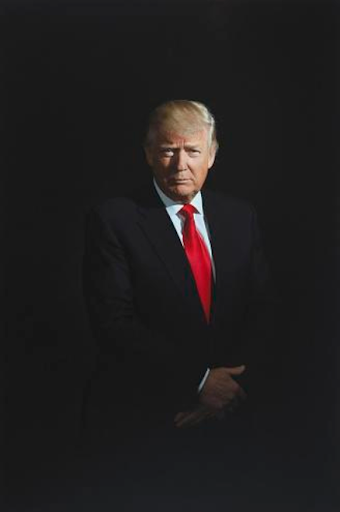
Time in office
January 20, 2017–January 20, 2021; January 20, 2025–January 20, 2029 (anticipated)
Vital Statistics
Born: June 14, 1946, in Queens, New York City
Currently: Living in Washington, DC, and Palm Beach, FL
Political Affiliation
Republican Party
First Bite
Donald Trump keeps a button on the Resolute Desk that, when pressed, summons a staffer with a can of Diet Coke, most days bringing his Diet Coke count to about a dozen.
Donald Trump showing off his Diet Coke button to a Fox News correspondent (King TV, Youtube)
THE MAIN COURSE
Donald Trump’s relationship with food IS SOMETIMES INSTINCTIVE AND SOMETIMES image-making.
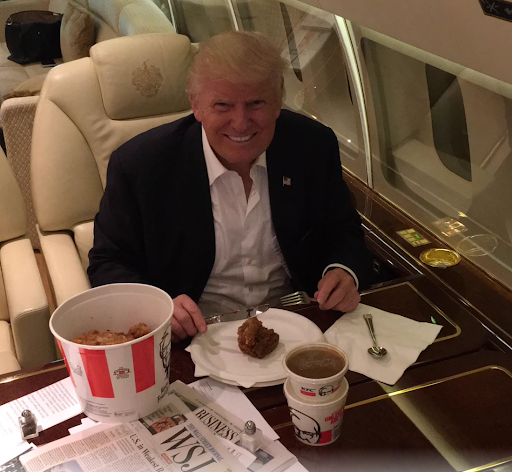
Trump’s well-known love of McDonald’s, KFC, and pizza is sometimes a calculated appeal to the “everyday American,” a billionaire eating the same Big Mac as everyone else. But by all accounts, it’s also a reflection of his genuine tastes. His campaign manager, Corey Lewandowski, once summed up the road diet bluntly, describing “four major food groups”: McDonald’s, KFC, pizza, and Diet Coke. Trump’s typical McDonald’s order is two Big Macs, two Filet-O-Fish sandwiches, and a chocolate shake, occasionally combining two of the sandwiches into one. With pizza, he reportedly skips the crust and eats only the toppings. Burger buns get much the same treatment. Iceberg lettuce stands as one vegetable he admits to liking.
One of his favorite main courses is steak, and when he orders one, he asks for it cooked so thoroughly it “would rock on the plate,” according to his longtime butler. He prefers to finish it with ketchup rather than any kind of steak sauce. He’s also spoken fondly of his mother’s meatloaf, which he once prepared on a 2005 episode of Martha Stewart’s cooking show.
Trump working the McDonald’s fry station and drive thru as a publicity stunt on the campaign trail for the 2024 election (Associated Press, Youtube)
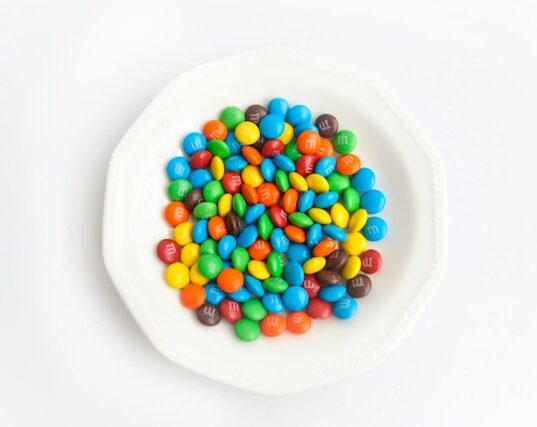
Trump’s sweet tooth runs deep. According to a Rolling Stone report drawing on several administration officials, he’s kept bowls of Tootsie Rolls, Reese’s, caramels, M&M’s, Starburst, and mini Hershey chocolate bars stocked in the West Wing during both his administrations, occasionally summoning aides to bring a bowl into the Oval Office. As a self-described lifelong teetotaler, he doesn’t drink alcohol or coffee (despite owning a winery in Virginia and launching his own vodka brand in 2005) after watching his older brother’s death from alcoholism. He has joked that candy is “my alcohol.” When it comes to ice cream, he prefers cherry vanilla, and famously gets two scoops while his guests get just one. A sharp observer might notice an incongruity between Trump’s diet and his government’s advice in the Dietary Guidelines for Americans (no added sugar or ultra-processed foods).
By his own account and that of associates, germaphobia is at the root of Trump’s food preferences. He has said he favors chain restaurants like McDonald’s because of their consistency and cleanliness. He avoids eating from snack packages that have already been opened. According to the 1993 biography Lost Tycoon, on a 1990 trip to Tokyo he refused to eat raw fish and had a McDonald’s hamburger instead. Melania vetoed sushi at a formal dinner during the couple’s 2019 state visit to Japan, prompting the Imperial Palace to adjust its menu to avoid any raw seafood.
In January 2026, Trump’s Health and Human Services (HHS) Secretary Robert F. Kennedy Jr. called Trump’s eating habits the most “unhinged” he had ever seen. Kennedy added, “I don’t know how he’s alive….pumping himself full of poison all day long.” Kennedy added that Trump eats considerably healthier at the White House and his Mar-a-Lago home, reverting to fast food mainly while traveling, so he won’t get sick on the road.
Trump’s dinner table has, on occasion, been a stage for unpresidential behavior. One former White House aide recalled Trump throwing a lunch plate against the wall during a fit of anger and ketchup running down the wall alongside shattered porcelain. Trump also uses food to express power. Shortly after demoting Chris Christie from his role leading the presidential transition, Trump announced at a White House lunch, “Chris, you and I are going to have the meatloaf.” Ordering for a grown man was a small, pointed reminder of who was in charge.
In January 2019, Trump hosted the Clemson Tigers football team to celebrate their national championship. With White House staff furloughed during a government shutdown, he ordered a spread of McDonald’s, Wendy’s, and Burger King fare––fries, chicken nuggets, salads, fish sandwiches, hundreds of hamburgers––and Domino’s pizzas, proudly calling it “great American food.” It remains one of the most iconic Trumpian food moments of his presidency: equal parts personal taste and showmanship.
Trump hosted only two official state dinners in his first term. He reportedly viewed the dinners as a waste of time, while his predecessors treated them as effective diplomatic tools. An April 2026 dinner honoring King Charles III and Queen Camilla, timed to America’s 250th anniversary, included a garden vegetable velouté, spring herbed ravioli, and Dover sole meunière, finished with a beehive-shaped flourless chocolate cake drizzled with honey from the White House’s hives, about as far from a Big Mac as a White House meal could get.
Food occasionally collided with real diplomacy. During an April 2017 dinner with Chinese President Xi Jinping at Mar-a-Lago, Trump chose the dessert course, what he later called “the most beautiful piece of chocolate cake that you’ve ever seen,” to inform Xi that U.S. airstrikes on Syria were about to begin. Trump recalled Xi pausing for roughly ten seconds before asking his interpreter to repeat the news, a reaction Trump found unnerving, though Xi ultimately said he approved of the strikes given Assad’s use of chemical weapons. It’s a strange, memorable example of major military news landing mid-dessert rather than in any formal briefing room.
Donald Trump recounts the famed chocolate cake during an MSNB interview.
Trump’s food and agriculture policy tells a mixed story, marked by some differences between his two terms:
- Trump’s first-term trade war with China triggered retaliatory tariffs that reduced agricultural exports to China by more than half between 2017 and 2018, amid farm debt that hit a record in nominal terms and, by 2019, the most farm bankruptcies since 2011. His administration responded with roughly $23 billion in trade-war aid. By 2020, government payments made up nearly half of net farm income, though more than half of that year’s aid was pandemic relief. More than half of the trade aid went to the largest 10 percent of recipients, while the smallest 80 percent received less than a quarter.
- When COVID hit, Trump’s administration invoked the Defense Production Act to keep meatpacking plants running despite major outbreaks inside. More than 59,000 workers ultimately tested positive and over 250 died, but the Occupational Safety and Health Administration declined to issue enforceable safety standards even as the virus tore through the workers on processing lines. Although Trump claimed that a possible meat shortage justified the deaths of workers and their families, he permitted continued meat exports to China.
- Trump’s second term brought sweeping U.S. Department of Agriculture (USDA) workforce cuts under the Department of Government Efficiency (DOGE) initiative. USDA lost roughly 18,000 to 24,000 employees, nearly 27 percent of its staff, mostly through buyouts and deferred resignations, crippling its ability to conduct its ordinary functions. The Natural Resources Conservation Service lost close to a quarter of its workforce, leaving 144 counties with no NRCS staff and farmers waiting longer for conservation help, disaster relief, and crop insurance. The Centers for Disease Control and National Institutes of Health, both of which have programs on nutrition research and food safety, also suffered major funding and staffing cuts.
- On nutrition programs, in his first term, Trump proposed, but was not able to implement deep cuts in the Supplemental Nutrition Assistance Program (SNAP, or food stamps). He did weaken Obama-era school-lunch standards, but that was later ruled illegal by a federal judge. His second term rebranded nutrition policy under the Make America Healthy Again (MAHA) banner, allowing states to restrict SNAP-funded purchases of soda and candy and allowing whole milk back into school lunchrooms. But he finally succeeded in slashing SNAP benefits, which deprived millions of families access to that vital program.
- While HHS Secretary RFK Jr. waged a full-throated attack on sugar, seed oils (soy, canola, safflower, etc.) food dyes, and ultra-processed foods, he also urged people to eat meat, beef fat, and butter. Many heart-disease researchers warned that animal fats increase the risk of heart disease, and vegetable oils reduce that risk. It is unclear whether his admonitions will translate into binding regulations or affect consumers’ food choices.
- The Trump administration rolled back a range of food-safety and environmental protections across both terms. It blocked a pesticide ban linked to child brain damage, rescinded proposed Salmonella limits in raw poultry, and gutted USDA’s independent research arm, contributing to broader erosion of public trust in the agency.
Between the fast food, the candy bowls, and the plate occasionally meeting the wall, Trump’s relationship with food has often been dramatic. Whether it’s a Big Mac at the Resolute Desk, cuts to SNAP, or a farm-bailout signing, the same instinct runs through both: Trump puts appetite first, consequences later.
Try it at home
McDonald’s-Style Copycat Big Mac
According to Alex Prud’homme’s Dinner With the President, Trump once asked executive chef Cristeta Comerford to recreate his favorite fast food from scratch, only for insiders to report it never quite matched the real thing. Instead of eating it, he sent his "bodyman" out for the genuine article. Try your hand at the homemade version and see how it stacks up to the drive-thru.