
January 20, 2009–January 20, 2017
Born: August 4, 1961, in Honolulu, Hawaii
Currently: Living in Washington, DC
Democratic Party
Barack Obama’s own review of his cooking was hardly a rave: “I’m not a great cook. I’m an okay cook.” He claimed a good omelet and toast until Michelle called out “Chili,” and he conceded, “I make a very good chili, it’s true.”
Obama spent part of his childhood in Jakarta, Indonesia, where on his very first day he watched the killing of a chicken that would later become dinner. It was an early lesson in where food actually comes from. The young Obama encountered ingredients totally unfamiliar to Americans, such as grasshoppers and dog meat. He later wrote about these experiences in his memoir, Dreams from My Father, which his political opponents later tried to weaponize during the 2012 campaign to paint him as callous. It didn’t work, but it points to how far back his genuine comfort with unfamiliar food goes. His longtime chef, Sam Kass, later noted that both Obamas loved good food—Michelle was typically the more adventurous eater, but Barack took real, quiet pleasure in meals that were simple and well prepared.
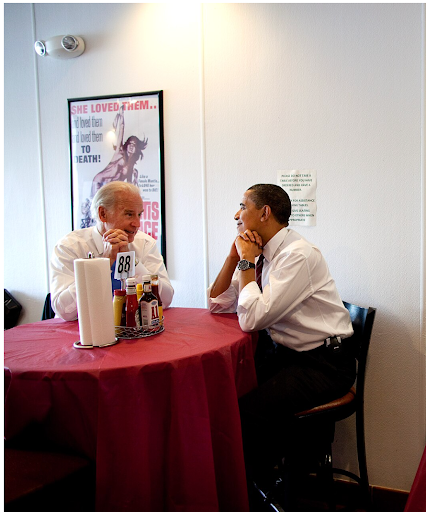
He was a fan of Planter’s trail mix and almonds (a widely circulated myth held that he ate exactly seven almonds a day; he later joked he’d “let himself go” by indulging in ten or eleven). He had genuine affection for D.C.’s spicy, coarsely ground “half-smoke” sausage, a taste he acquired during a January 2009 visit to Ben’s Chili Bowl as president-elect. He loved chili, French fries, and pork chops, and hated mayonnaise, ranch dressing, and M&M’s mixed into trail mix. His aide, Reggie Love, once recalled that Obama meticulously picked out every M&M “like pieces of candy-coated toxic waste” before eating the rest.
Barack Obama and DC Mayor, Adrian Fenty on their impromptu visit to Ben’s Chili Bowl on U Street in Washington, DC (AP News via Youtube)
Obama drew unwanted political criticism more than once for sounding too much like a foodie. A 2007 campaign remark about the price of arugula at Whole Foods was seized on as proof of his elitism and dubbed “Arugula-gate,” and a 2009 burger order with Dijon mustard instead of ketchup at Ray’s Hell Burger in Alexandria, VA drew similar mockery.
The Obamas treated dinner as close to sacred. “At 6:30 we make it a point, that if we’re in town, no matter what the president is doing, we stop what we’re doing,” Michelle Obama told NPR in 2012, “we sit down and have a meal as a family.” The president’s schedule didn’t always cooperate, but the ritual remained a high priority.
The couple also kept a standing Friday date night at Chicago’s Zinfandel restaurant before moving to Washington, always ordering pot roast, Brussels sprouts, and mashed potatoes. Once in the White House, they brought in Sam Kass, their personal cook in Chicago, as their personal chef and food-policy director. Kass specialized in dishes based on vegetables, whole grains, and lean proteins, and he also served as the White House’s food-policy director. Barack Obama reportedly worried at first that “Kass cuisine” might be a little too fancy for his taste, but Michelle wanted their daughters, and Barack, eating real, fresh food instead of the Lunchables, Capri Suns, and the McDonald’s runs that fueled them during his campaign.
Obama was possibly the first president to brew beer at the White House. In January 2011, he bought a home-brewing kit with his own money, and White House chefs Sam Kass and Tafari Campbell—neither with any brewing experience—figured out to make it work after consulting with local homebrew shops and a few knowledgeable staff members. Their first batch, a honey brown ale made with honey harvested from the South Lawn’s brand-new beehive, debuted at Obama’s 2011 Super Bowl party for roughly 200 guests. More varieties followed, and public demand eventually grew loud enough (including a We the People petition that boasted twelve thousand signatures) that the White House shared the honey brown ale recipe in 2012.
One memorable food moment of Obama’s presidency took place in 2016 on a plastic stool in Hanoi, Vietnam, where he sat down for a bowl of bun cha with chef Anthony Bourdain for an episode of the docuseries, Parts Unknown. Before the meal, Ben Rhodes, a top foreign policy advisor, briefed Obama on his host. “His philosophy isn’t that different from yours,” Rhodes later recalled telling him. “If people would just sit down and eat together and understand something about each other, maybe they could figure things out.” It’s a line that sums up how Obama seemed to view food: not just as sustenance, but as useful as any other tool of foreign policy.
President Obama and Anthony Bourdain sharing a beer and a bowl of bun cha at Bún Chả Hương Liên in Hanoi (HBO Max via Youtube)
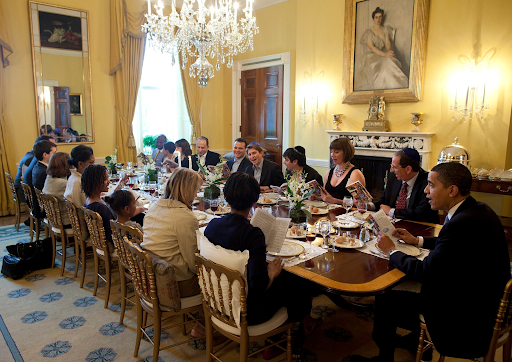
Obama also brought a personal, spiritual dimension to the White House table. Starting in 2009, he began hosting an annual Passover Seder in the residence, leading it himself with the classic Maxwell House Haggadah. Chef and writer Susan Barocas, who helped prepare Sephardic dishes like Moroccan haroset balls and chicken for three of the Seders, later recalled: “I still have chills remembering what it was like to hear from another room the President’s booming voice leading ‘We Shall Overcome’ during the Seder.”
The night before his first inauguration, Obama discussed food policy with New York chef Dan Barber. Obama believed that even incremental change in the food system could have an important impact and that Michelle might be the best ambassador for that issue. She took up the cause enthusiastically and made it personal at an event in Alexandria, Virginia, revealing that a pediatrician had become concerned and suggested looking at their daughters’ body mass index. Days later, in February 2010, she announced “Let’s Move!,” a campaign aimed at ending childhood obesity within a generation, and the president created a task force on the issue the same day. The campaign’s ambitious goal, cutting childhood obesity to five percent by 2030, looks far out of reach, and critics charged that its focus drifted from nutrition reform toward physical activity, a safer subject for the food industry.
Michelle Obama announces the “Let’s Move Campaign”
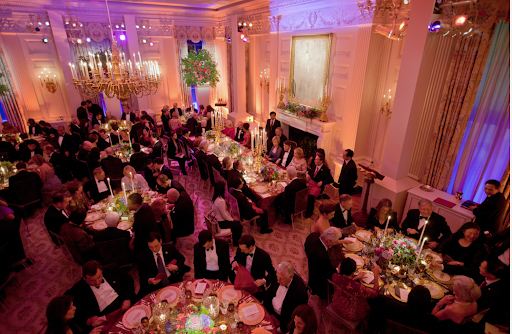
Obama’s first State Dinner (CBS News)
That same instinct for using food as a messenger carried into the formal side of the White House table. Entertaining under the Obamas leaned toward the personal and the accessible, a shift from the more formal state functions of prior administrations. State dinners still happened, and happened often, but they were paired with a genuine effort to open the White House up to a broader cross-section of Americans. Everyday community organizers found themselves seated at the same tables as heads of state. The co-founder of the New York Taxi Workers Alliance was a guest at the first state dinner, and the leaders of three D.C. nonprofits were Michelle’s guests of honor at the dinner for Mexico’s president. A 2011 celebration brought student poets and former U.S. Poet Laureates into the White House to work alongside established writers.
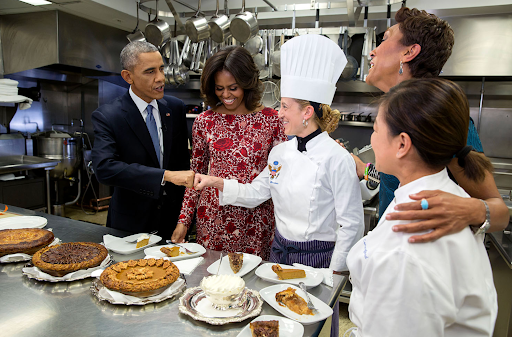
Working closely with Executive Chef Cristeta Comerford, who also served in the George W. Bush administration, Michelle pushed for showcasing “the best of American cuisine” through fresh, sustainable, and regional ingredients, often incorporating produce grown right on the White House grounds (arugula, herbs, and lettuce from the White House Kitchen Garden, and honey from the South Lawn hive) into official state dinner menus. The Obamas regularly brought in guest chefs to collaborate with Comerford on high-profile dinners as part of a broader effort to move away from the classical European style that had dominated formal dining for many other presidents. They wanted White House entertaining to be a genuine reflection of America’s own diversity and creativity at the table.
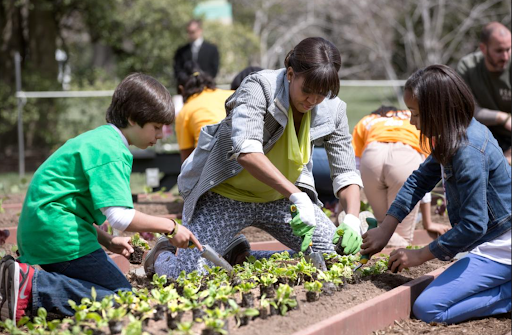
The Kitchen Garden became one of the most visible food-related projects of the Obama White House. It was the first working food garden at the White House since Eleanor Roosevelt’s WWII-era Victory Garden. Twenty-six fifth-graders from a D.C. elementary school helped turn the soil on groundbreaking day, and Michelle joked that the whole project was a scheme to get her daughters to eat more vegetables. The plot started at roughly 1,100 square feet and grew to nearly 2,800 by the end of the administration.
The White House garden eventually was planted in everything from standard kale and Brussels sprouts to heirloom varieties of vegetables tied directly to Thomas Jefferson’s Monticello garden (with one notable exclusion: beets, which the president simply couldn’t stand). A beehive went in the first year, and a dedicated pollinator garden followed in 2014 to support declining bee and monarch butterfly populations. In 2016, Michelle added a walkway, an arbor, and benches built from salvaged wood tied to the estates of Jefferson, Madison, and Martin Luther King Jr. The garden and beehives became a permanent fixture that the Biden and Trump administrations even expanded.
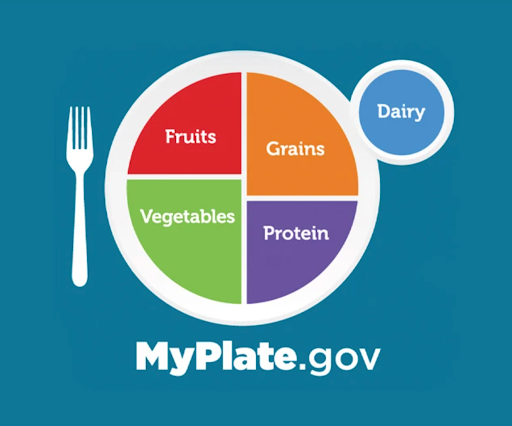
Obama never fully embraced the foodie label, but he clearly took food seriously enough to build policy around it. Obama’s food policy record was one of the most robust of any president:
In the end, Obama himself seemed to sense the limits of what any president could do. Real change would come in inches, not miles. But he spent nearly a decade insisting that the standard he held for his family’s meals—safe, nutritious, real food—should apply to every American’s plate.
One of three dishes Obama can reportedly make—and by his own admission, the one he’s genuinely good at. Straight from the family’s own recipe, since shared publicly as “President Obama’s Chili”: Onion, green pepper, garlic, and ground turkey or beef, simmered with cumin, chili powder, and kidney beans into a simple, homemade classic.
We use cookies to improve your experience on our site. By using our site, you consent to cookies.
Manage your cookie preferences below:
Essential cookies enable basic functions and are necessary for the proper function of the website.
Google reCAPTCHA helps protect websites from spam and abuse by verifying user interactions through challenges.
Statistics cookies collect information anonymously. This information helps us understand how visitors use our website.
Google Analytics is a powerful tool that tracks and analyzes website traffic for informed marketing decisions.
Service URL: policies.google.com (opens in a new window)
Marketing cookies are used to follow visitors to websites. The intention is to show ads that are relevant and engaging to the individual user.
A video-sharing platform for users to upload, view, and share videos across various genres and topics.
Service URL: www.youtube.com (opens in a new window)
You can find more information in our Cookie Policy and Private: Privacy Policy.
Please join our email list to occasionally hear our views on timely issues and learn about The National Food Museum’s progress. We promise we won’t clutter your inbox!