
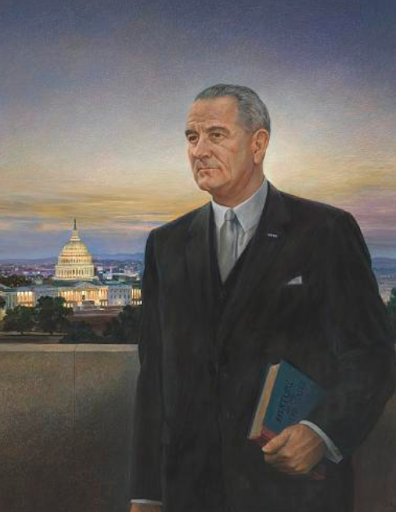
Time in office
November 22, 1963–January 20, 1969
Vital Statistics
Born: August 27, 1908, in Stonewall, Texas
Died: January 22, 1973, at his LBJ Ranch near Johnson City, Texas
Political Affiliation
Democratic Party
First Bite
Lyndon Johnson’s appetite came with its own hardware. President Johnson had a button installed on his Oval Office desk—the “Fresca button”—that summoned a military aide to bring him a fresh can of the diet grapefruit soda on demand.
THE MAIN COURSE
Lyndon B. Johnson’s experience of profound poverty—no electricity, no running water, a small family farm on the Pedernales River outside Stonewall, Texas—never left hiS CONSCIOUSNESS.
His father and grandfather were both Texas politicians, and Lyndon was tagging along to floor debates in Austin by age ten. After teaching at a poor, segregated Mexican-American school in Cotulla, an experience he later cited as foundational to his War on Poverty, he climbed Washington’s power ladder fast: congressional aide, the House, the Senate, Senate Majority Leader, and finally vice president under Kennedy, whose assassination in 1963 landed him in the White House.
Johnson spent the next five years winning passage of an extraordinary series of major laws: the Civil Rights Act, the Voting Rights Act, Medicare, Medicaid, education, environment, consumer. And much of that while the Vietnam War ate the administration alive, with massive public protests and opposition from within the Democratic party ultimately convincing him not to seek reelection in 1968.
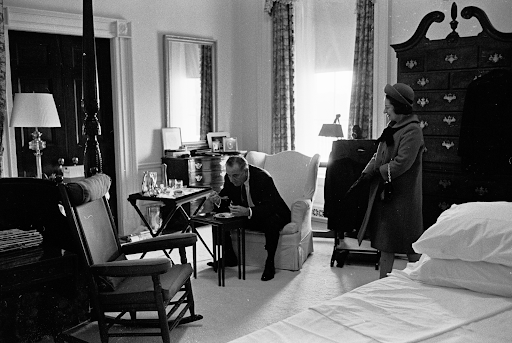
LBJ’s appetite for power was matched by appetite at the table. Johnson favored many foods associated with Texas and the South, including chicken-fried steak, chili, barbecue, and very spicy deer sausage. Chili, though, was non-negotiable. One staffer joked that a week without chili in the Johnson White House was a week wasted. He was also, somewhat surprisingly for a man with such a taste for rich, heavy food, a genuine vegetable lover—he liked his salad and vegetables chopped fine enough to eat with a spoon, mostly because he ate everything fast, a man with too little time and too much on his plate, literally and figuratively. His manners could be notoriously loose. Former Texas Governor John Connally recalled that Johnson would simply reach over and eat off the plate of whoever was sitting next to him if he liked what he saw there. And he had a major sweet tooth––coconut cream pie, banana pudding, German chocolate cake, peach cobbler—the general rule being that if it was sweet, it was fair game.
By the time he reached the White House, though, Johnson was technically supposed to be eating a much healthier diet. A serious heart attack in 1955, suffered while he was Senate Majority Leader, had put him on a strict diet, doctor’s orders: Half a melon, hot tea, and grilled lean steak for breakfast; bouillon, grilled fish, and herb-flavored string beans for lunch; and, for dinner, unsweetened fruit, a low-calorie cheese soufflé, and a green salad with grated carrot, capped off with a “pie” made almost entirely of diet substitutes. Vegetables weren’t really the problem. By most accounts, he genuinely loved them, going so far as shipping okra up from his Texas ranch so the White House kitchen could pickle it, and keeping spinach soufflé in regular rotation. As president, he sometimes treated the restriction more as a suggestion than a rule. At receptions he might sneak snack mixes and fried shrimp behind first lady Lady Bird’s back, prompting her well-documented exasperation.
The Johnsons’ longtime cook was Zephyr Wright, a native Texan and African American, capable of moving seamlessly from corn pone to chocolate soufflé and, per Chief Usher J.B. West, was the undisputed “queen of the kitchen on the second floor.” She had been with the family since 1942, when Lady Bird hired her straight out of Wiley College. She had driven the segregated highways of the Jim Crow South with the Johnsons more than once, and refused to do it again after a trip where she was barred from restaurants and restrooms along the way. Johnson carried those stories with him and leaned on them in building support for the Civil Rights Act of 1964. He even gave her one of the pens he used to sign that landmark legislation, telling her she deserved it more than anyone else. The two of them traded barbs and gossip like old friends—she needled him about his sleep schedule, and he asked her opinion on his latest legislative initiatives.
That closeness once emboldened Wright to leave a note under her boss’s plate: “Mr. President, you have been my boss for a number of years and you always tell me you want to lose weight, and yet you never do much to help yourself. Now I am going to be your boss for a change. Eat what I put in front of you, and don’t ask for more and don’t complain.” It is unclear to what extent she succeeded. In his book, The President’s Kitchen Cabinet, Adrian Miller reports that “Johnson broke [the low-fat diet] whenever he could.”

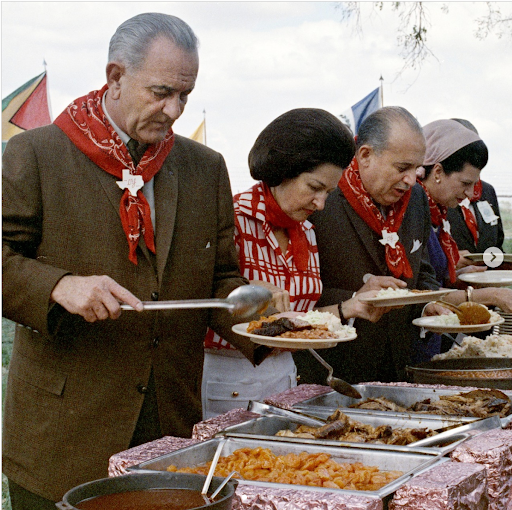
The Johnsons entertained differently than their predecessors—less formal and considerably warmer. Lady Bird’s receiving lines famously ran long because she genuinely wanted to talk to people. They kept the Kennedy-era four-course format––soup or fish, entrée, salad and cheese, dessert—and stayed behind after dinners to mingle, leaving guests with the sense that the White House “seemed like a real home.” At the LBJ Ranch, entertaining meant something else entirely: full-scale barbecues, officiated at least once by Fort Worth’s self-styled “Barbecue King,” Walter Jetton, that fed foreign heads of state deer sausage and spare ribs under the Hill Country sky. That form of relation-building was dubbed at the time “barbecue diplomacy.”
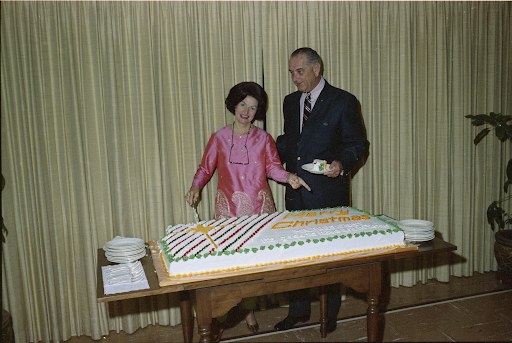
The Johnson daughters brought some of the biggest entertainment moments of the whole administration. Lynda Bird married Marine Captain Charles Robb in the East Room on December 9, 1967, in a ceremony timed so the couple could have time together before Robb shipped out to Vietnam. Some 500 guests, including Alice Roosevelt Longworth (President Theodore Roosevelt’s daughter, who famously said, “If you can’t say something good about someone, sit right here by me.”), stayed after the ceremony for champagne, cake, and dancing.
Lynda Bird’s younger sister Luci had married the year before at the National Shrine of the Immaculate Conception, with the reception held back at the White House for 700 guests. Between the two events, executive chef Henry Haller found himself producing wedding cakes and full receptions worthy of, as CBS News later put it, “America’s closest thing to a royal wedding.” That was a considerably more glamorous use of the White House kitchen than deer sausage and Fresca.

The same impoverished childhood that shaped Johnson’s tastes also influenced his food policy, even if ifood never became his signature issue. He caught a bit of good timing along the way: Communist countries had begun buying American feed grains in bulk just as the broader U.S. economy rebounded, easing pressure on farm policy generally. Some of Johnson’s achievements included:
- In 1964, he signed the Food Stamp Act, making the federal food-stamp program permanent and expanding access to food assistance for low-income Americans. More than half a million people enrolled at the outset, and enrollment jumped from roughly two million to eleven million between 1968 and 1971. In 2026 the renamed Supplemental Nutrition Assistance Program helps support over thirty million people and has an annual budget of about $100 billion.
- He paired the bill with an agricultural subsidy measure specifically to win over reluctant farm-state legislators, building a coalition between urban anti-poverty interests (mostly Democrats) and rural farm interests (mostly Republicans) that later analysts credit with making both programs unusually hard to shrink or dismantle. That coalition remains alive to this day.
- In 1965, he signed the Food and Agriculture Act, which aimed to guarantee farmers a fair income, keep consumer food costs low, and wind down costly government-held surpluses. It also established a National Advisory Commission on Food and Fiber to study long-range agricultural policy. The 1965 law helped move farm policy from annual crises to longer-term planning.
- 1965 also saw expansions of the National School Lunch Program and the Food for Peace Program as part of the broader Great Society push, with school-lunch provisions structured to give farmers an outlet for surplus dairy and grain.
- Despite growing up on a farm and later owning a ranch, he delivered no major agricultural policy address during his 1964 campaign, largely continuing Kennedy-era voluntary acreage-reduction programs rather than pursuing mandatory controls.
Johnson never lost the appetite of the boy who had once gone without: for food, for power, for accomplishment, all of it consumed fast and without much patience or restraint. That same hunger that filled his plate with chicken fried steak and secretly smuggled shrimp also drove some of the most consequential food policy of the century: food stamps made permanent, school lunches expanded, a farm-and-poverty coalition built to outlast him.
Try it at home
Pedernales River Chili
Straight from the LBJ Ranch, no beans, no nonsense.