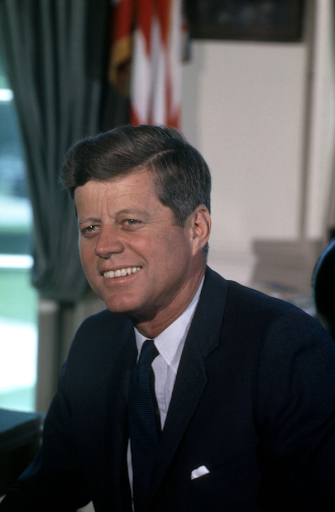
Time in office
January 20, 1961–November 22, 1963
Vital Statistics
Born: May 29, 1917, in Brookline, Massachusetts
Died: assassinated November 22, 1963, in Dallas, Texas
Political Affiliation
Democratic Party
First Bite
Boston’s oldest restaurant, the Union Oyster House, kept a permanent table reserved for President Kennedy—Table 18, just in case he dropped by. Now, that table is blocked off from seating completely on November 22nd—the anniversary of his assassination—when the eatery places a single white rose on the table.
THE MAIN COURSE
There’s a real gap between what the Kennedy White House ate and what the Kennedy White House served, and almost nothing captures the Kennedy presidency better than that gap.
Jack Kennedy himself was, by most accounts, a small eater with simple tastes—a preference that may have been shaped as much by complicated chronic illnesses as by personal preference. He managed Addison’s disease with the help of medications and a careful, high-sodium diet. He also had persistent, unexplained gastrointestinal problems that limited his ability to tolerate much in the way of rich or heavily processed food.
His breakfast was pretty constant: a large glass of orange juice, toast with jam, two soft-boiled eggs, broiled bacon, and coffee with cream and sugar. Lunch, more often than not, meant soup—chef Rene Verdon once noted that whatever was on the menu, Kennedy always wanted soup alongside it—with New England fish chowder a particular favorite tying back to his Boston roots. He kept a standing reservation, Table 18, at Boston’s Union Oyster House, which bills itself as the oldest continuously operating restaurant in the country. Booth 3 at Martin’s Tavern in Washington is similarly famous for being where Jack proposed to Jacqueline Bouvier. And, as a practicing Catholic, Jack stayed devoted to fish on Fridays. Steak, when he ordered it, came unadorned: no sauces, just peas, carrots, and mashed potatoes. Politics, by most accounts, interested him far more than food, and aides often had to remind him it was mealtime.

JFK eating an ice cream cone in September 1963
(JFK Presidential Library and Museum)
Jacqueline Kennedy had an entirely different kitchen philosophy, and she quickly transformed the White House table. She recruited chef Rene Verdon away from New York’s Carlyle Hotel specifically to bring French cooking to state dinners, a move that landed as an instant sensation and drew comparisons to Dolley Madison for sheer entertaining flair and to Thomas Jefferson for seriousness about food and wine. Verdon’s own philosophy was simple: “If the ingredients are superb, then the cooking can be, and must be, simple.” It was elegant restraint dressed up as French sophistication. Jackie also streamlined the format itself, shifting state dinners to four courses instead of the usual sprawling multi-course affairs, both to cut down on waste and to get guests mingling faster, seated at round tables designed to encourage exactly that kind of interaction. Even the optics were carefully managed: California wines appeared prominently on official menus for the sake of appearances, while the president reportedly preferred some imported wines for his own consumption.

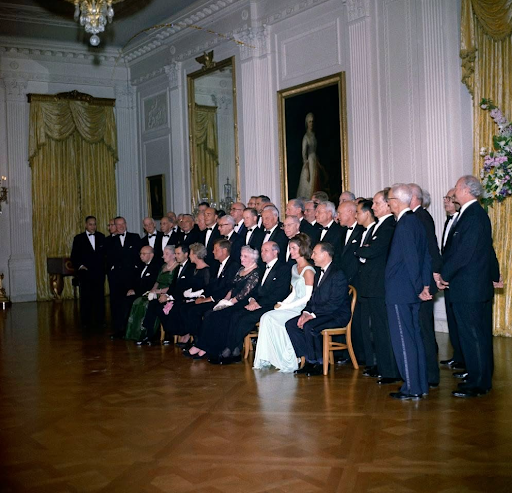
Entertaining under the Kennedys had a genuinely different energy than anything Washington had seen before—looser, younger, and considerably more glamorous. Formal receiving lines gave way to actual dancing, the Twist included. Jacqueline, who was all of thirty-one years old, wanted only the best, turning White House dinners into showcases for world-class performing arts, bringing in the Metropolitan Opera, the American Ballet Theater, and Shakespeare festival companies.
As explained by the JFK Library and Museum, she once persuaded legendary cellist Pablo Casals to break a decades-long self-imposed boycott of performing in the United States, convincing him to play at a 1961 dinner honoring the Governor of Puerto Rico. Similarly, a 1962 dinner for French Minister of Culture André Malraux, born out of a friendship with the Kennedys that had formed during a Paris visit the year before, yielded a spectacular gift to Americans: Malraux privately promised to send the Mona Lisa to the National Gallery of Art in Washington.
The single most celebrated event of the administration was the so-called “Brains Dinner,” an April 1962 gathering of 49 Nobel Prize winners from across the Western Hemisphere. A menu featuring seafood mousse and beef Wellington exemplified Jackie’s style. Kennedy himself called it the most extraordinary collection of talent ever assembled at the White House—“with the possible exception of when Thomas Jefferson dined alone.”
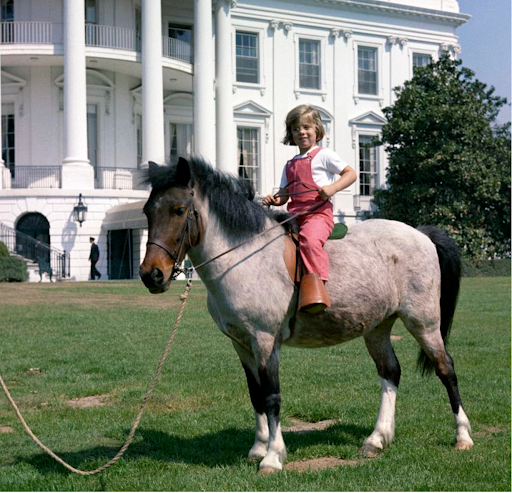
Behind all the glamour, the Kennedys were still raising two young children in the White House: Caroline and John Jr. (A third, Patrick, died just two days after his birth in 1963.) Caroline kept a pony named Macaroni on the grounds, a gift that became something of a minor media fixture—one of many small domestic details that coexisted alongside the formal state dinners and Nobel laureates.
Kennedy came from a wealthy Boston stockbroker’s family with about as little firsthand agricultural experience as any candidate in history, yet he declared falling farm income “the number-one domestic problem in the United States” during his 1960 campaign, promising full parity income for farmers through mandatory supply management—a sharp contrast to opponent Richard Nixon’s preference for letting free markets sort out the farm surplus on their own. Many farm-belt voters went for Nixon anyway. Historians generally credit Kennedy’s narrow overall win to his youthful charisma, the economy, religion, and other factors. Once in office, his administration moved fast on several fronts:
- He revived the Food Stamp Program by executive order within a month of taking office, launching it as a pilot initiative to aid low-income Americans.
- He enacted the 1961 Feed Grain Program, paying farmers to voluntarily pull twenty to forty percent of their acreage out of corn, barley, and sorghum production in exchange for a guaranteed income. It pulled twenty-six million acres out of production and boosted farm income by a billion dollars, though it fell short of its original production-cut target.
- He pushed a stronger 1962 plan for mandatory acreage and marketing controls through Congress. However, wheat farmers rejected it in a 1963 referendum, choosing lower support levels over federal control of their planting decisions—a telling sign that even farmers eager for government help weren’t necessarily willing to accept government oversight in exchange for it.
- He suspended Cuba’s sugar import quota amid Cold War tensions.
Kennedy’s most lasting food legacy, though, was arguably international rather than domestic:
- He inherited the “Food for Peace” program Eisenhower had started two years earlier, but transformed the office from a quiet surplus-disposal program into a genuine centerpiece of American foreign policy. He expanded the program with several billion new dollars. He appointed George McGovern (later a senator from South Dakota) to run it and directed him to use American “agricultural abundance” to fight malnutrition abroad.
- Just five days into his presidency, he announced a famine relief program for the Congo at his very first televised press conference.
- Under his watch, the United Nations founded the still-active World Food Programme in 1961. As the world’s largest humanitarian anti-hunger program, it won the Nobel Peace Prize in 2020.
- In a June 1963 address, he he sought to inspire other countries to join the fight against hunger when he told the UN’s World Food Congress that humanity finally possessed the means to eliminate hunger worldwide, lacking only the collective will to do it.
His assassination that November cut short ongoing efforts to resolve chronic agricultural overproduction and rural decline at home, even as the food program he had reenergized went on to grow into a nearly $2 billion global effort within just a few years of his death.
Kennedy’s own table was never the point of his presidency, and it shows—history remembers his wife’s French chefs and Nobel dinners far more vividly than anything the president himself actually chose to eat. But food, in the broader sense, was a major Kennedy priority. It shaped how America positioned itself abroad, how it tried to manage a struggling farm economy at home, and how a young, image-conscious White House chose to present itself to the world. Kennedy himself never needed much more than soup and a soft-boiled egg. The rest of the country, and a good part of the world beyond it, got something considerably richer.
Try it at home
New England Fish Chowder
Kennedy’s favorite meal and a direct tie to his Boston roots...and about as far from Chef Verdon’s French sophistication as a White House meal ever got.