

Time in office
January 20, 1953–January 20, 1961
Vital Statistics
Born: October 14, 1890, in Denison, Texas
Died: March 28, 1969, in Washington, DC
Political Affiliation
Republican Party
First Bite
Dwight D. Eisenhower’s recipe for vegetable soup, calling for a peppery garnish of nasturtium stems, was so beloved that when he was president of Columbia University he contributed it to a student cookbook. When that was pubicized, grocery stores around the country were soon beleaguered with requests for the stems.
THE MAIN COURSE
In December 1943, Dwight D. Eisenhower was appointed Supreme Commander of the Allied Expeditionary Force, tasked with planning and executing the D-Day invasion and overseeing all Allied military operations in Western Europe.
That was the role history remembers him for above all else—but in some quarters, he’s remembered just as fondly for something else entirely.
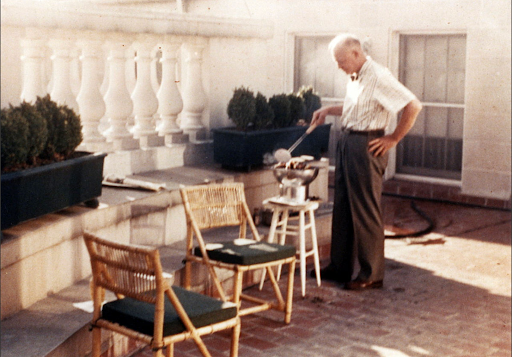
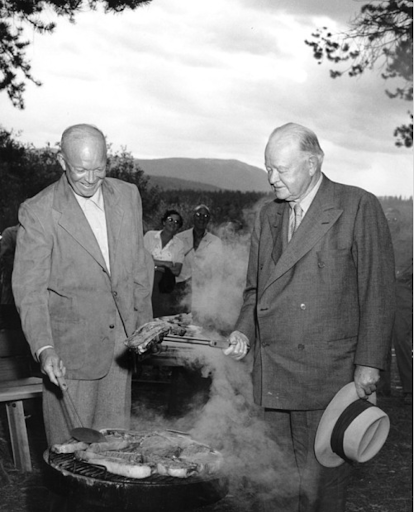
Eisenhower might have been the closest thing the White House has ever had to an actual chef-in-residence. Ike genuinely loved cooking, and he was good at it. He was not a gourmet by his own admission, but a serious, accomplished home cook who credited his mother with insisting all her sons learn to cook, sew, and manage a household growing up in Kansas. “Cooking gave me a creative feeling,” he said once, and he meant it: He flipped his own pancakes, mixing the batter the night before so it could rest until morning. He even kept a charcoal grill on the roof, just outside the solarium, firing it up whenever needed. And he maintained his own recipe collection, organized alphabetically by type, and pasted into his personal cookbook. Sometimes he credited the friend who’d passed a dish along and sometimes not. The largest category, tellingly, was meat.
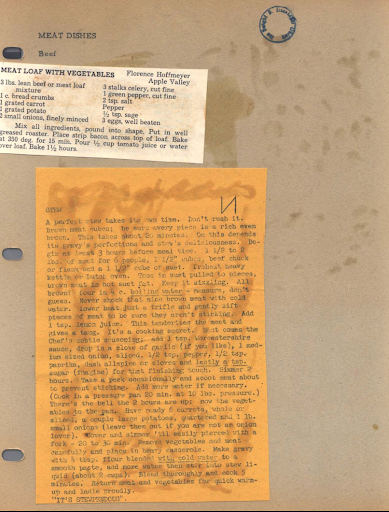
A page from the “Meat Dishes” section of Eisenhower’s cookbook. Here, he describes his recipe for beef stew as, “STEWPENDOUS.”
(The Dwight D. Eisenhower Presidential Library and Museum)
Ike was an avid outdoorsman, and it showed up directly on the table: He hunted his own game birds, so quail and other fowl turned up regularly at White House meals, and he fished often enough that fresh trout became a household staple. A friend who ranched in Kansas kept the family supplied with fresh steak, which Eisenhower was more than happy to cook himself. His farm-boy competence occasionally caught even his own soldiers off guard. One wartime story has been oft repeated by biographers and cited in The New York Times: A cow was “captured” and a group of mess-hall men fumbled to milk it, only for the general himself to walk over, sit down, and fill an entire bucket in minutes flat. “You city slickers have a lot to learn,” he reportedly told them.
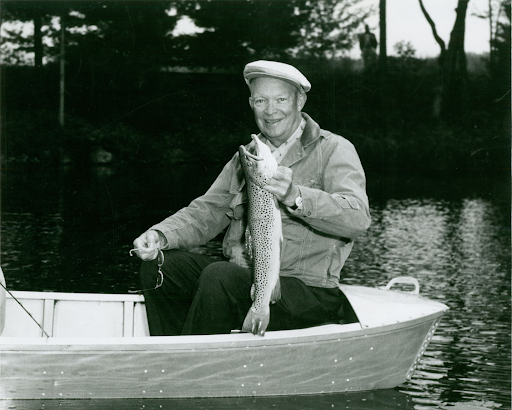
His culinary preferences included international as well as Kansas standards. Cream of artichoke soup and boeuf à la mode became favorites after years spent dining with friends in London and Paris, and the family developed a genuine fondness for Chinese food that stuck with them through his presidency. He never lost his taste for comfort foods, specifically requesting succotash from the White House kitchen as a reminder of his childhood. Onions and garlic were personal staples he reached for constantly, much to the irritation of the first lady, Mamie, who couldn’t stand either one. He frequently downed a couple of whiskeys in the evening and had a poured heavy cream generously over many desserts. However, that indulgence didn’t last forever. After a 1955 heart attack, Eisenhower was put on a stricter, lighter diet, which required a big adjustment for a man who had spent a lifetime as an unapologetic meat-eater.
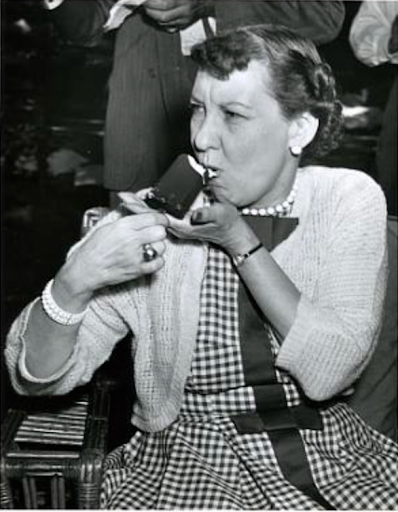
Mamie, for her part, arrived in the marriage little ability to cook. She later recalled that growing up, “the cook would not allow us in the kitchen, so I never had any kitchen experience.” Married to a man who genuinely loved to cook, she nonetheless built her own small, well-loved repertoire of dishes over the years,. The top of the list included Frosted Mint Delight (pineapple and mint-flavored apple jelly cut with whipped cream), a deep-dish apple pie, sugar cookies, and a fudge so good it earned the nickname “Million Dollar Fudge.” She also ran the household with real thrift, quietly ordering that all leftovers be saved and reworked into “one-pot wonders,” a directive that reportedly surprised White House staff.
Entertaining under the Eisenhowers took a notably more intimate turn than in many previous administrations. Starting in 1953, Ike began hosting small, closely guarded “stag dinners.” Guest lists ran to around fifteen at a time, drawn from politics, journalism, academia, religion, and the arts, with invitations that couldn’t be bought. By April 1955, he had hosted 749 people at these dinners, and the format proved so effective that guests genuinely felt they had the president’s ear.
At the same time, Eisenhower made a point of meeting every member of Congress through what he called “knife and fork meetings.” He ultimately dined with all but four of 567 senators and representatives who held office in Ike’s eight White House years. It was another instance of a president using food as a tool of gentle persuasion—not abroad this time, in furtherance of foreign policy, but right at home, spending one dinner at a time with the allies and opponents he needed to court or cajole. After Eisenhower’s 1955 heart attack and a stroke two years later, the pace of entertaining shifted from exhausting dinners toward gentler luncheons.
Mamie, meanwhile, threw herself into the more festive side of hosting, reviving the White House Easter Egg Roll after a wartime hiatus and once throwing a Halloween party for the wives of White House staff members that guests remembered as one of the liveliest, most unexpectedly fun events the mansion had ever seen.
Eisenhower had a deep connection to the land, and it wasn’t a retirement afterthought. He had written to Mamie as early as 1943, in the middle of the war, that he dreamed of “a little place far away from cities.” And when the couple finally bought a 189-acre farm near Gettysburg, Pennsylvania, it came with a barn, farm machinery, about 25 Holstein cows, a dozen heifers, and 500 White Leghorn chickens. He took the operation seriously, devoting attention to restoring the soil, with an explicit personal goal to “leave the place better than I found it.” He often cooked for family and friends on the farm, closing the loop between his hands-on love of food and his hands-on love of the land.
That same instinct shaped some of the more consequential food policy of his presidency. As Eisenhower once said, “Without a prosperous agriculture, there is no prosperity in America.” In 1954, Eisenhower signed the Agricultural Trade Development and Assistance Act, better known as P.L. 480 and Food for Peace. That program shipped America’s massive postwar grain surpluses abroad through low-interest credit and donations. The official goals were ambitious—expanding foreign trade, stabilizing American agriculture, and using surplus commodities as a tool of foreign policy.
Eisenhower himself framed the effort in sweeping and altruistic terms, calling America’s fight against world hunger a “genuinely noble war,” insisting that “food, family, friendship, and freedom” were weapons “mightier than bombs.” But a big part of the motivation was more mundane. The government was spending millions of dollars a year just storing grain that was, in some cases, rotting away in silos. Eisenhower coined the “Food for Peace” name in the late 1950s. Whatever the motives behind it, by the early 1960s the program actually moved five million tons of grain to more than fifty countries. Food aid accounted for roughly a third of all U.S. agricultural exports.
Domestically, the food policy picture was messier. Ike’s Agriculture Secretary, Ezra Taft Benson, pushed hard to dismantle the costly price-support system for grains left over from the Depression. He argued it only encouraged farmers to keep overproducing since the government would buy up whatever surplus resulted. It was a bold position for a Republican farm-state cabinet secretary to take, and it made Benson deeply unpopular. Congress, including many farm-state Republicans, opposed him, and Eisenhower spent much of his presidency vetoing farm bills that tried to keep supports fixed high, pushing instead for a more flexible, sliding-scale system. But he ultimately lost the larger fight against his own party. In that context, Food for Peace aid therefore served two purposes: providing food overseas while creating an outlet for some of America’s agricultural surpluses.”
Eisenhower was more successful on other fronts. In August 1954, the Watershed Protection and Flood Prevention Act quietly funded conservation work in farm communities across the country, channeling technical and financial help through the Soil Conservation Service to local watershed groups that otherwise had nowhere to turn. The 1955 Rural Development Program, meanwhile, provided additional assistance to low-income rural residents and farmers who had benefited less from traditional farm-support programs. And the Soil Bank program, which Eisenhower supported, became an important example of using payments to encourage farmers to take land out of production. Backing an incentive program avoided a legislative brawl, and it worked well enough that it became a model for land-retirement programs decades later.
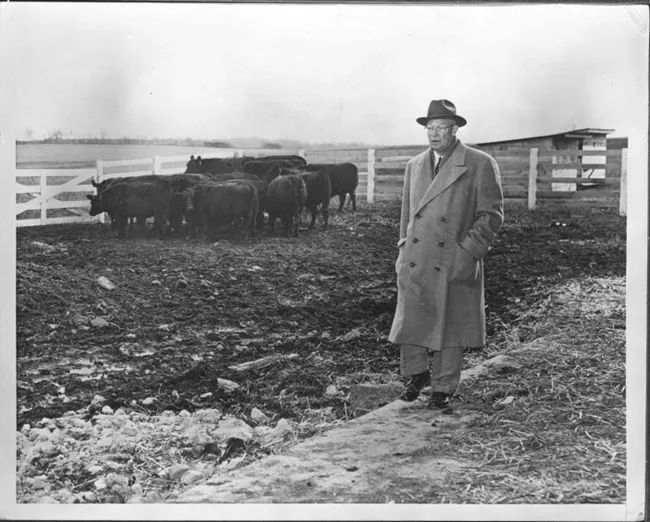
President Eisenhower with a show herd of black Angus cattle on his Gettysburg farm.
(National Park Service)
As Eisenhower himself once put it, with characteristic bluntness, “Farming looks mighty easy when your plow is a pencil and you’re a thousand miles from the cornfield.” It was a fair claim, coming from a man who’d actually walked behind a plow himself. He left office in 1961 and headed straight for the Gettysburg farm he had been dreaming about since the War where he was finally free to raise Angus cattle, cook, and paint at his own pace.
Try it at home
Ike’s Two-Day Vegetable Soup
Slow-built and deeply savory, this was Eisenhower’s signature dish and arguably the most famous recipe ever to come out of a sitting president’s own kitchen. Garnish with nasturtium stems if you’re feeling especially presidential, and if they happen to be in season.