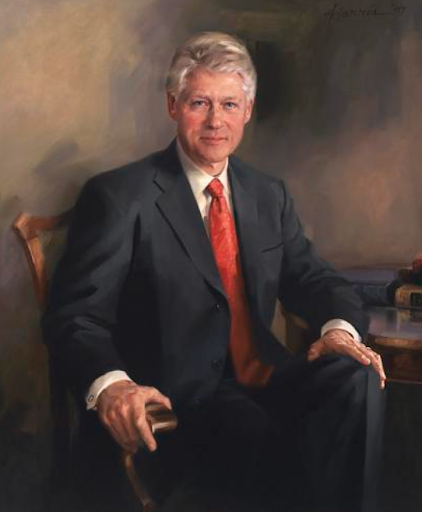

January 20, 1993–January 20, 2001
Born: August 19, 1946, in Hope, Arkansas
Currently: Living in Chappaqua, New York
Democratic Party
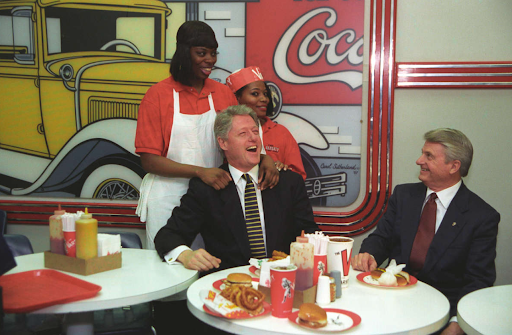
Bill Clinton’s fast-food habit was famous enough by 1992 that Saturday Night Live built a whole sketch around it: Actor Phil Hartman’s Clinton jogs into a McDonald’s mid-campaign, grabbing fries off strangers’ trays between policy talking points. Funny at the time, but in hindsight, not so funny given the quadruple bypass operation he underwent after he left office.
He preferred heavy, fatty, and meat-forward meals, squarely typical of his generation and his Arkansas upbringing. Fried chicken, roast beef sandwiches, jalapeño cheeseburgers loaded with the works, chili con queso so delicious that a restaurateur called it “addictive,” and cinnamon rolls “nearly as big as hubcaps. He loved barbecue, tamales and French fries, two-pound steaks and greasy cheeseburgers at Doe’s Eat Place in Little Rock, Arkansas, and an Egg McMuffin from McDonald’s whenever he wasn’t actively dieting. Vegetables?—not so much.
One of his all-time favorites was enchiladas stuffed with chicken, cheese, and a homemade enchilada sauce. Cherry pie ranked among his favorite desserts, so much so that during the darkest days of the Monica Lewinsky scandal, his daughter Chelsea took up baking as a coping mechanism and made him one herself. His wife Hillary summed up his relationship with food before her own intervention began: “He loves to eat, even when things are not always right for him.
Clinton’s relationship to food eventually became a genuine health crisis, but the first effort to rein it in came early in his presidency. With Hillary’s backing, the White House brought in physician Dean Ornish, famous for reversing heart disease through diet and lifestyle, to help the kitchen shift toward lower-fat menus built around fruits, vegetables, and whole grains. Not everyone adapted. In 1994, executive chef Pierre Chambrin, a classically trained French cook who had clashed with the First Lady over the menu, resigned along with three other kitchen staffers.
The new chef, Walter Scheib, was hired away from West Virginia’s Greenbrier resort in April 1994 after a national search overseen by Hillary herself, who wanted the White House to serve distinctly American food after decades of French cooking dating to the Kennedy years. Scheib’s style emphasized regional American and ethnic flavors. Clinton, for his part, developed an unusually casual rapport with kitchen staff. Sous chef Marti Mongiello recalled the president dropping by to chat, which made Mongiello nervous at first but which he came to enjoy.
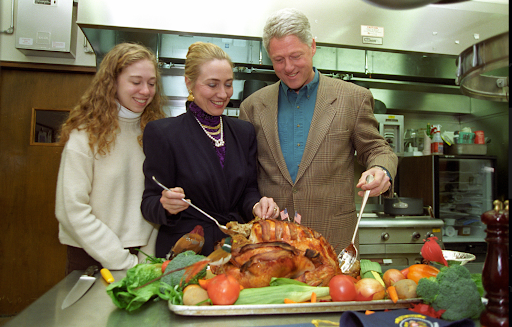
But even that dietary overhaul wasn’t enough. In 2004, Clinton underwent quadruple bypass surgery. When one of the bypass grafts clogged in 2010, requiring two stents, he adopted a largely vegan diet. (Though he later acknowledged that he still allowed himself an omelet or a piece of salmon about once a week.) Chelsea was pulled into the same orbit, so impressed by the new White House chef’s health-focused cooking that she asked for cooking lessons and for a decade became a vegetarian.
In 2026, Ornish observed, “After his bypass surgery, he became much more committed to following the diet that my colleagues and I proved could often reverse the progression of even severe coronary heart disease. I am grateful that he continues to do well today. Whatever your politics, when a President of the United States decides to eat more healthfully, it sets a great example for everyone—especially one who was previously known for jogging to McDonald’s.”
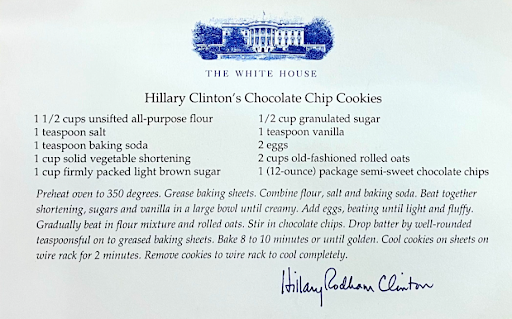
Hillary had her own memorable brush with food politics during the 1992 campaign, and it nearly became a liability. Asked to defend her legal career against critics who thought a future first lady should behave more traditionally, she famously snapped back, “I suppose I could have stayed home and baked cookies and had teas, but what I decided to do was to fulfill my profession.” The remark set off a public backlash, with critics accusing her of disrespecting stay-at-home mothers. Family Circle magazine responded by launching what became the First Lady Bake-off, pitting Hillary’s oatmeal chocolate chip cookie recipe against Barbara Bush’s (President George H.W. Bush’s wife) classic chocolate chip cookies in a national reader poll. Hillary’s recipe narrowly beat Barbara Bush’s by a 52 to 48 percent vote by readers.
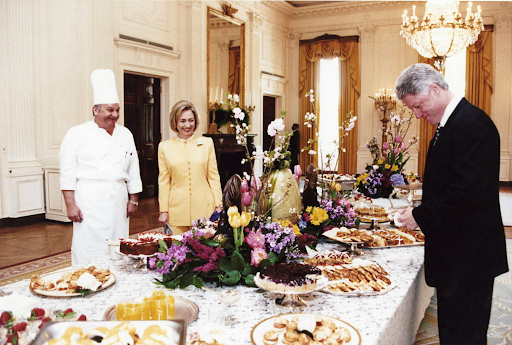
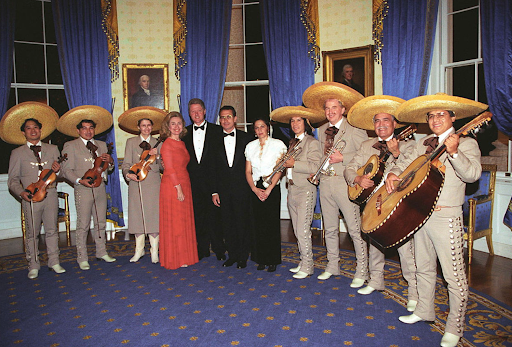
Entertaining under the Clintons ran famously big. They hosted weekly receptions, with themes that included an Eastern Shore (Maryland) cookout, a New Orleans jazz celebration, and a congressional luau, just to name a few. The receptions often drew 200 to 400 guests at a time, utilizing the South Lawn whenever the weather allowed. Chef Scheib’s range stretched from intimate rooftop parties to state dinners for up to 700 people and holiday menus serving several thousand. The dinner honoring Nelson Mandela stood out as one of the most anticipated events of the entire eight-year administration, and the White House’s Millennium New Year’s Eve celebration reportedly kept Scheib awake orchestrating food for twenty-nine consecutive hours. State dinners leaned hard into the honored country’s own cuisine while still spotlighting American ingredients: A 1995 dinner for Mexican President Zedillo featured a sweet corn and tequila ice cream mold, along with a live mariachi band.
Even the White House grounds got a culinary upgrade. Frustrated with inconsistent produce from outside suppliers, Scheib planted a rooftop vegetable garden growing tomatoes, squash, cucumbers, and herbs for the family’s private meals. He utilized local farms and co-ops to source produce for larger events.
John Moeller, a White House chef for over a dozen years in the 1990s and early 2000s, wrote Dining at the White House, a book that provides the best view into the nuts-and-bolts operations of the kitchens and the rapport between presidents and kitchen staff. He describes everything from how the small staff prepared state dinners for hundreds of guests to the pleasures of working with Chelsea, who was both an enthusiastic cooking student and the model of graciousness. Because the largest room in the White House seats only about two hundred and twenty-five people, he says that hosting any larger group means setting up tents on the White House lawn. He would have welcomed having a much larger, indoor facility.
Clinton’s food and agriculture policy was extensive, touching farm support, trade, and food safety:
Clinton’s most striking food-policy moment, though, came years after he left office. In 2008, addressing a United Nations gathering on the global food crisis, he openly criticized his own administration’s approach. He admitted, “We all blew it, including me when I was president,” for treating food crops as pure commodities rather than as a vital right of the world’s poor. He faulted the World Bank and the International Monetary Fund (IMF) for pressuring poor countries, particularly in Africa, to cut subsidies for fertilizer and seed, which undermined their ability to feed themselves. It was a rare, blunt admission of error by a former president.
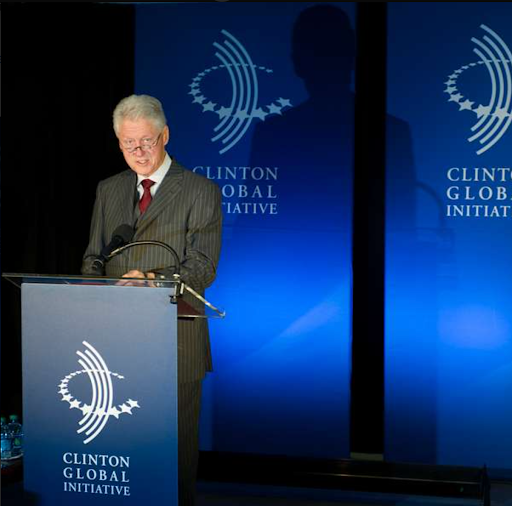
Clinton left office in January 2001 having weathered impeachment, an economic boom, and a personal health challenge that persuaded the junk-food eater to radically improve his diet. Post-presidency, he built the Clinton Foundation and Clinton Global Initiative, channeling much of his energy and resources into global health and disaster relief work, often working alongside former presidents George H.W. Bush and George W. Bush.
One of Clinton’s favorites from his omnivorous days: Shredded cooked chicken is folded into sour cream and grated cheddar, rolled into tortillas, and smothered in a slow-simmered tomato and green chile sauce. This hearty, cheesy comfort food comes straight from an official White House recipe card.
We use cookies to improve your experience on our site. By using our site, you consent to cookies.
Manage your cookie preferences below:
Essential cookies enable basic functions and are necessary for the proper function of the website.
Google reCAPTCHA helps protect websites from spam and abuse by verifying user interactions through challenges.
Statistics cookies collect information anonymously. This information helps us understand how visitors use our website.
Google Analytics is a powerful tool that tracks and analyzes website traffic for informed marketing decisions.
Service URL: policies.google.com (opens in a new window)
Marketing cookies are used to follow visitors to websites. The intention is to show ads that are relevant and engaging to the individual user.
A video-sharing platform for users to upload, view, and share videos across various genres and topics.
Service URL: www.youtube.com (opens in a new window)
You can find more information in our Cookie Policy and Private: Privacy Policy.
Please join our email list to occasionally hear our views on timely issues and learn about The National Food Museum’s progress. We promise we won’t clutter your inbox!