
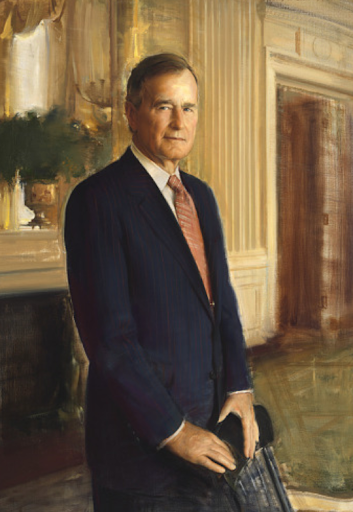
Time in office
January 20, 1989–January 20, 1993
Vital Statistics
Born: June 12, 1924 in Milton, Massachusetts
Died: November 30, 2018 in Houston, Texas
Political Affiliation
Republican Party
First Bite
At his father’s funeral, George W. Bush brought up his father’s hatred of broccoli in the eulogy—a joke that outlived the presidency by thirty years and counting.
THE MAIN COURSE
George H. W. Bush was a Greenwich-raised, Yale-educated oilman who governed like he was hoping nobody would notice either credential.
He wasn’t a man of elaborate meals—he was a snacker, and his food habits became part of his carefully cultivated image as an ordinary American. On the trail, he talked up pork rinds with Tabasco as his go-to snack, and the country bought it completely: Pork rind sales jumped eleven percent. That echoed the boost William Henry Harrison got from touting hard cider and squirrel burgoo a century-and-a-half earlier. Bush gave jerky the same treatment. At home, the simplicity held up just as well—he crushed Butterfinger bars over his morning cereal, or just had cereal for dinner, full stop.
Whether all this folksiness was real or staged depended on the day. The pork rinds and jerky had campaign fingerprints all over them—the kind of detail a strategist plants on purpose. But some of his dietary preferences were clearly genuine. Decades after leaving office, he had a friend smuggle a steak from Morton’s into his hospital room, with no cameras and no audience left to perform for. And the Bush family’s hundred-plus visits to Peking Gourmet Inn in Falls Church, Virginia, read like pure habit, not spin. The restaurant kept a table permanently reserved for them, eventually adding bulletproof glass at the Secret Service’s request.
Then there was broccoli, which Bush truly hated, and which the country would not let him quietly retire it from his plate. In March 1990, U.S. News & World Report broke the “explosive” news that broccoli had been banned from Air Force One. California’s growers—who supplied roughly 90 percent of the country’s broccoli—did not sit around. They organized a ten-ton broccoli convoy and sent it rolling toward the White House. While the trucks were already en route, a reporter caught up with Bush and asked him point blank about it. Cornered, he dropped the act entirely: “I do not like broccoli. And I haven’t liked it since I was a little kid, and my mother made me eat it. And I’m President of the United States, and I’m not going to eat any more broccoli.” Barbara accepted the shipment on his behalf, and the ten tons eventually went to the Capital Area Food Bank. Not a single floret made it to his plate. Bush kept the bit going for most of his term, and the country never let him live it down, no matter how many times he tried to laugh it off.
Bush’s image took a rougher hit at a state dinner in Tokyo in January 1992, when he collapsed mid-course, vomited into the lap of his host, Japanese Prime Minister Kiichi Miyazawa, and passed out. It was just a stomach flu—but the cameras were rolling, and the footage circulated for years. The incident was so widely discussed in Japan that reports at the time said a slang term, bushuru (meaning “to vomit”), has outlived nearly every other memory of the trip.
Here’s the real punchline, though: Bush’s administration did more to shape how Americans think about healthy eating than almost any before it. In 1990, he signed the Nutrition Labeling and Education Act, which established a national framework for nutrition labeling on almost all packaged foods and gave FDA authority over nutrient-content and health claims.
But the exact content of the nutrition label was not determined until the final days of the Bush administration, as recounted by David Kessler, then the commissioner of the FDA, in his book A Question of Deceit. FDA and the U.S. Department of Agriculture (and its meat industry allies) disagreed on the recommended daily intake of calories: USDA wanted 2,350 (close to what men consume), FDA wanted 2,000 (an average of men and women). After at least two White House meetings, Bush aide Bob Zoellick finally told the warring agencies, “This is the President’s decision.” Bush sided decisively with the FDA. Ironically, one key influence on he decision was a McDonald’s tray liner that used the 2,000-calorie figure, which was what a National Academy of Sciences report specified.
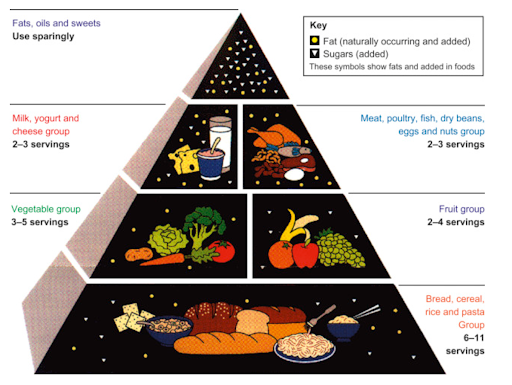
Other Bush achievements included the 1990 Organic Foods Production Act, which established the federal framework that eventually (2000) led to USDA’s national organic standards and certification program. In 1992, the USDA rolled out the Food Guide Pyramid, nudging the country toward grains and vegetables. So a president who ate pork rinds, but not broccoli, helped build the architecture for healthier eating.
Try it at home -- Image not yet available
Pork Rinds with Tabasco and Popcorn
No recipe needed. According to close associates, Bush’s truest loves were ultraprocessed pork rinds—best served with a generous shake of Tabasco—and popcorn, with the debate over which he preferred never quite settled. Beef jerky and crushed Butterfinger bars rounded out the snack drawer.