
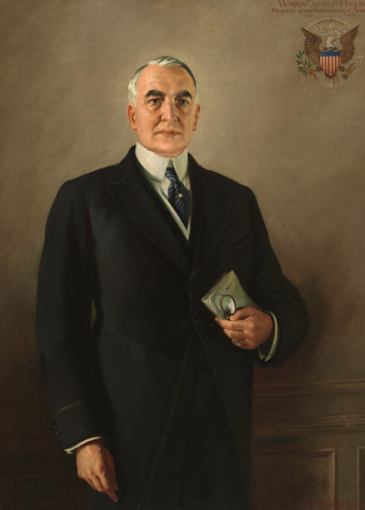
Time in office
March 4, 1921–August 2, 1923 (He died of a heart attack while in office.)
Vital Statistics
Born: November 2, 1865, in Corsica (now Blooming Grove), Ohio
Died: August 2, 1923, in San Francisco, CA
Political Affiliation
Republican Party
First Bite
Waffles were such a Harding favorite that he prescribed exactly how to eat them: “You eat the first fourteen waffles without syrup, but with lots of butter. Then you put syrup on the next nine, and the last half dozen you eat simply swimming in syrup. Eaten that way, waffles never hurt anybody.” That’s twenty-nine waffles! But did he actually eat that many or was he just pulling the leg of history? Hard to know.
THE MAIN COURSE
Warren G. Harding won the first presidential election after the Great War, campaigning on a promise to return the country to “normalcy,” and his table delivered on that promise before he’d even taken office.
During his famous 1920 “Front Porch Campaign,” waged from the wraparound porch of the Ohio home he’d built for his wife Florence, it was Florence’s waffles that became something of a secret weapon. She fed them to campaign staffers, reporters, and visiting dignitaries alike, and when word of their quality spread, she happily handed her recipe out to newspapers and women’s magazines until it became a minor sensation in its own right—arguably better known than her husband’s platform.

Warren G. Harding giving a speech on his Marion, Ohio, front porch in his 1920 run for office. Ohio History Connection)
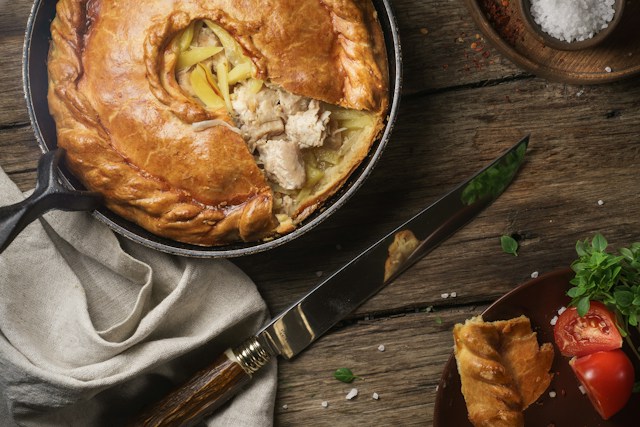
That homespun instinct followed the Hardings straight into the White House. Florence declared on Inauguration Day that the couple were “just folks,” and the menu backed her up: chicken pot pie, made from her own recipe, showed up regularly at family meals, and waffles occasionally made the leap from breakfast to dinner, sometimes buried under chipped beef and gravy for good measure. Harding turned breakfast into an event of its own, hosting informal Sunday morning gatherings at Friendship, a private Washington estate owned by his wealthy close friends and flamboyant socialites, Edward and Evalyn McLean. The spread featured grapefruit, wheat cakes, corn muffins, and the proverbial “gallons” of coffee. One critic later summed up the whole administration’s culinary spirit as “efficient, entertaining on a large scale, undistinguished cuisine, and a general aura of mediocrity”—just how a critic might describe Harding’s presidency itself.
Beneath the Midwestern comfort food ran a streak of contradiction that suited Prohibition-era Washington perfectly. Official dinners strictly excluded wine, in keeping with the 18th Amendment, which the Hardings publicly enforced. But privately, staff recalled the first lady mixing cocktails for her husband and friends in their private quarters, and Harding’s stag dinners with his poker-playing “Ohio Gang” ran on knockwurst, sauerkraut, whiskey, and beer, laws notwithstanding. Florence’s preferred entertaining, meanwhile, was considerably more wholesome: garden parties on the South Lawn featuring nonalcoholic fruit punches she called “squalls.”
Beyond the breakfast table and the bar, Harding’s most lasting food-related legacy was legislative. In 1922, he signed the Capper-Volstead Act, later nicknamed the “Magna Carta” of agricultural cooperatives. It allowed farmers to band together to market and sell their goods without running afoul of antitrust law—a meaningful boost to their bargaining power against big distributors. He also expanded farm credit to help struggling farmers refinance debt during the postwar agricultural slump. And he signed the Fordney-McCumber Tariff to shield American agriculture from foreign competition, though historians largely agree it did little to fix the underlying problem of overproduction. Its historically high tariffs triggered retaliatory tariffs, costing US farmers millions of dollars in lost sales. His choice of Henry C. Wallace as Secretary of Agriculture proved especially consequential: Wallace became one of the era’s most influential farm policy advocates, and his son would go on to hold the same job under FDR, as well as serving as FDR’s vice-president from 1941–1945.
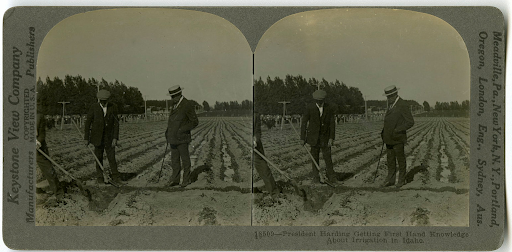
President Warren G. Harding learning about irrigation techniques on a farm in Idaho during his “Voyage of Understanding.” (White House Historical Association)
Harding never got the chance to see how any of it played out. He died of a heart attack in the summer of 1923, partway through a cross-country tour, leaving behind an administration that history would remember more for scandal and mediocrity than major achievements. But at the family table, at least, the Hardings never pretended to be anything more than what they were—just folks, eating pot pie and waffles, doing their best to keep things normal in increasingly abnormal times.
Try it at home
Florence Harding’s Waffles
The recipe that outshone a presidential campaign and became a White House staple—light, simple, and built to be eaten with gusto.