
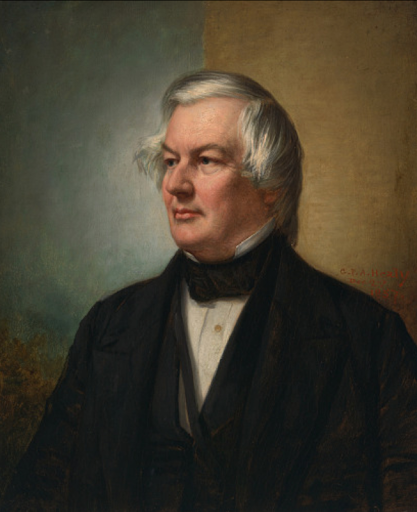
Time in office
July 9, 1850–March 4, 1853
Vital Statistics
Born: January 7, 1800, in Locke Township, NY
Died: March 8, 1874, in Buffalo, NY
Political Affiliation
Whig Party
First Bite
According to his New York Times obituary, Millard Fillmore’s last words, commenting on the soup he had just eaten, were, “The nourishment is palatable.”
THE MAIN COURSE
Millard Fillmore did not win his way into the White House. He inherited it, mid-tragedy, with zero warning.
On the morning of July 9, 1850, the vice president was going about his business in Washington when word came that Zachary Taylor—likely felled by a foodborne illness, of all things—hadn’t made it through the night. By that afternoon, Fillmore had taken the oath of office. He’d go on to serve just two years and eight months before the Whig Party’s civil war over slavery and the Compromise of 1850 (which barred slavery in the new state of California but tolerated or even strengthened its grip elsewhere) closed the door on a second term.
Fillmore had grown up dirt poor on the New York frontier, the second of nine kids. He worked on his father’s farm and apprenticed with a cloth maker before basically teaching himself law. That no-frills upbringing followed him straight to the dinner table. Fillmore’s food was hearty frontier fare: thick soups built from meat, potatoes, and vegetables, more stew than broth, the kind of meal that left nothing behind to waste. Corn pudding and resurrection pies (a frugal little dish made from layered meat and potatoes meant to use up scraps) were regulars too. He was a man of strict temperance with zero patience for frivolity, at the table or anywhere else. Under his watch, the White House traded dancing and gala parties for formal dinners and official functions.
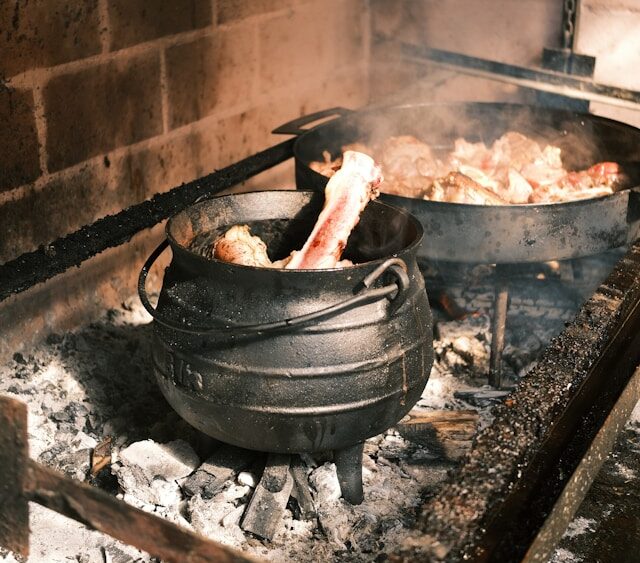
When Fillmore moved in, the White House kitchen was still cooking like it was 1800—quite literally, since the same colonial-style hearth that had served John Adams was still the only thing standing between the kitchen staff and dinner, eleven presidents later. At some point during Fillmore’s term, his wife, Abigail, a former schoolteacher with a reputation for practicality, arranged for a shiny new iron cookstove to be brought in, but it sit untouched in the basement, gathering dust like an unused treadmill.
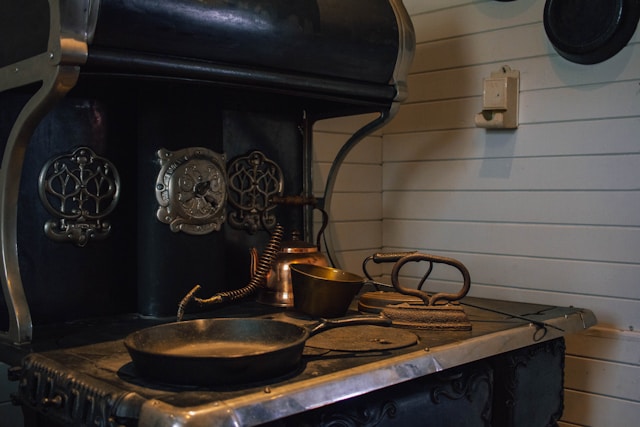
The kitchen staff wanted nothing to do with the newfangled oven. As the story goes, Fillmore’s chef called it a “contraption” and openly doubted anyone could cook on the thing. So Fillmore, never one to let a problem just sit there, is said to have marched down to the U.S. Patent Office himself, studied the stove until he understood exactly how it worked, then came home and taught his staff how to use it. It’s a charming story, and one that’s been repeated in presidential food histories for decades—though, worth noting, the trail traces back mainly to Poppy Cannon’s 1968 The Presidents’ Cookbook, and no contemporary firsthand account has surfaced to confirm that the Patent Office field trip actually happened. It circulates alongside another Fillmore legend—that he installed the first White House bathtub—which turned out to be an outright, pre-internet hoax invented by journalist H.L. Mencken in 1917, then absorbed uncritically into reference books for generations after. Whether or not Fillmore was personally involved in installing it, the underlying fact holds up: Abigail Fillmore is the one generally credited with getting a modern stove into the White House kitchen.
By the time it reached the White House, the iron cookstove had already been quietly revolutionizing American kitchens for decades. It burned more efficiently, gave cooks real control over heat, and was already standard in ordinary households across the country. That it still took this long to get one into the executive mansion says something about all too many institutions: They’ll happily keep doing things the old way long after a better way exists.
Fillmore’s actual food policy, it turns out, was just as practical as his soup. As chairman of the House Ways and Means Committee, he had already helped push through protective tariff legislation back in 1842, a cause he stuck with for decades. As the frontier farm kid that he was, he genuinely believed tariffs on foreign imports were good policy and helped farmers. But he reversed course once he reached the White House and learned about the value of guano. In his first annual message to Congress, he declared that Peruvian guano had become so essential to American farmers that it was the government’s job to ensure it kept flowing in at a fair price. He promised nothing would be left undone to make that happen.
The guano trade was serious business: Nitrogen-rich bird droppings mined from islands off Peru had become the era’s most valuable fertilizer, so central to American farming that Congress passed the Guano Islands Act in 1856, allowing U.S. citizens to claim any unoccupied island containing guano deposits as American territory. The boom, though, was sometimes built on brutality, including indentured Chinese workers subjected to horrific conditions on the mining islands—a dark moral undercurrent beneath an important agricultural policy.
Fillmore never got the grand legacy he might have hoped for. History mostly remembers him as an accidental president who inherited the job when President Taylor suddenly died and that his Whig Party collapsed not long after he left office. Those factors helped ensure that his time in the White House felt more like a footnote than an era. But in his own quiet way, the same qualities that got him there—stubbornness, self-reliance, and a frontier kid’s refusal to accept that something couldn’t be figured out—showed up again and again, whether it was a stove sitting unused in the basement or an important tariff bill. Fillmore never dazzled anyone at the dinner table, and he never dazzled anyone in office either. He just quietly got on with the business of fixing what needed fixing, one problem at a time.
Try it at home
Millard Fillmore’s Beef Stew
This one-pot stew embodies Millard Fillmore’s tastes exactly: hearty, simple, and a meal in and of itself.