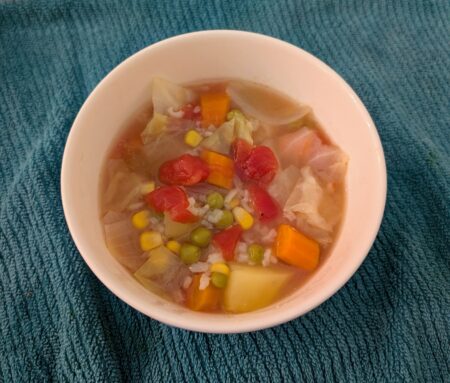
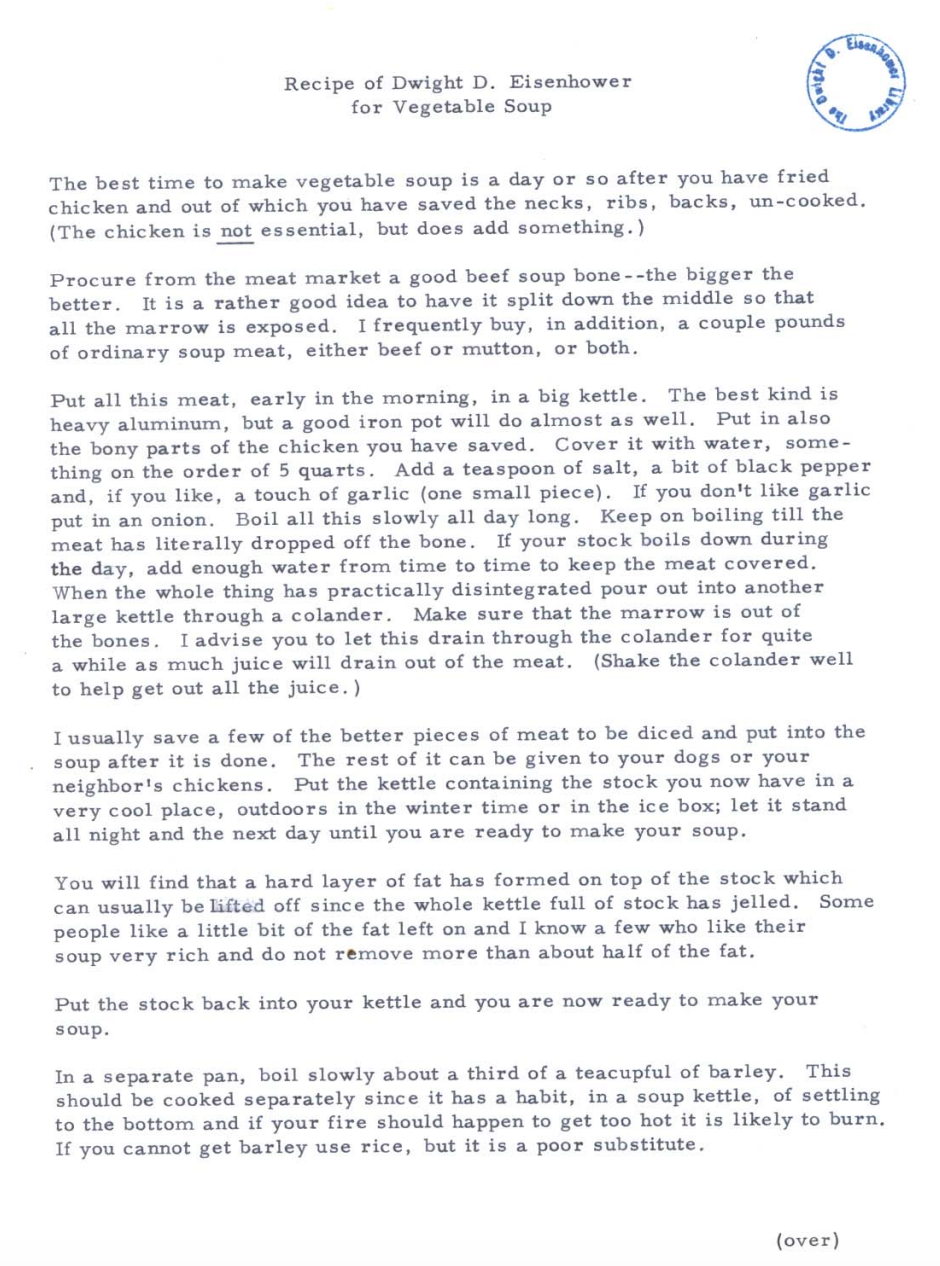

Two-day Vegetable Soup
Prep Time
30 minutes
Cook time
8–12 hours
30 minutes
Total time
9–13 hours
Ingredients
1st day – For stock:
- Large soup bone, split down the middle to expose marrow
- 2 pounds of beef or mutton soup meat, or a combination of both
- One clove of garlic or small onion
- Optional: uncooked chicken carcass after making roast or fried chicken
2nd day:
- 6–8 ounces, or ¾–1 cup of barley (you could replace barley white or brown rice, but it would be a poor substitute)
- 1 quart (32 ounces) of canned tomatoes
- ½ teacup of fresh peas. If you can't get peas, a handful of good green beans cut up very small can substitute
- 2 normal-sized potatoes, diced into cubes of about half-inch size
- 1 good-sized onion (sliced)
- 3 nice-sized carrots diced about the same size as potatoes
- 1 turnip diced like the potatoes
- ½ cup of canned corn
- A handful of raw cabbage cut up in small pieces
- Worcestershire sauce, to taste
Instructions
Day 1:
- Early in the morning, put meat, soup bone, and chicken carcass (if you have it) in a big kettle, either heavy aluminum or iron pot. Add enough water (about five quarts) to cover the meat.
- Add a teaspoon of salt, a bit of black pepper and, if you like, a touch of garlic (one small piece). If you don’t like garlic, put in an onion.
- Boil all this slowly all day long, 8–12 hours. Keep on boiling till the meat has literally dropped off the bone. If your stock boils down during the day, add enough water from time to time to keep the meat covered.
- When the whole thing has practically disintegrated, pour out into another large kettle through a colander. Make sure that the marrow is out of the bones. I advise you to let this drain through the colander for quite a while as much juice will drain out of the meat. (Shake the colander well to help get out all the juice.)
- Set aside better pieces of meat to be diced and added back into the soup when it is finished.
- Put the kettle containing the stock you now have in a very cool place, outdoors in the wintertime or in the ice box; let it stand all night and the next day until you are ready to make your soup.
Day 2:
- You will find that a hard layer of fat has formed on top of the stock which can usually be lifted off since the whole kettle full of stock has jelled. Some people like a little bit of the fat left on, and I know a few who like their soup very rich and do not remove more than about half of the fat.
- Put the stock back into your kettle and you are now ready to make your soup.
- In a separate pan, boil slowly about a third of a teacupful of barley. This should be cooked separately since it has a habit, in a soup kettle, of settling to the bottom and if your fire should happen to get too hot it is likely to burn.
- Your vegetables should not all be dumped in at once since they will finish cooking at different times. The potatoes and carrots will take about 15 minutes to cook, so they can be put in first, along with the canned tomatoes to get rid of the “tinny” flavor. Ingredients like the corn and peas can be put in toward the end since they cook very quickly. Use your best judgement.
- Keep stove on medium to low heat, making sure the soup is still bubbling. While you are cooking the soup, do not allow the liquid to boil down too much. Add a bit of water from time to time. If your stock was good and thick when you started, you can add more water than if it was thin when you started.
- When the soup is about done, put in your barley which should now be fully cooked, add one teaspoonful of Lee and Perrin’s Worcestershire Sauce.
- Cut up the few bits of the meat you have saved and put a small handful into the soup.
- As a final touch, in the springtime when nasturtiums are green and tender, you can take a few nasturtium stems, cut them up in a small pieces, boil them separately as you did the barley, and add them to your soup (about one tablespoonful after cooking).
Notes
Any of the vegetables can be substituted depending on preference or availability. Frozen peas or corn could substitute for fresh and canned, respectively.
Adapted from: 177 Milk Street
Nutrition per serving (8 servings)
Calories 370 • Total Fat 7g • Saturated Fat 3g • Sodium 830mg • Total Carbohydrates 44g • Dietary Fiber 9g • Added Sugars 0g • Protein 36g
Dietitian’s note
Consider using less meat and adding even more vegetables to deliciously increase its healthfulness.
Nutrition per serving (8 servings)
Calories 370 • Total Fat 7g • Saturated Fat 3g • Sodium 830mg • Total Carbohydrates 44g • Dietary Fiber 9g • Added Sugars 0g • Protein 36g
Dietitian’s note
Consider using less meat and adding even more vegetables to deliciously increase its healthfulness.