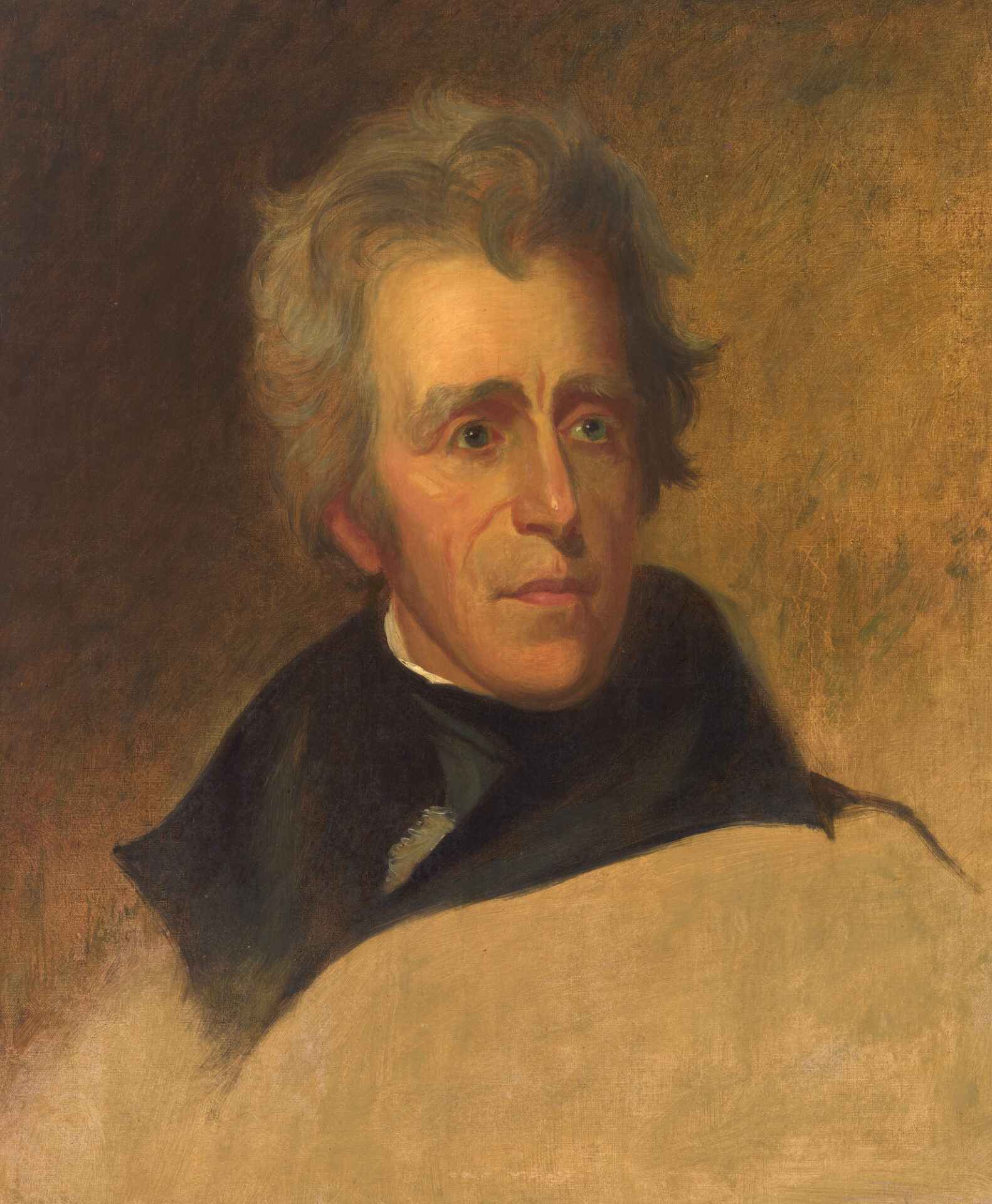
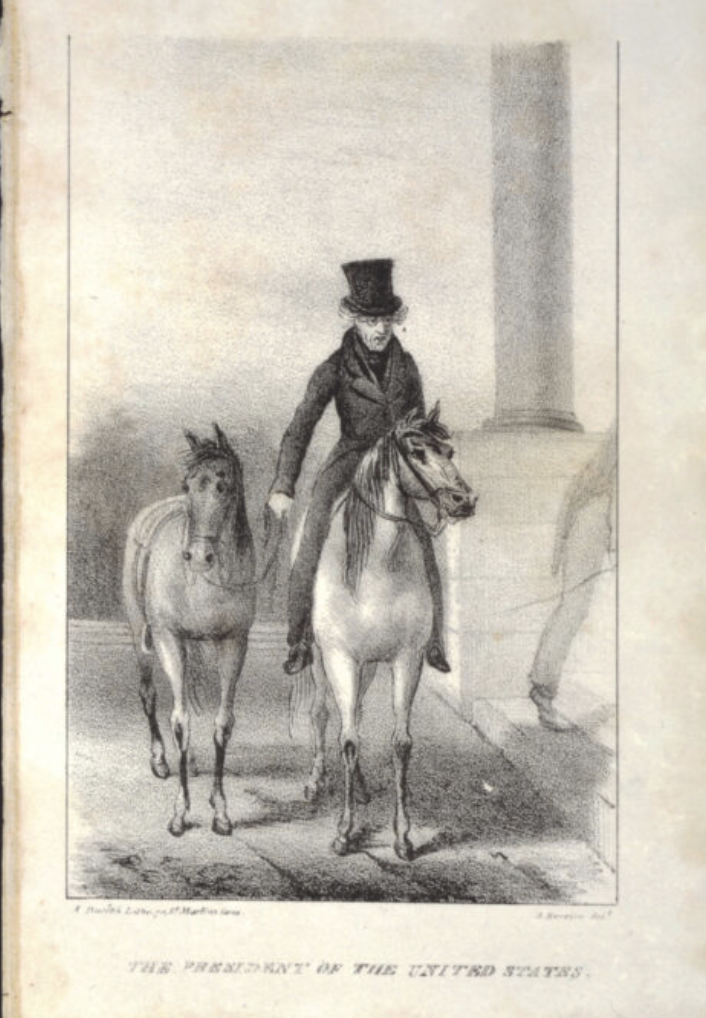
Andrew Jackson on horseback
(Library of Congress)

March 4, 1829–March 4, 1837
Born: March 15, 1767, in the Waxhaw settlement/region (straddling North Carolina and South Carolina)
Died: June 8, 1845, in Nashville, Tennessee
Democratic Party (a founder)
Andrew Jackson liked his milk so much he kept a heifer at the White House during his second term to guarantee a reliable supply.
There was “Old Hickory,” the self-made frontier hero celebrated by his supporters. And there was “King Andrew,” the wealthy Southern planter with imported crystal, French wine, and an enslaved chef. Jackson never really picked one. He just let them coexist, sometimes in the same meal.
Jackson became a hero in the War of 1812. His greatly outnumbered force crushed a much larger British army. Before he was elected president, he was briefly a U.S. representative and senator, as well as a justice on the Tennessee Supreme Court. Jackson bred and raced thoroughbreds at the Hermitage, his Tennessee plantation, and kept the hobby going even as president. To keep the sitting president’s gambling away from public scrutiny, he ran a racing stable under the name of his nephew, Andrew Donelson.
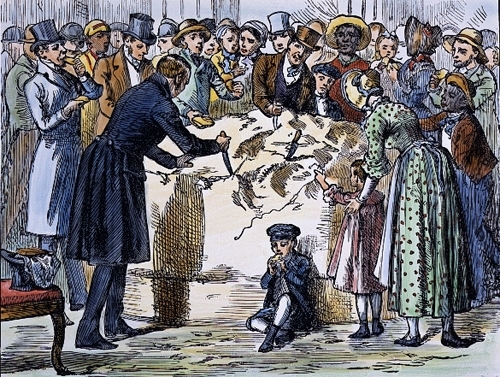
Andrew Jackson’s rowdy cheese reception (White House Historical Association)
Andrew Jackson on horseback
(Library of Congress)
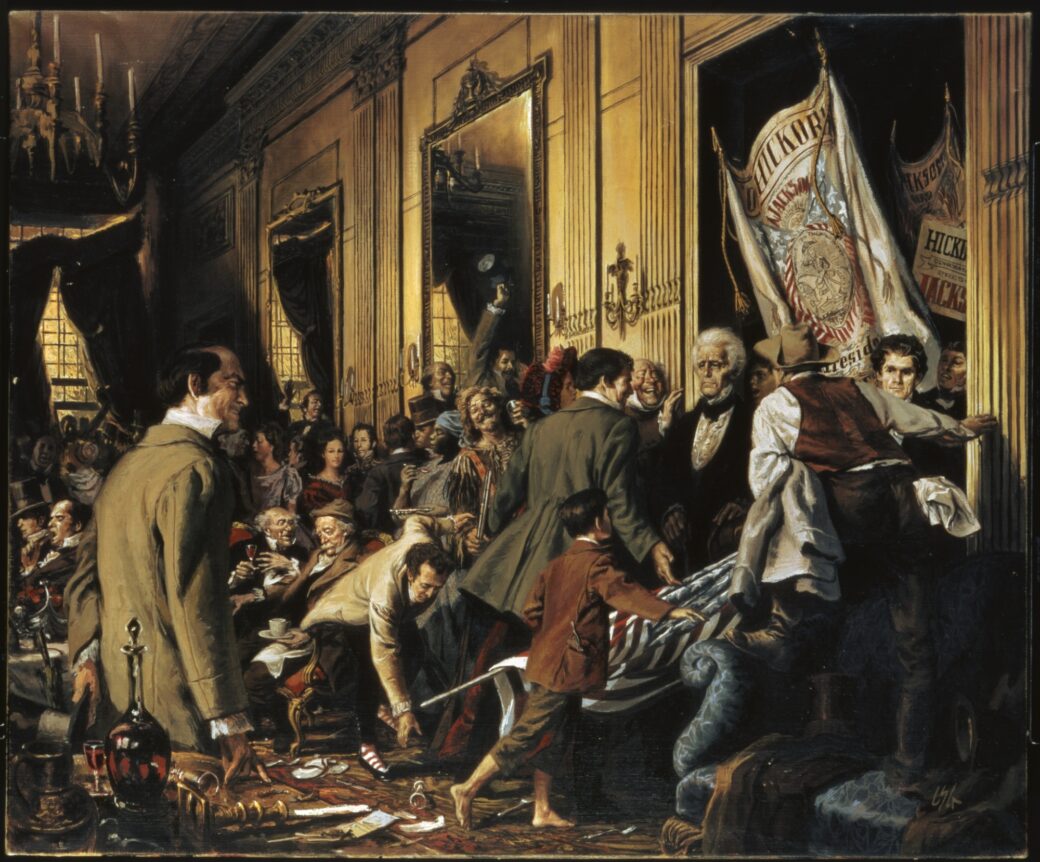
That contradiction announced itself on day one. Jackson’s inauguration reception was supposed to be a dignified open house. It became something closer to a riot—people stood on furniture, glassware shattered, fights broke out, and Jackson himself had to be smuggled out a back window to escape his own party. Staff eventually dragged the punch bowls onto the lawn just to lure the unruly mob outside.
His table told the same split story. Tennessee comfort food—leather britches (green beans cooked with bacon), hoppin’ John (black‑eyed peas, rice, and onions, cooked with pork), fried ham swimming in gravy, oysters by the half shell—sat right alongside soufflés and crème brûlée. He developed a real taste for New Orleans cooking while serving in the War of 1812, plus a fondness for hickory nut soup, floating islands (a sweet meringue served over boiled custard), and rosemary lamb chops. For special occasions, there was Daniel Webster’s Punch—brandy, claret, champagne, green tea, lemon, and fruit, mixed in quantities so lethal that one food historian summed it up as, “one cup would do it.”
But nothing captures Jackson quite like the cheese. In 1835, a New York dairy farmer shipped the president a wheel of cheese four feet wide, three feet thick, and over 1,400 pounds. Jackson let it age in the White House Entrance Hall for two years, presumably walking past it daily like a man guarding treasure. Then, on Washington’s birthday in 1837, days before leaving office, he threw the doors open and invited the public to come eat it.
And come they did––more than ten thousand people! When the crowd grew too large to fit through the doors, people started climbing through the windows instead. The entire 1,400-pound wheel disappeared in two hours flat. What didn’t get eaten was smeared into the carpets, ground into the walls, and worked permanently into the draperies—a smell that lingered for weeks and a mess so severe that Jackson’s successor, Martin Van Buren, had the entire hall stripped and scrubbed, then banned food at White House public events for good (or at least until it was rescinded). A fittingly chaotic final event, perhaps, from a president who never did anything halfway.
Brandy, claret, champagne, black tea, lemon, and fresh fruit, combined in quantities that demand real restraint. Consider yourself warned: “one cup would do it.”
We use cookies to improve your experience on our site. By using our site, you consent to cookies.
Manage your cookie preferences below:
Essential cookies enable basic functions and are necessary for the proper function of the website.
Google reCAPTCHA helps protect websites from spam and abuse by verifying user interactions through challenges.
Statistics cookies collect information anonymously. This information helps us understand how visitors use our website.
Google Analytics is a powerful tool that tracks and analyzes website traffic for informed marketing decisions.
Service URL: policies.google.com (opens in a new window)
Marketing cookies are used to follow visitors to websites. The intention is to show ads that are relevant and engaging to the individual user.
A video-sharing platform for users to upload, view, and share videos across various genres and topics.
Service URL: www.youtube.com (opens in a new window)
You can find more information in our Cookie Policy and Private: Privacy Policy.
Please join our email list to occasionally hear our views on timely issues and learn about The National Food Museum’s progress. We promise we won’t clutter your inbox!