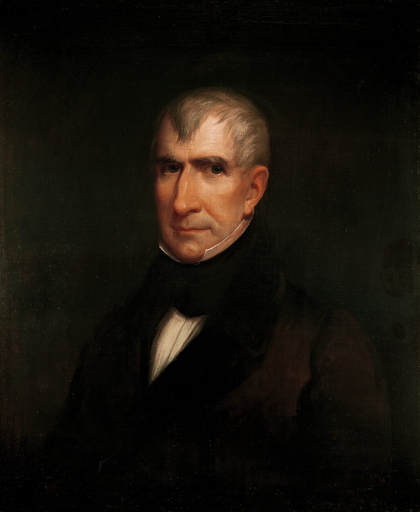
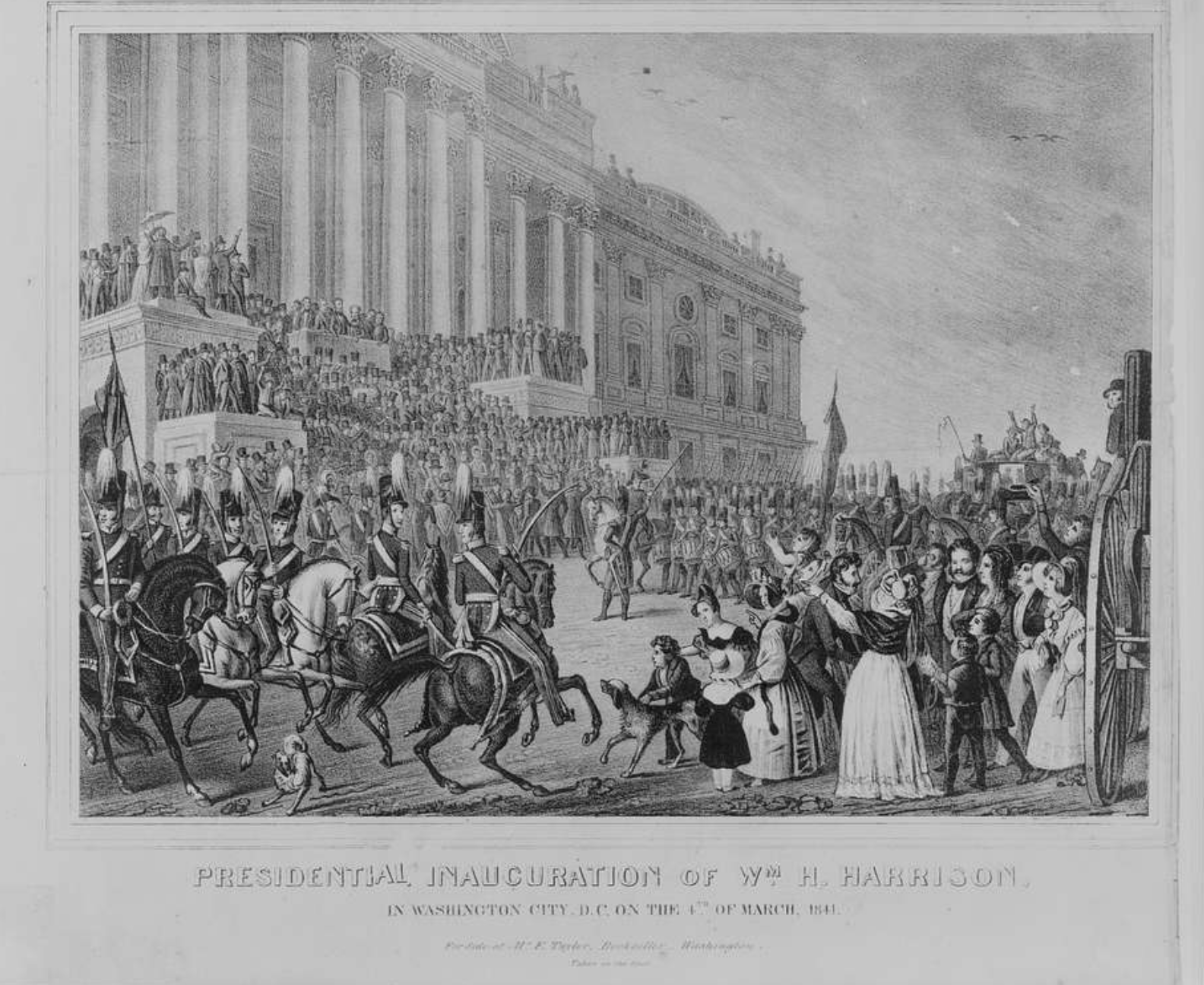

March 4, 1841–April 4, 1841
Born: February 9, 1773 in Charles City County, VA (Berkeley Plantation)
Died: April 4, 1841 in Washington, DC
Whig Party
Harrison holds the record for the shortest presidency in American history—31 days. He barely had time to unpack and eat dinner.
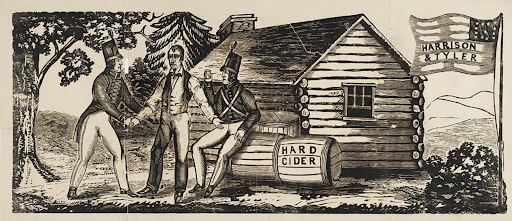
Harrison’s 1840 presidential campaign helped establish the modern style of popular presidential campaigning, using imagery of log cabins and hard cider to portray him as a man of the people.
The backdrop was the Panic of 1837, an economic gut-punch that left Americans broke and furious at anyone who still looked well-fed. The sitting president, Martin Van Buren, made an unusually easy target—a known fan of fine dining, mocked as “Martin Van Ruin,” at a moment when half the country couldn’t afford dinner, let alone a fancy one.
Harrison’s campaign smelled blood. Never mind that he’d actually grown up on a wealthy Virginia plantation—his handlers repackaged him as a log-cabin, cider-jug man of the people. Best part: the whole bit was a gift from his own enemies. A Democratic newspaper, attacking Harrison as being too old and washed-up to run, joked that he’d be happier with a barrel of hard cider and a pension, left alone by his fireside. Harrison’s team heard “insult” and read “campaign slogan.” They grabbed it and ran. Cider and log cabins—cheap, humble, the polar opposite of Van Buren’s table—became the entire pitch. He was “the hard cider candidate” before anyone thought to ask if he’d set foot in a log cabin in his life.
At rallies, cider flowed by the barrel next to cornbread, cheese, roasted meats, and burgoo—a stew made from whatever wild game happened to be lying around––often made from squirrel. Every barrel cracked open was a little jab at Van Buren’s White House spread. And it worked beautifully: Harrison won in a landslide, demonstrating just how effectively food, imagery, and celebrity could be turned into effective political campaign tools.
Once he actually got to the White House, the man-of-the-people act mostly held up, at least at breakfast—he liked to walk to market himself and pick out his own lamb chops and beef steaks. He was also a lifelong vegetable enthusiast, a habit that had trailed him all the way to Bogotá, where he served as U.S. Minister to Colombia in the 1830s and wrote home like a proud new gardener, listing off his beans, peas, cabbages, cauliflower, celery, and artichokes, with beets reportedly on the way. Then, 31 days into the job, pneumonia ended things before the beets ever got their moment. His stay in the White House was the shortest of any president, but the family name got a second act in 1888, when his grandson Benjamin Harrison was elected—beets, presumably, optional.
The Election of 1840 proved something that’s stayed true ever since: What a candidate eats and drinks can say as much as anything he actually says.
This is about as close as you’ll get to what was actually ladled out on the campaign trail. No squirrel on hand? Rabbit or chicken will do the job just fine.
We use cookies to improve your experience on our site. By using our site, you consent to cookies.
Manage your cookie preferences below:
Essential cookies enable basic functions and are necessary for the proper function of the website.
Google reCAPTCHA helps protect websites from spam and abuse by verifying user interactions through challenges.
Statistics cookies collect information anonymously. This information helps us understand how visitors use our website.
Google Analytics is a powerful tool that tracks and analyzes website traffic for informed marketing decisions.
Service URL: policies.google.com (opens in a new window)
Marketing cookies are used to follow visitors to websites. The intention is to show ads that are relevant and engaging to the individual user.
A video-sharing platform for users to upload, view, and share videos across various genres and topics.
Service URL: www.youtube.com (opens in a new window)
You can find more information in our Cookie Policy and Private: Privacy Policy.
Please join our email list to occasionally hear our views on timely issues and learn about The National Food Museum’s progress. We promise we won’t clutter your inbox!