Over the past century, the United States Department of Agriculture, foreign governments, the World Health Organization, and many private organizations have provided dietary advice to the general public. Most of the dispensers of advice tried to provide the most scientifically accurate advice possible, though the advice was often influenced by political considerations and organizational philosophies. Advice varied from the very simple to overly and unnecessarily complicated—but none of it has had a major impact on what people actually ate—except children, whose school meals may be dictated by official dietary advice, patients in VA hospitals, people incarcerated in federal prisons, and millions of others touched by federal food and feeding programs. Family and cultural traditions, marketing, taste, and convenience are all powerful influences to overcome. Still, nutritionists, graphic designers, government officials, and others have sought to develop graphics that would improve the typical diet. But that introduced another complication: is there really a typical diet, especially in the United States, a nation populated by immigrants (excepting, of course, Native Americans). And the careful, science-based advice usually offered appeared to be strongly influenced by the meat and dairy industries in the graphic in the 2026 Dietary Guidelines for Americans.
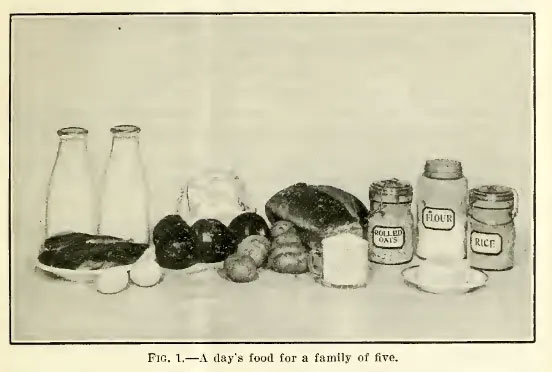
The USDA published one of its first dietary guides in 1917, around the time the first vitamins were discovered. Farmers’ Bulletin 808 was titled “How to Select Foods—What the Body Needs.” Like more recent guides, it reflected eating patterns common at the time. It divided the recommended diet into five groups: fruits and vegetables, meats (and “meat substitutes,” AKA beans, peas, nuts) and other protein-rich foods (dairy, poultry, fish, eggs), starchy foods (cereal grains, potatoes), sweets, and foods “very rich in fat” (bacon, butter, cream, etc.) Indeed, it advised, without sugars and fats “the diet is likely to be lacking in flavor.” Milk, especially, was emphasized. “Remember that a quart of whole milk a day for each child, to be used as a beverage and in cookery, is not too much….skim milk should never be substitute for whole milk as the principal food in a child’s diet.”
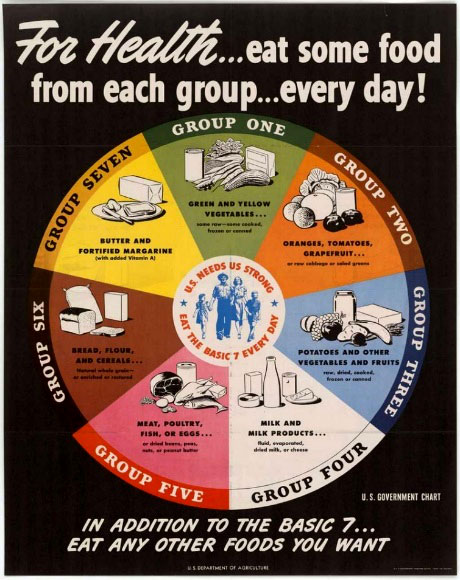
Dietary advice got more complicated after the discovery of most vitamins and the necessities of World War II. USDA nutrition experts divided foods into seven categories because “U.S. Needs Us Strong,” but waffled when it added, “Eat any other foods you want.” Fruits and vegetables constituted two separate categories, potatoes were separated from grain-based foods, and dairy products got their own category separate from meat, poultry, fish, and eggs (dried beans and other protein-rich plant-based foods).
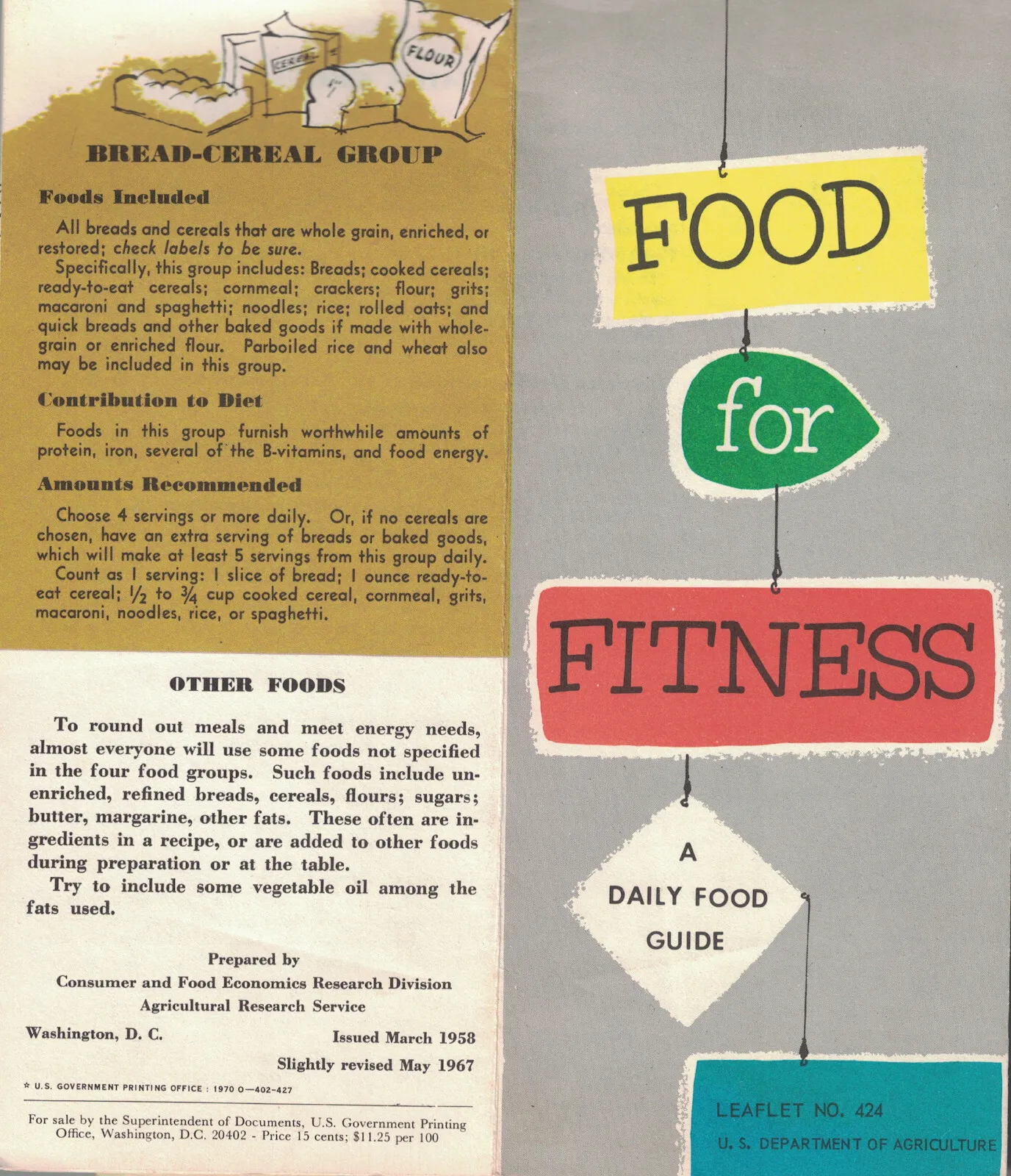
Food for Fitness (Basic Four) – 1956 (USDA)
In 1956 USDA published its Food for Fitness “Basic Four” Daily Food Guide. In the perpetual war between the lumpers and the splitters, this time the lumpers won out. Seven food categories were collapsed into four: milk, vegetables and fruits, meats (again with “alternates” in small print), and bread and cereals. Fats, sugars, and calories disappeared. At the time relatively little evidence connected diet to the risks of obesity, blood pressure, heart disease, stroke, diabetes, and cancer, so the government’s advice was not controversial.
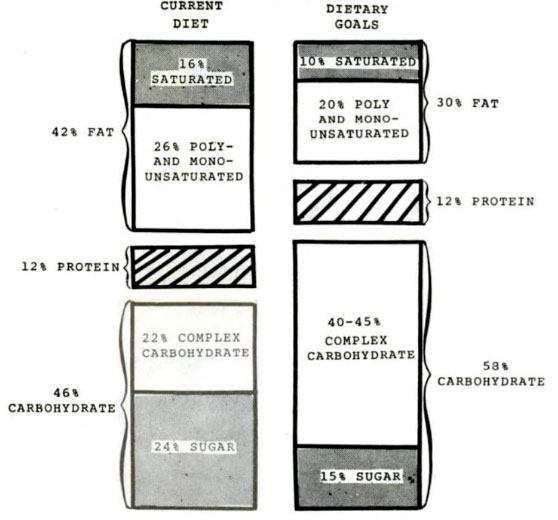
Dietary Goals for the United States – 1977 (Senate Select Committee on Nutrition and Human Needs)
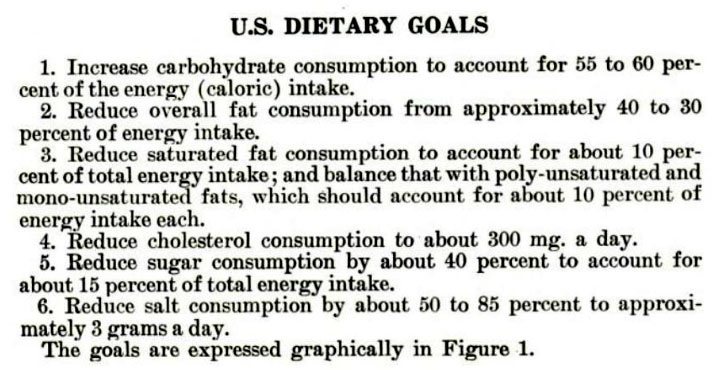
In 1977, the Senate Select Committee on Nutrition and Human Needs’ Dietary Goals for the United States” advised people to eat less meat, sugar, salt, eggs, and butterfat. That generated a tsunami of controversy and criticism, especially from the affected industries. Other industries welcomed the advice to eat more fruits, vegetables, poultry, and fish. Nutrition scientists and public health officials have been debating the effects of cholesterol, dietary fiber, and different types of fats and sweeteners (natural or synthetic), and the foods in which they are abundant or limited, ever since.
Dietary Guidelines for Americans – 1980–2020 (updated every five years; USDA, HHS)
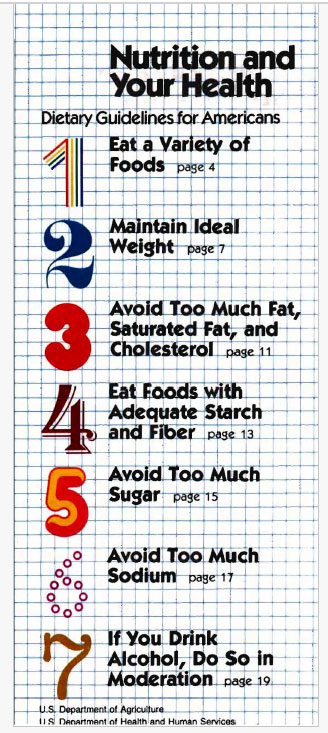
The controversy over the Senate’s report (which was guided by Harvard nutrition professor Mark Hegsted) emboldened USDA to spearhead the development of the first Dietary Guidelines for Americans in 1980. Mirroring the Senate report, the original Dietary Guidelines report, a slender 20-page document, recommended that people “avoid too much” fat, saturated fat, cholesterol, sugar, and sodium. For the first time, alcohol was included in the government’s nutrition report: “If you drink alcohol, do so in moderation.” The Dietary Guidelines has been updated every five years since 1980, typically with controversy over an external advisory group that has included industry consultants and over the final publication. USDA also provides online dietary advice for vegetarians and vegans, something that would have been unthinkable 50 years ago. Meanwhile, the 2020–2025 edition of the Dietary Guidelines has grown to 164 (full-sized) pages and provides detailed advice about recommended servings of different foods for people following vegetarian and Mediterranean diets.
Food Guide Pyramid – 1992 (USDA)
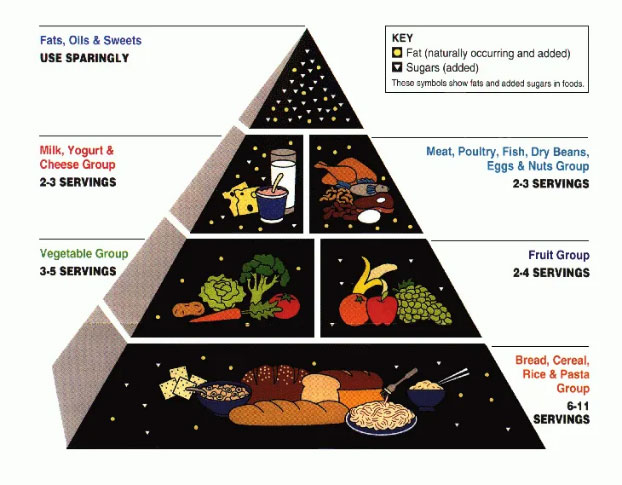
The government translated the Dietary Guidelines advice into a graphical form, the Food Guide Pyramid. That pyramid—actually a triangle—indicated the relative amounts of different foods that people should consume. Thus Fats, Oils, & Sweets resides at the tip—”Use Sparingly”—of the pyramid, while the bottom, and largest, section encouraged people to consume copious amounts of grains. But are unsaturated vegetable oils harmful and to be avoided? And should we be consuming so many servings of grains, which inevitably would be refined (not whole) grains? And are fatty meat and dry beans nutritionally equivalent?
MyPyramid (the “Food Guide Pyramid”) – 2005
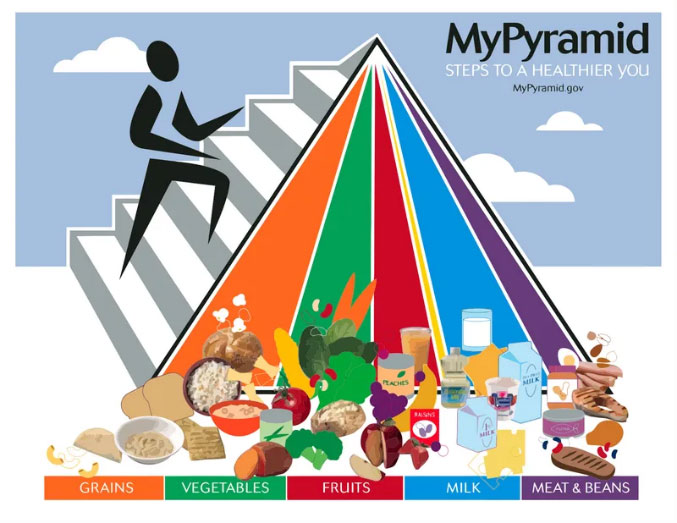
After a dozen years, USDA modified the Food Guide Pyramid, but didn’t make it any easier to read and use. And where did vegetable oil and refined sugars (including high-fructose corn syrup) go to?? The stripes are colorful, but unclear that the width represents the recommended numbers of servings. This version was the first to encourage physical activity but probably didn’t get many people running up stairs or jogging.
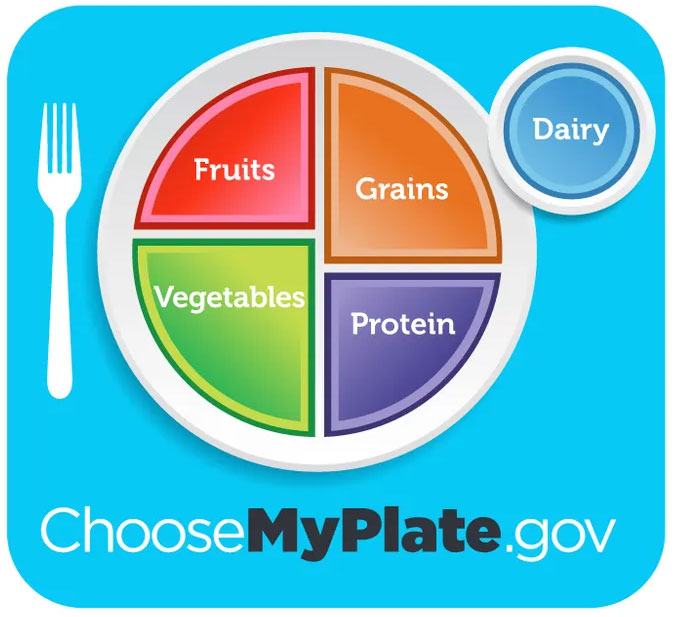
The Obama administration, with first lady and nutrition advocate Michelle Obama in the lead, replaced the Food Guide Pyramid with a simple graphic that divided foods into five categories (reminiscent of the Basic Four). It clearly indicates that half the plate should be filled with fruits and vegetables, in contrast to the old Basic Four in which fruits and vegetables were put into just one of the four categories. Like previous diagrams, this edition doesn’t distinguish between, say, high-fat and low-fat dairy and meat products, though clicking on the online image does provide such advice. And some people argued that the beverage should be water, not dairy.
Dietary Guidelines for Americans – 2025–2030 (USDA/HHS)
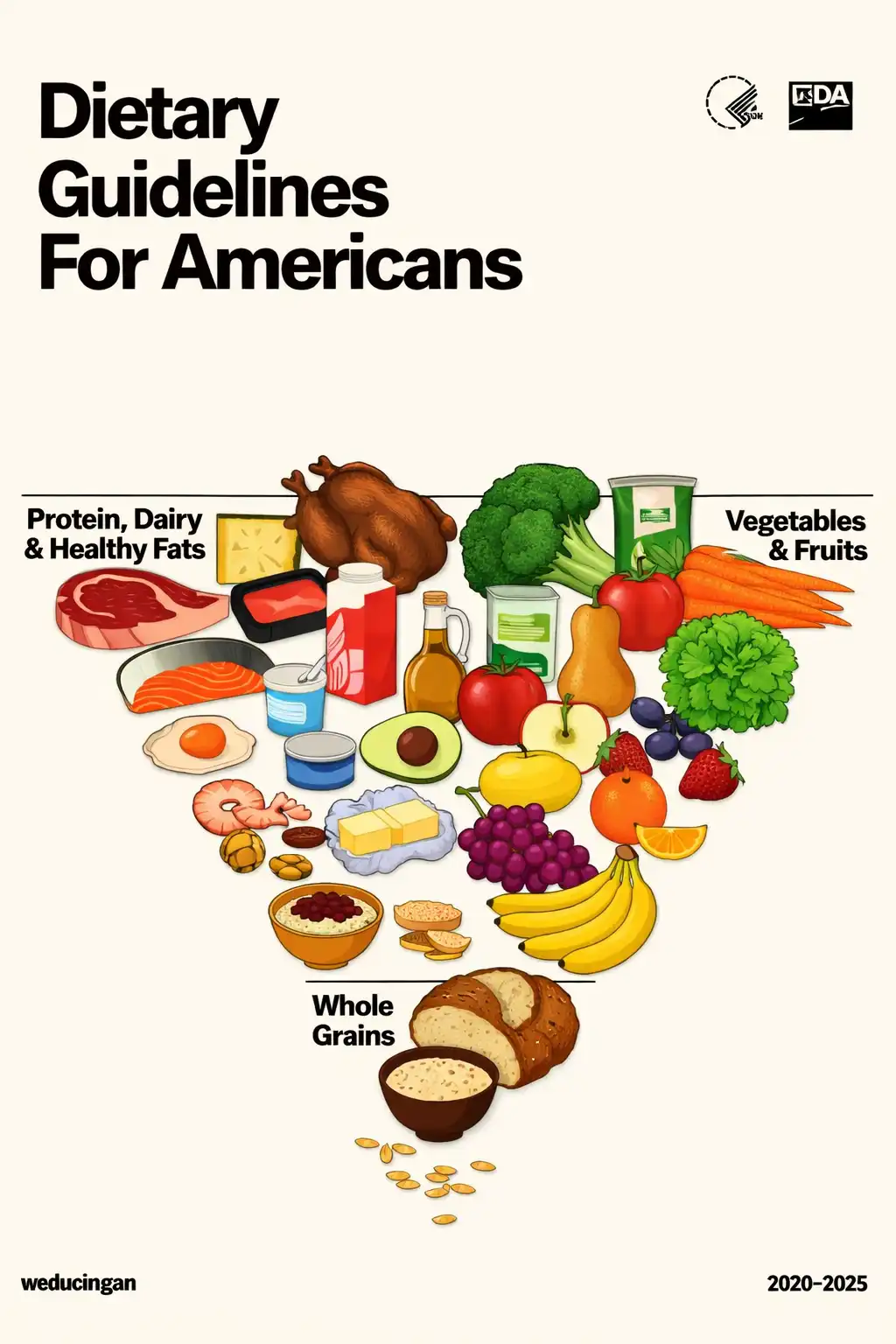
This controversial graphic on the cover of the 2025–2030 Dietary Guidelines for Americans thrilled the meat and dairy industries, but angered nutrition experts and food manufacturers. It put meat, whole milk, and cheese at the top of the triangle, along with fruits and vegetables, indicating their purported importance in the diet and put wholesome whole grains at the skinny bottom tip. Most meats and full-fat dairy foods are rich in saturated fat, which promotes heart disease. No sugar, no highly processed foods on the graphic. In fact, for the first time the Dietary Guidelines advised Americans to minimize consumption of processed foods, including ones made with preservatives, artificial flavors, non-caloric sweeteners, and other food additives. But totally unrealistically, and joylessly, it said that kids 10 and under should not consume any added sugars at all (good-bye peanut-butter-and-jelly sandwiches, ice cream, Cheerios, and more!).
Non-governmental Food Guides
In the wake of USDA’s food pyramids, or triangles if you prefer, many private groups and individuals produced their own variations to, they believed, overcome the flaws in the official pyramids.
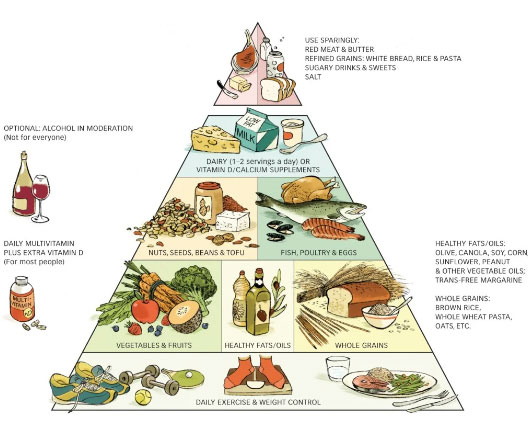
The Harvard School of Public Health produced a Healthy Eating Pyramid that put meat, butter, salt, refined grains, and sugary drinks and foods up at that tiny tip. And instead of discouraging consumption of all fats and oils, it included polyunsaturated oils (soy, canola, corn, olive, peanut) right along with fruits, vegetables, and whole grains. Harvard also allowed for moderate consumption of alcohol (“not for everyone”) and recommended multi-vitamin/mineral supplements for most people plus daily exercise.
The Center for Science in the Public Interest, the nutrition-advocacy group that led efforts to require Nutrition Facts labels on food and to improve the nutritional quality of school meals, produced the first and only actual food pyramid, the Healthy Eating Pyramid. CSPI’s 3-dimensional graphic (printed on card stock) devoted one side each to foods of high, medium, and low nutritional quality and that people could eat “Anytime,” “Sometimes,” or “Seldom.” The fourth side provided information about the pyramid.
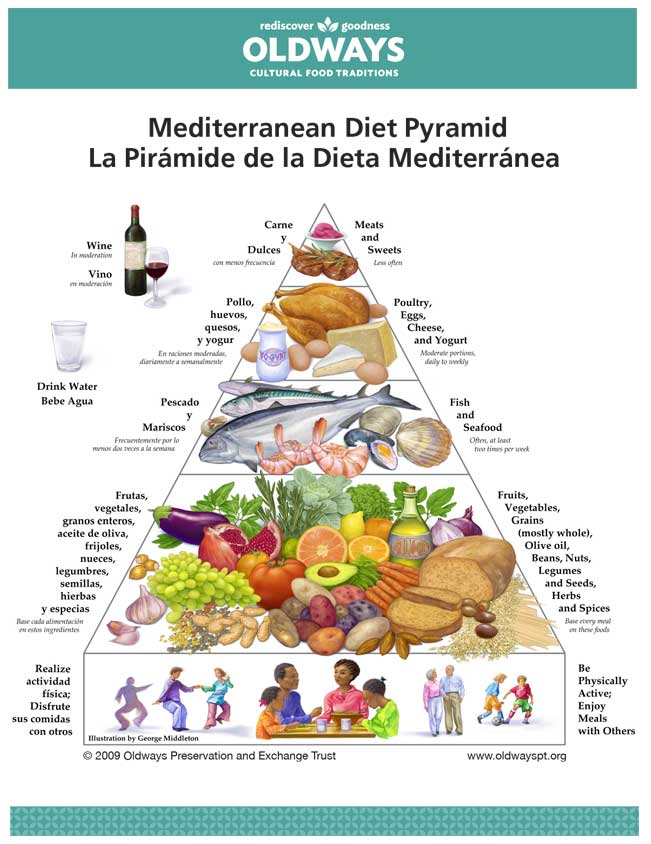
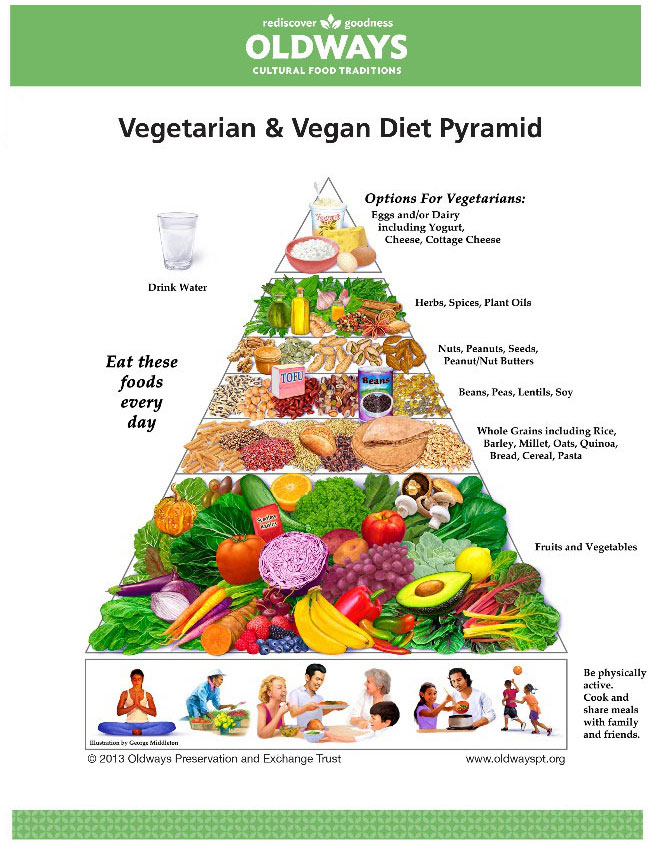
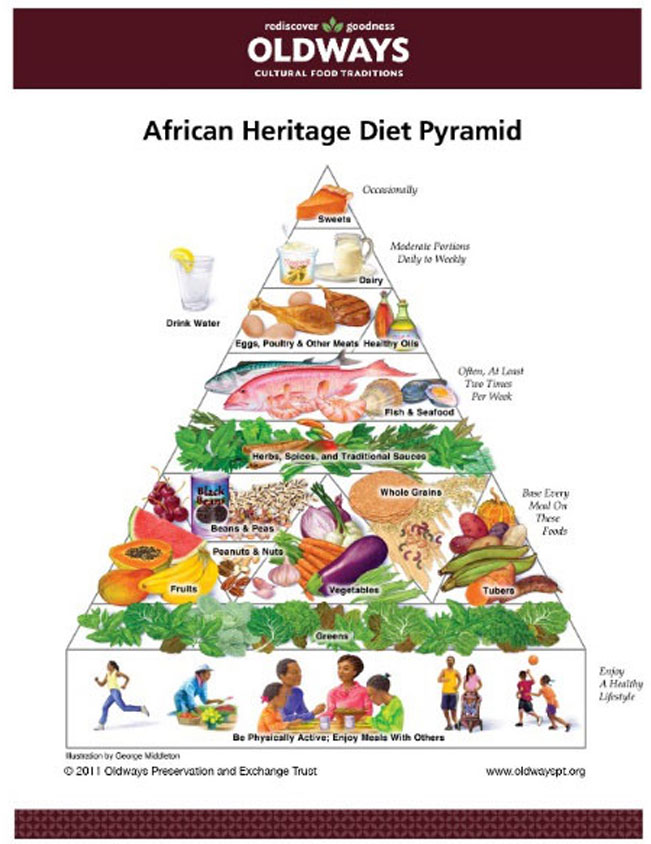
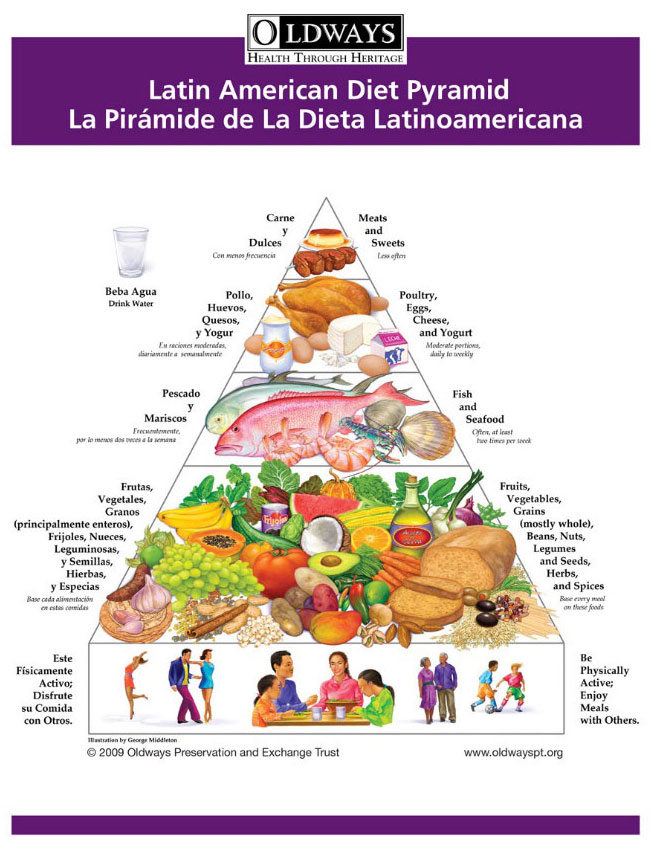
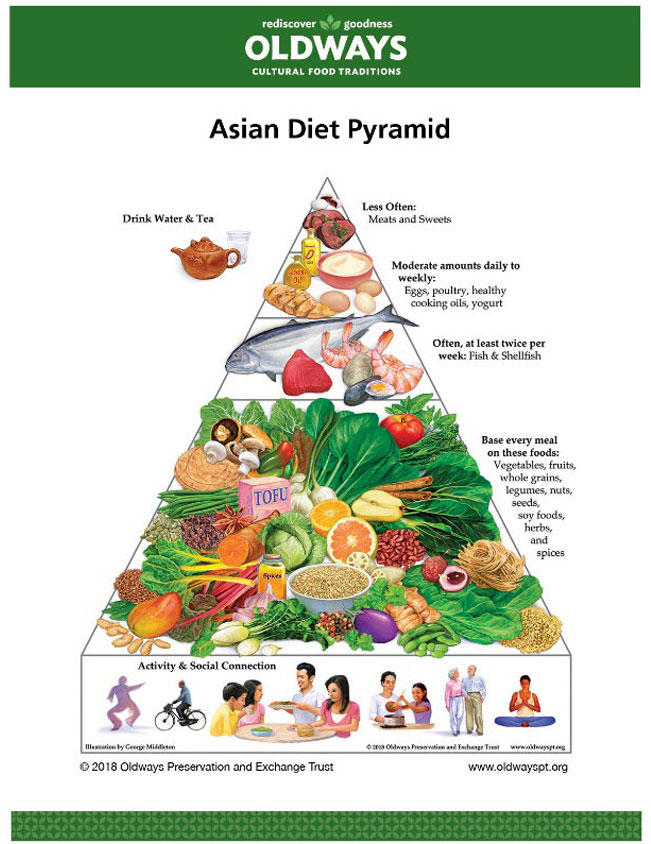
Oldways, a nonprofit organization that advocates for healthy, traditional diets, produced food triangles appropriate for Mediterranean, vegetarian, African, Latin American, and Asian cuisines. They all emphasize vegetables, fruit, nuts, beans, and whole grains, as well as water or tea for beverages, and they de-emphasize meat, dairy, and sweets by putting them at the small tips of the triangles.
No graphics here, because no one knows what scientific advances will have been made, what people will be eating, and what new graphic devices will be popular. Will cattle, hogs, and poultry be relics of the past, and “meats” be made of plants and fungi or grown from cells in lab-factories? Will statins, diuretics, and semaglutides be engineered into staples? Or will Americans still prefer cheeseburgers from McDonald’s, sugar drinks offered up by Coke and Pepsi, and frozen meals from supermarkets? Stay tuned!