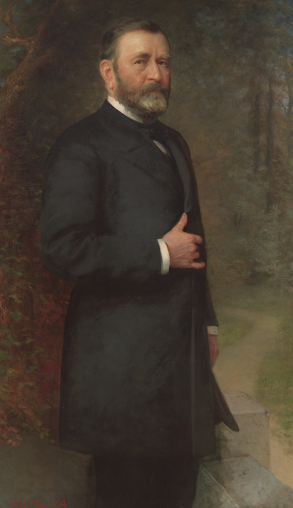
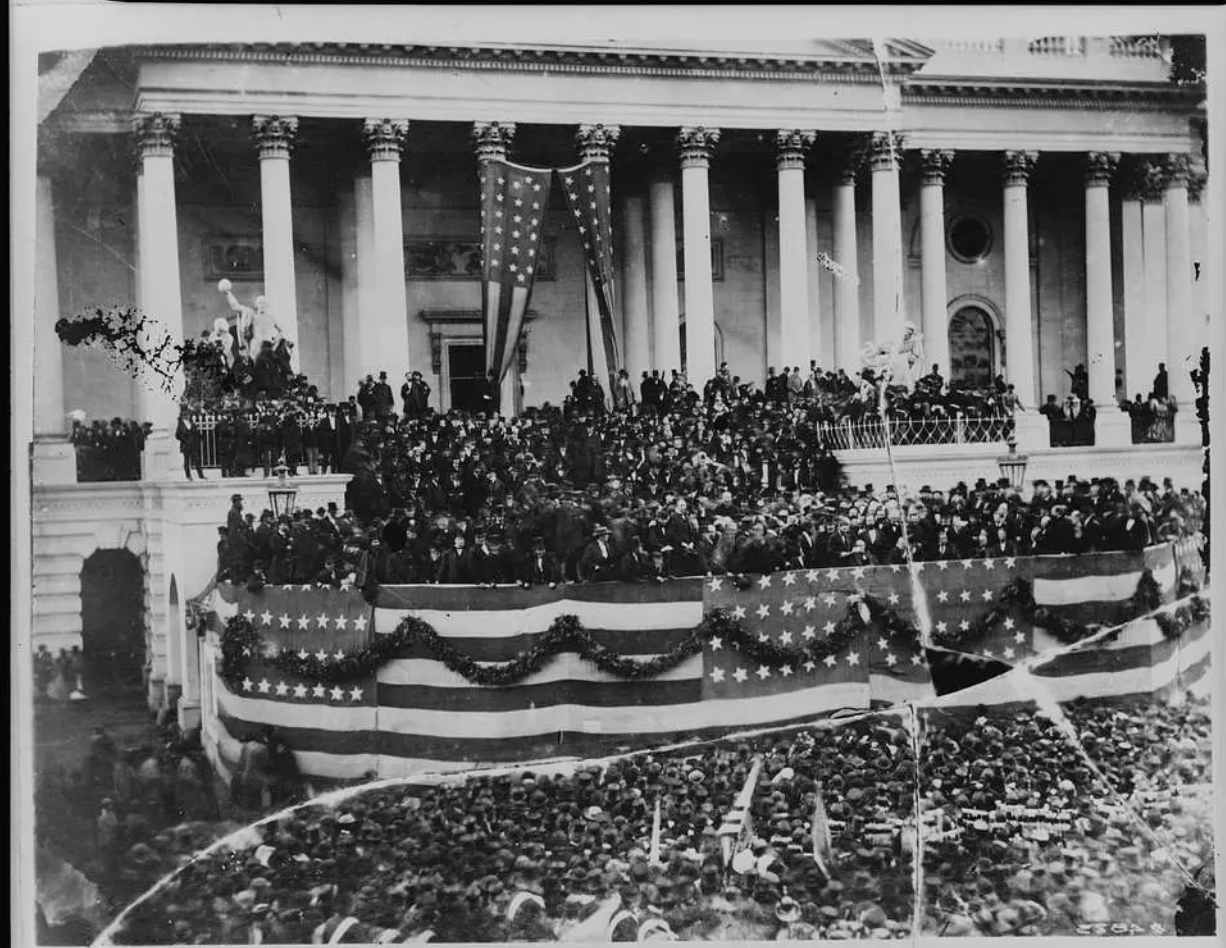
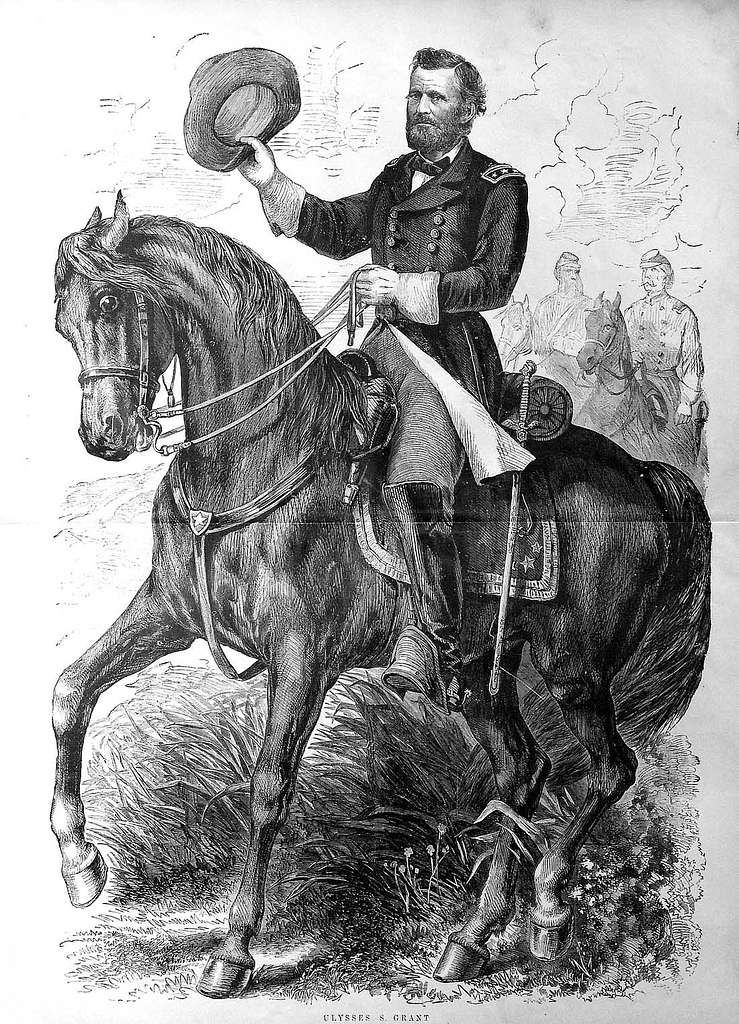

March 4, 1869–March 4, 1877
Born: April 27, 1822, in Point Pleasant, Ohio
Died: July 23, 1885, in Mount McGregor, New York
Republican Party
Grant wanted nothing to do with fowl. “I never could eat anything that goes on two legs,” he said—which didn’t stop the White House kitchen from serving turkey so often that his wife, Julia, eventually had to ask for a change of menu.
He spent the Civil War staring down Robert E. Lee without so much as a flinch. And, in the White House, he also was among Reconstruction’s fiercest defenders—as president, he used federal power to fight the Ku Klux Klan and protect Black Americans’ (or at least men’s) voting rights when few others would.
However, put a rare steak in front of him, and the man went pale. Grant insisted his meat be cooked until it was almost more like charcoal than beef. Some historians have floated an explanation that might or might not be accurate: His father owned a leather tannery (and also a working farm) that young Grant loathed, and a childhood spent around hides and raw flesh may have left Grant with a lifelong aversion to anything resembling them. Whatever the cause, the man who commanded armies through some of the bloodiest campaigns in American history could hardly look at a rare chop.
Grant grew up on his family’s Ohio farm doing the unglamorous work of a farm kid—tending horses, taming the unruly ones that nobody else could handle, and caring for the other livestock—and eating ordinary country food. As an adult, breakfast was his favorite meal, heavy and hearty: Spanish mackerel, steak (well-done, of course), bacon, fried apples, flannel cakes or buckwheat cakes, and black coffee strong enough to stand a spoon in. During his Army days, that breakfast was sometimes just black coffee and a cucumber doused in vinegar, which tells you everything about how little Grant cared about ceremony at the table. Dessert was rice pudding, a fondness one biographer described as “almost a mania.”
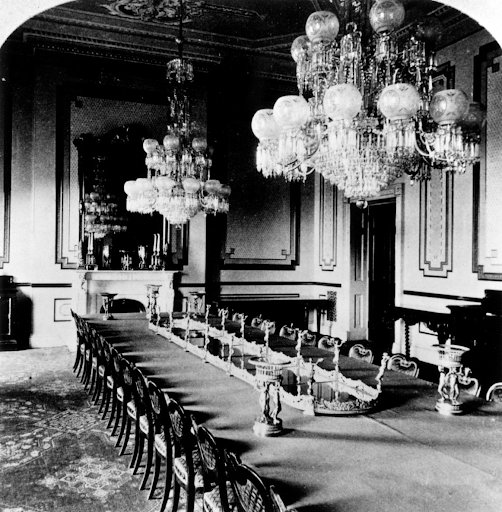
None of it, though, came from a cook with any real finesse. That cook, inherited from Grant’s Army days, had exactly one setting: quantity. He’d fed regiments, not dinner parties, and it showed. That changed the moment the Grants brought in an Italian immigrant steward named Valentino Melah, and the White House table transformed overnight from mess-hall practicality into something closer to European excess. State dinners under Melah stretched to twenty-five or thirty courses, running the Grants $700 to $1,500 a night—and that’s before the wine. One champagne bill alone came to $1,800. Melah eventually capped guest lists at 36, on the grounds that fine dining simply falls apart past that number. It’s a remarkable turn for a man who once ate cucumbers in vinegar for breakfast: humble beginnings, then dinners that cost more than anything his old Army salary would have ever gotten him close to.
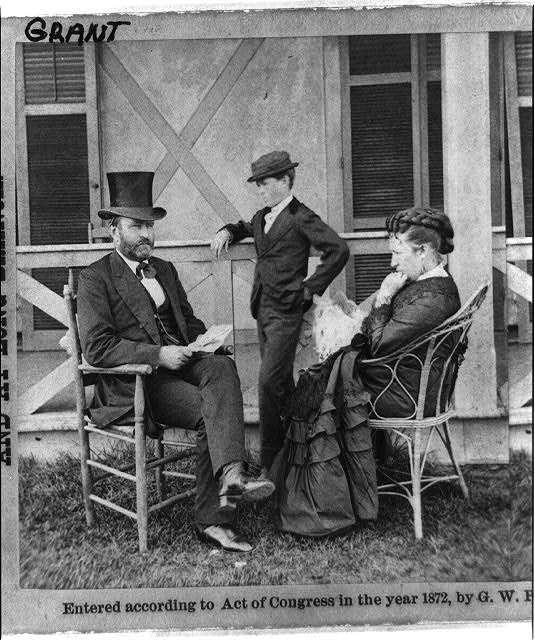
Family dinners told a different story. Served sharply at five o’clock, with Julia always keeping six extra plates on hand just in case, these were simple, soldierly affairs where Grant was known to ball up bits of bread and lob them at his children across the table—the same man who’d commanded armies, turned dinner-table prankster the moment the formality lifted.
Grant’s food politics carried more weight than his dinner-table antics might suggest. He was a genuine believer in agriculture as the backbone of the republic, and as president he helped grow the young USDA (created during President Lincoln’s administration) into a real federal institution—expanding crop and livestock research, distributing free seed to farmers, and building out the country’s first serious agricultural statistics. He’d tried farming himself once, unsuccessfully, on land near St. Louis, and seemed determined that others should have better luck.
But the Grant administration’s record on food and land had tragic faults, at least as seen from a twenty-first-century perspective. Grant’s Indian policy pushed Native American tribes toward European-style farming and onto reservations, disrupting food systems that had sustained communities for countless generations. And in 1874, when a bill to prevent the “useless slaughter” of bison reached his desk, one that specifically exempted Native hunters and targeted commercial overhunting, Grant let it die with a pocket veto. Bison weren’t just wildlife on the Plains; they were a primary food source for Indigenous nations, and their deliberate destruction was already being used as a weapon to starve tribes into submission. Without federal protection, the herds collapsed from an estimated 15 million in the 1860s to roughly 1,000 by the 1890s. Two years earlier, Grant had signed Yellowstone into existence, protecting millions of acres from development. The bison bill asked for something much smaller, and arguably more urgent, and he let it die instead.
In the end, Grant’s table mirrors the contradictions of the man himself: an ordinary farm boy who became one of the era’s most extraordinary leaders, unafraid to use federal power boldly, yet still happiest with burnt steak and rice pudding. He wanted his morning meals simple—and still presided over thirty-course dinners with eighteen-hundred-dollar champagne bills.
A dessert plain enough for a soldier’s palate, but comforting enough to explain the “mania.” It’s simple, sweet, and about as far from a thirty-course dinner as it gets.
We use cookies to improve your experience on our site. By using our site, you consent to cookies.
Manage your cookie preferences below:
Essential cookies enable basic functions and are necessary for the proper function of the website.
Google reCAPTCHA helps protect websites from spam and abuse by verifying user interactions through challenges.
Statistics cookies collect information anonymously. This information helps us understand how visitors use our website.
Google Analytics is a powerful tool that tracks and analyzes website traffic for informed marketing decisions.
Service URL: policies.google.com (opens in a new window)
Marketing cookies are used to follow visitors to websites. The intention is to show ads that are relevant and engaging to the individual user.
A video-sharing platform for users to upload, view, and share videos across various genres and topics.
Service URL: www.youtube.com (opens in a new window)
You can find more information in our Cookie Policy and Private: Privacy Policy.
Please join our email list to occasionally hear our views on timely issues and learn about The National Food Museum’s progress. We promise we won’t clutter your inbox!